A Sad Tale’s Best for Waugh-ton

Image

Long time no blog post, and the reason for my recent silence is that when I’m not writing about Muriel Spark, I work in university administration, and we’ve just been through our Undergraduate Examinations Boards. If I had access to a font that could render the words ‘Examinations Boards’ in a typeface that looked as if it were made up of blood, sweat and tears, believe me, I would have used it right there. There was certainly a lot of sweat; quite a few tears dribbled out before I could stop them; and given the number of papercuts I inflicted on myself whilst sifting through piles of undergraduate essays, marksheets, moderation reports, and so on and so on, I can truthfully say there was also a certain amount of blood.

Image

Image

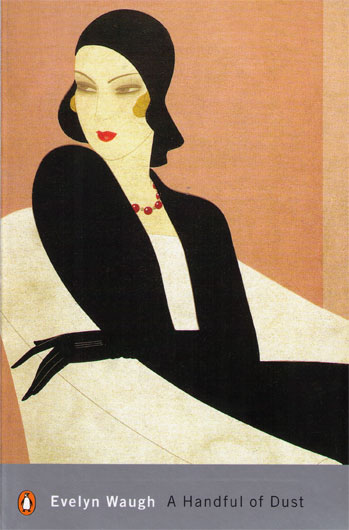
However, it’s all over bar the shouting now, so I’ve been catching up with a few old friends this weekend: my laundry basket, for example; my long-neglected oboe; and, as you can see, my blog. Today I’d like to write about a couple of books I’ve read recently, The Glimpses of the Moon by Edith Wharton and A Handful of Dust by Evelyn Waugh. Now, I’ve lumped these books together because they contain scenes of a similar nature: a married couple seeking a divorce organise a ‘clandestine’ meeting between the male partner and another woman, who is paid for her services. This meeting, however, is witnessed by paid detectives and documented accordingly. Arrangements of this kind were made prior to the Matrimonial Causes Act of 1937. Before this legislation, it was possible for a man to divorce a woman on the basis that she had committed adultery, but women were required to provide proof of the man’s adultery, hence the need for a make-believe assignation. In Wharton’s novel, Nick and Susy’s marriage appears initially to have broken down because Priggish Nick can’t get off his sanctimonious high horse; Lady Brenda is the adulterous party in Waugh’s novel, but an aristocratic divorce would almost certainly have made it into the papers in the early 1930s, so an assignation would have been staged to salvage whatever was left of Brenda’s reputation thereby allowing her to continue to move in the higher social circles.

Nick Lansing in the Wharton novel never does meet with his mystery woman at Fontainebleau: he comes back for Susy instead. And once again, I find myself wanting to rewrite the ending of a novel. Wharton does sad endings so well, you see. I blubbed at The House of Mirth and howled over The Age of Innocence. I am still devastated by Ethan Frome, which has to be The Saddest Book I Have Ever Read Ever. And I think Glimpses would have been a much better book if Susy had married Streffy and Nick had come to his senses too late. There’s a lovely little tragic ending for you, right there. But oh no – Susy deserts Streffy and then comes over all Won’t Someone Think Of The Children, and it’s just nauseating, frankly. I preferred her when she was an unscrupulous scrounger. She was more fun.

The picture below shows a scene from the musical of Glimpses(!!), although I can’t tell what’s going on. It looks like Nick and (I’m guessing) Cora warbling excitedly over a shard of some sort of pot.

Image

I’m afraid A Handful of Dust also proved to be unsatisfactory. It was all going really well until Waugh sent Tony off to Brazil, and then I wondered whether I’d picked up the wrong book by mistake – what’s this? Where’s everyone gone? Why is Tony in Brazil? What the chuff is going on? Waugh apparently finished his novel by Sellotaping one of his short stories on to the end, so it really is a book of two halves and the first half is infinitely superior. The novel’s ending was rewritten for publication in the States (because the short story had already appeared there), and while the alternative ending is a better fit, I just don’t believe in Tony’s implied affair with Viola Chasm. The whole thing is a great shame, because I was really enjoying the novel up until the Brazil bit, and I even got all emotional about the death of poor little John Andrew. Immediately once I’d read that part, I texted a friend to tell him that I would never forgive Brenda Last for that ‘oh thank God’. I don’t care what happens to her now, I said. She can die in the gutter for caring more about her feckless namby-pamby lover than her own little boy, I said.

The picture below shows the divine and effortlessly beautiful Kristen Scott-Thomas as Brenda Last.

Image

Well, there you have it. The lessons here, my friends, are: (1) stick to what you’re good at (sad endings); and (2) don’t pack your hero off to die in Brazil just as things are getting really interesting at home.

It Could Have Been So Good: Daphne du Maurier’s ‘Rebecca’


It could have been so good: Daphne du Maurier’s ‘Rebecca’

This post has been removed because the content is now available in book form with many other essays and blog posts previously available on this site. The book is titled Ungrammaticalities: Linguistic Literary Criticism from ‘The Battle of Maldon’ to Muriel Spark, and it is available for purchase HERE from August 2024.

Please see this page for the cover art and table of contents.

Cartoons and Politics

I love cartoons and comics, and I’m a big fan of Stephen Collins’s work. He does the cartoon in the Saturday Guardian magazine that appears underneath Lucy Mangan’s column, and he’s recently published a book entitled The Gigantic Beard That Was Evil.

This week’s cartoon, pasted below, features a voxpop interview with a woman-in-the-street. (I’ve downloaded the image from Stephen Collins’s website, and am happy to remove it if requested to do so. This cartoon, and many others, can be found here: http://www.guardian.co.uk/lifeandstyle/cartoon/2013/may/18/2.)

Image

I wanted to write about this one because I think it’s about the seemingly inexorable rise of UKIP. When asked for her opinion on the ‘new government’, the woman-in-the-street replies that she doesn’t ‘follow politics’. Having ascertained that the ‘new goverment’ are the ones with the long legs and the guns, she says she quite likes them because: 1) their leader came over well on Have I Got News For You; 2) their leader seems to be more human than ‘that pink one’ David Cameron*; and 3) it’s nice to have a change. The backdrop to this interview is a War-of-the-Worlds-style zapping of innocent people, including someone walking past the café directly behind the interviewee.

Now, I laughed the first time I read this, but then I put the pieces together: the leggy gun-wielding zappers are the UKIP politicians, our new leaders in the cartoon world, and the woman-in-the-street is the average citizen who, out of a general apathy, condones their activities simply because they don’t impinge on her everyday existence. She barely knows who these new politicians are. She’s not the one being zapped.

It’s a funny cartoon, of course it is – Stephen Collins is always amusing – but the sub-text is one I find very alarming. I have to add that I was worried about publishing this post, for fear of reprisals from UKIP supporters – but if I take no interest and say nothing, then I’m just like the woman-in-the-street, aren’t I? If she had a life beyond this cartoon, I’d be willing to bet that she didn’t bother to vote. She probably sat back and said something along the lines of ‘I never bother, because they’re all as bad as each other, aren’t they?’


Well, no. Some are much, much worse than others.


*I think ‘that pink one we had. With the head’ may well be a nod to the very funny depiction of Cameron in the cartoons of the excellent Steve Bell. But ‘pink’ here could also refer to the derogatory term for Socialist politics, meaning that if Cameron and his crew can be described as Socialist, then UKIP by comparison are more Tory than the Tories.

Introducing Basil Bun and Petey Pickles

I thought it was time for Basil Bun and Petey Pickles to feature on Aunty Muriel’s Blog, so I’ve put together one or two photographs and placed them alongside a couple of Roy’s lovely cartoons starring these Fabulous Furries.

Basil Bun joined us when he was very tiny, but he had already gained something of a reputation as a bunny troublemaker:

Image

Soon he grew into a big strong bunny:

Image

Bored of his life of crime, Basil Bun turned instead to amateur dramatics. You see him here starring as Second Shepherd From The Right, in the local Nativity Play:

Image

But Basil Bun was lonely, so we acquired a very small guinea pig called Petey Pickles to keep Basil company:

Image

Petey ate everything he could lay his paws on, but he didn’t really get any bigger:

Image

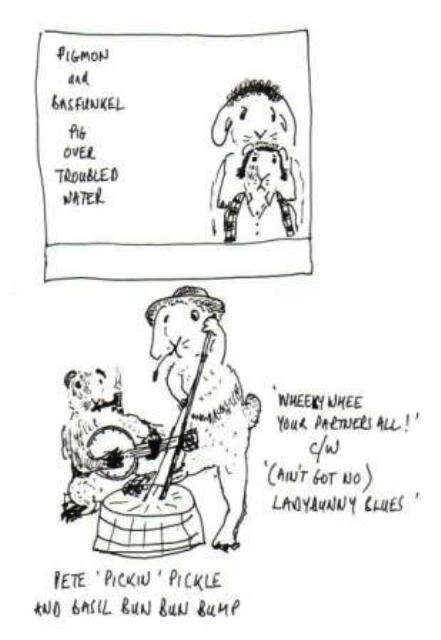
Basil’s brief taste of fame on the amateur stage proved a headstrong mixture, and, missing the limelight, he formed a successful musical duo with Petey Pickles and they enjoyed a long and lucrative career.

Image

The End.

Ghost Stories Part IV (b): Muriel Spark’s ‘The Executor’

Ghost Stories Part IV (b): Muriel Spark’s ‘The Executor’

This post has been removed because the content is now available in book form with many other essays and blog posts previously available on this site. The book is titled Ungrammaticalities: Linguistic Literary Criticism from ‘The Battle of Maldon’ to Muriel Spark, and it is available for purchase HERE from August 2024.

Please see this page for the cover art and table of contents.