My Top Five Favourite Comic Books, an Also-Ran: Stephen Collins’ ‘The Gigantic Beard That Was Evil’

Image


Warning: spoilers!

Before I begin, allow me to say how much I love Stephen Collins’ work. Every week I cut out his comic strip from the Saturday Guardian magazine and glue it into my notebook. Many’s the happy hour I’ve passed in the library re-reading old comic strips instead of making notes on yet another article about Spark’s manipulation of narrative time in The Prime of Miss Jean Brodie, and here I am now, writing a blog post about Collins’ first graphic novel instead of sifting through aborted PhD chapter drafts to weed out the useable bits. May I also point out as a preliminary observation that as a title, The Gigantic Beard That Was Evil takes some beating, it really does. For me, this title encapsulates Collins’ work in a very neat way: a superficially childish locution which hides a deeper profundity…and is very amusing at the same time.

Not that there’s much to laugh at in TGBTWE. It’s actually a very sad story, beautifully drawn and multi-layered: I’m not at all sure that I’ve yet plumbed its depths and fathomed all its meanings. The story takes place on the island of Here, which is neat, tidy and soulless. The people who live on Here are also neat, tidy and soulless: they spend much of their time transfixed by the screens of their phones. Everything is homogenised as far as possible and everything is in its place. The daily routine continues unchanged day after day. The weather forecast is the same every day. People go to work every day, but they don’t really know what they’re doing or what their job is. However, this seems to be the way they like it.

Beyond the sea, however, lies There, a place of disorder and chaos. And There breaks into Here through Dave, our enormously likeable hero. Dave is not quite the same as the other inhabitants of Here because although he loves his quiet, orderly life, he doesn’t sit in front of the telly every evening as the others do: he sits in his front room and draws what he can see in the street. But Dave the artist becomes a conduit for evil when There invades Here in the form of an enormous beard which grows out of Dave’s face in the space of a few frames and resists all attempts to be shorn. 

 Image

The moment a break in the routine pattern of repetition is established is the moment a narrative is formed. The remainder of Collins’ book relates the phenomenal and inexorable growth of the beard and how finally the beard – and Dave – are dealt with, all to the backdrop of The Bangles’ Eternal Flame, which Dave listens to over and over. The scary story of what happened to the fisherman’s son who sought to know What Was Over There functions as a standard literary device to provide a pre-echo and perhaps an indication of Dave’s fate, but on the other hand, perhaps the same fate did not befall Dave, because his drawings keep coming. Collins collapses the narrative levels here between author/narrator/characters: Dave’s drawings are identical to the author’s own and Professor Black’s final book is not intended for publication, but it’s clear that TGBTWE is that book. Dave’s departure leaves its traces. The world of Here is changed forever, and I’m left wondering whether There is so terrible after all. Perhaps the beard came to Here to encourage its inhabitants to embrace change and to face their fear of difference.

Image

Collins is a satirist, after all, and like my very own Muriel Spark, he uses humour and satire as an effective means of attack. The Daily Mail is vilified in this graphic novel and elsewhere in Collins’ work as a rag for the mindless, a pernicious publication for those who want someone else to do the thinking for them. Its fictional counterpart The Here Mail’s hatred for and suspicion of all things that come from over There will be recognisable to all as characteristic of our very own hate-filled red top. Collins is also an eager parodist of consumer culture: his Exit Ian strip shows a dead man shopping for memorabilia of his own life in a heavenly gift shop before he is allowed to move on, complete with souvenir baseball cap. (You can visit Collins’ website here. Look down the left-hand side for separate links to the Guardian strips.) Once Dave has been removed, his house is turned into a museum and visitors’ centre, and the merchandise for sale invokes an unbearable melancholy while at the same time we can raise a wry smile at the familiarity of the scene. 

Worthy of note is Collins’ use of the gutter, or the space between the frames. What may be lurking in the blank space which separates the images ties in with the thematic concern of TGBTWE, and Collins exploits this idea in the placing of captions and the fragmentation of the images. The gutter is also essential to the timing of comic book narratives, and in the image below we can see Collins using the gutter as a kind of film strip, both in external appearance and in its relation to narrative pace: each successive frame reveals the extent to which Dave’s beard has grown since the previous frame, so the reader is left in no doubt that the beard grows in a matter of seconds. 

Image

TGBTWE has much in common with utopian narratives: a seemingly perfect world is actually a hideous nightmarish dystopia, because the humanity has been wrenched out of it. In Huxley’s Brave New World the people are controlled by sex and the happy-feel-good drug soma; in Orwell’s 1984 people are controlled by terror and lies. In TGBTWE the people have become like the robots in the last of the Wright/Pegg/Frost Cornetto Trilogy, The World’s End. As is usually the case in utopian fiction, there is no room for art or artistic expression. Dave, the man who liked to spend his evenings with his pencils and his sketchpad, is the artist for whom there is no place in Here, the man who asked what it was that his company actually did (and didn’t get an answer), the man who suspects that the reason for the apparently meaningless routine is fear. The invasion of Here takes the form of a beard in a world of clean-shaven men and Dave always had that small, tough hair that would not be plucked, razored or waxed. 

Why isn’t this wonderful book in my Top Five? I wish it could be, I really do, but I thought I was pushing it by lumping Tintin and Asterix together at #2. If I’d put this together with Gemma Bovery as I wanted to, then I would have been giving myself carte blanche to include as many books as I liked in the Top Five, and that’s cheating. So I’m afraid TGBTWE has to remain outside the Top Five as an also-ran, but that doesn’t mean you shouldn’t beg, borrow or steal your own copy right away. You could even buy one. Make sure you have a box of tissues nearby when you read it, however, because it’ll make you a bit weepy. Happy reading!

I Had That Sherlock Holmes In The Back of My Cab The Other Day

Image

I’ve been living with my DVDs of the recent TV series of Sherlock (Gatiss and Moffat) for almost two weeks now and it’s got to the stage where I just have to write a blog post in order to clear my mind. As things stand at present, I cannot focus on anything except this new obsession of mine and I haven’t had a decent night’s sleep since watching the first episode (too excited to sleep!). Once this blog post is done, perhaps I’ll be able to get down to rewriting my chapter on the repetition in Muriel Spark’s use of prolepsis which has to be submitted in about six weeks’ time…I hope so, anyway. Otherwise I’ll end up frantically searching for a way to haul my conkers out of the fire. Again.

Image

So, let’s begin by stating the obvious: in creating a series based on Sherlock Holmes, Gatiss and Moffat were dealing with a character already familiar to many: the super-sleuth of Baker Street, a violin-playing, drug-abusing loner, isolated by his intellect, but (marginally) humanised through his contact with Dr John Watson. Watson is the I-narrator and focaliser of the original Conan Doyle stories: he is the medium through which we observe events unfolding, and we watch Holmes solve the crimes through Watson’s eyes. Watson’s narratives are, of course, translated into a blog for the twenty-first century and the contemporary setting has necessitated other changes: Holmes and Watson refer to each other by their first names – there’s no ‘Elementary, my dear Watson’ (although I’m not entirely sure Conan Doyle’s Holmes ever said that anyway – I’m afraid I’m in a position of relative ignorance as far as the original stories are concerned), and obviously the technology is different – twenty-first century Sherlock uses a smartphone to access the information he needs. Sherlock’s brilliance is explained in twenty-first century terms – he describes himself as a high-functioning sociopath with a hard drive for a mind and John Watson makes reference to Asperger’s Syndrome in the Hound of the Baskervilles episode. But what is interesting is the extent to which the new Sherlock is still Conan Doyle’s Holmes: the way he talks, the way he dresses, the appearance of his flat at 221B Baker Street, and the fact that he almost always travels by taxicab. I was pleased that the villain in the first episode was a taxi driver, because taxis are important in this series (hence my title). So, the coat and scarf, the habit of talking in paragraphs or at least perfectly-formed sentences, the dated decor of the flat and the ubiquitous taxis, together create a distinctly nineteenth-century atmosphere. He is Sherlock Holmes still.

Image

As far as the TV series is concerned, John Watson is not our only narrator. The camera closely directs and controls our view of proceedings, and in addition to this, many scenes are complemented by the appearance of words or symbols actually in the frame, appearing next to or on the characters: we see the wording of texts and other written messages, or signs either linguistic or pictorial that reveal a little to us of Sherlock’s thought processes. All this is easy for a twenty-first century audience to assimilate, of course: thanks to the internet, we are used to reading words and images together and I’m guessing most viewers would take the appearance of words onscreen on board without batting an eyelid, especially those well-versed in comic books. It’s only a form of caption, after all. The fact that we can see, for example, the words ‘Number blocked’ in the frame when Sherlock receives a phone call negates the necessity for a verbal explanation or a close-up of the mobile phone in question. The close-ups we do get are, for the most part, of the almost impossibly beautiful Benedict Cumberbatch as Sherlock, which is ironic, because of course we are not close to this character and never will be. We watch him work as he unravels the latest mystery: he looks directly at us so that we take the place of the object he is gazing at, but in spite of this physical proximity, we are kept at a distance by Sherlock’s personality: by his genius and by his inability to relate to other human beings, his failure to understand, for example, why a woman should still mourn her still-born daughter of fourteen years ago. He is apart from us. In fact, as far as he’s concerned, we may as well be the corpse he is studying so closely. It’s very noticeable that in the odd moments here and there when Sherlock pretends to be ‘normal’ in order to get someone to do what he wants or to draw them out in some way, the effect is jarring and just a little bit scary.

Sherlock

And our camera-narrator works hard to emphasise this distance between him and us in another way, almost an opposite way: Sherlock is put behind glass for us, as if the roles have been reversed and he is the specimen we are to study. There is a proliferation of scenes in which we see Sherlock through windows, reflected in mirrors or in his magnifying glass, in reversed images viewed in the rear view mirror from the point of view of yet another taxi driver…once you become aware of it, it’s astonishing how many times some kind of glass frame falls between the viewer and Sherlock, particularly in the episode entitled The Great Game. Other blockages and obstacles obscure the audience’s view: scenes featuring a single light source are wreathed in shadows and the characters seen in silhouette as a result; often an object in the foreground is blurry and the viewer is forced to focus instead on what lies behind the object; physical objects obscure the full picture and the viewer is left looking at a blind spot; characters shift in and out of focus so the viewer’s concentration is directed at the character who can be clearly seen. Even the scene changes are very often marked by something moving across the screen and temporarily obscuring what we can see. In this way, our view is closely directed and manipulated, as I said earlier, all of which is very fitting for the detective-story genre, when all is opaque until the detective can reveal what happened and why. And the why and the who and the how is finally revealed in the kind of analeptic narrative sequence much-beloved of the genre in which we see what we have seen before, but Sherlock’s voiced-over narrative directs us to view events in a different light.

TV Sherlock 4

The shiftiness of the narrative doesn’t even end there: in the credits for The Great Game, James Moriarty is listed simply as ‘Jim’, recalling his brief stint as Jim from IT, but we know who he is by now so why not list him as Moriarty? And am I right in thinking that Mycroft Holmes is never listed at all? If so, this is a nice touch – a gesture towards verisimilitude – we’re not allowed to know who Mycroft really is because he occupies a position of some importance and it all has to be kept very, very secret. Nice. I like it. Trying to make us think that the fiction is a reality – good! It’s all gone a bit meta– now, and that’s the way I like my fiction. Yes, Series 1 and 2 are pitch-perfect.

Image

But what the hell happened in Series 3? The show went from Best Telly Ever to slap-in-the-face let-down. What had been a winning formula was overturned in favour of a dumbed-down version, with the intention of selling the show to a bigger audience, perhaps, but at the risk of alienating the existing body of fans. My DVD arrived complete with a flyer trying to sell me Sherlock-related merchandise, and three episodes later I felt the characters had been turned into marketable versions of their former selves. This was not the same show. These were not the same characters. I can’t fault the performances – the hugely talented cast are all working with the script that’s put in front of them, after all – but the writing was just awful: it was disrespectful to the characters, to the relationships that had been established between them, and worst of all, to the faithful audience. The end of Series 2 was incredibly powerful: an hour and a half of emotional intensity, which left me with the most appalling headache. The crying certainly didn’t help. No one is going to outdo me on grief here – the sight of poor smashed Sherlock on the pavement with blood all over his lovely face, and John Watson desperately trying to reach his friend – well, I had my knuckles in my mouth to stop me from screaming. By the time it got to John Watson’s graveside eulogy for his lost friend (‘please stop this, please don’t be dead’), I was blowing snot bubbles in between racking sobs.

…And what do I get in the first episode of Series 3? Silly slapstick in restaurants. Sherlock pretending that he and John are about to be blown to smithereens and then laughing at the expression on John’s face. A show that had fallen in love with its own cleverness and was attempting to emulate the parodic self-referentiality that so many US shows do so well: much of the humour of Buffy, for example, lies in the show’s ability to poke fun at itself and parody various genres within its own framework. But that’s not going to work with Sherlock, I’m afraid. We don’t want jokey fun Sherlock. We liked the sociopath. We don’t want a Sherlock who seduces women (Janine) in order to gain access to their bosses – he’s not James Bond, he’s Sherlock. I loved the disregard for gender that featured so strongly in the first two series: John’s sister is gay, Irene Adler tells us she is gay but she still fancies Sherlock, Sherlock might be gay but is fascinated by Irene Adler, etc. – it’s all people being attracted to other people regardless of genitalia, and this set-up is infinitely preferable to the repulsive James Bond-type scenario.

Image

As you may have guessed by now, in spite of my horror at the travesty that is Series 3, I am utterly and irredeemably Sherlocked. But I won’t be buying the T-shirt. Please, Gatiss and Moffat, please bring back Sociopath Sherlock, the one we really loved. Otherwise he truly is dead.

My Top Five Favourite Comic Books: #1 The Work of Will Eisner

Image


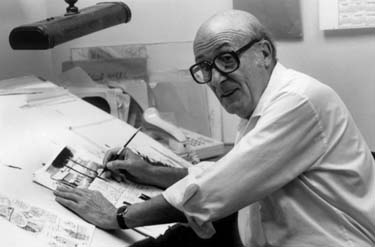
Will Eisner (1917-2005) would have been about twelve years old when Tintin first appeared, and, like Hergé, Eisner’s contribution to the world of comics is immeasurable and invaluable. Eisner’s status as a comic book artist is such that each year the Eisner Award is presented in recognition of significant achievement in this particular medium. Eisner’s stories usually feature city-based people struggling with poverty and hardship: often the ending is an unhappy one, but the tales themselves are rarely sentimental. Eisner’s characters have been brought low and made mean by hunger and hardship and there is a hardened edge to many of them, but one would have to be stony-hearted indeed not to sympathise. Eisner writes about those who lose everything during the Great Depression, those who struggle to raise a family in an impoverished and often violent neighbourhood, those who are the victims of racism, antisemitism, domestic abuse, those who are born poor and die even poorer. And after reading Eisner, one is left with a strong sense of the warmth and sympathy he felt towards his creations, how much he understood human nature and the desperate fight for survival. 

Eisner is, after all, writing from his own life. His parents were poor immigrants to the US and his father, also an artist, had a hard time making ends meet. Eisner was born in Brooklyn and his childhood in New York was a difficult one. He shared those experiences in his heartfelt and beautifully drawn graphic novels; he also wrote books of instruction on sequential art and lectured at the School of Visual Arts in New York City. There’s a bibliography at the end of this post and you can read more about Will Eisner on his Wikipedia page here

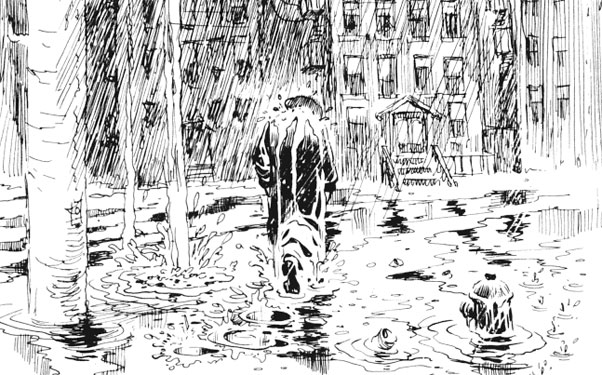
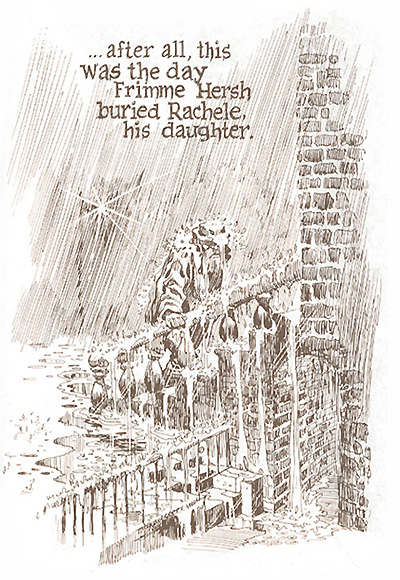
One thing about Eisner is that he does ‘weather’ better than anyone else I’ve come across so far. Look at this from The Contract With God

Image

The torrential downpour mirrors and magnifies the tears of Frimme Hershe, who is returning from burying his daughter, Rachele, the fictional counterpart of Eisner’s own daughter, Alice, who died of leukaemia when she was a teenager. Overwhelmed by grief, Hershe breaks his contract with God and becomes a ruthless landlord, but he never loses our sympathy because we have seen what he once was and we know what shape his demons take. 

Image

Eisner draws beautiful snow as well. In his story Sanctum, poor Pincus Pleatnik believes there to be safety in anonymity and he spends his life trying to keep out of everyone’s way. When his death is reported in error in the obituaries, events catch up with Pincus in quick succession, and, locked out of his home, he is forced to spend the night sleeping in the snow in one of the city’s parks. Unable to contact anyone to verify his continued existence and unrecognised by most owing to his habit of avoiding human contact, Pincus eventually meets his death when he attempts to escape from the union thugs who have kidnapped him, but who didn’t intend to harm him. It’s a very sad story and the salt in the wound comes at the end when the editor whose report led indirectly to Pincus’ death is awarded an ‘errorless editor medal…and a $5000 bond’ on her retirement. I actually jabbed the page and yelled ‘He’s dead because of you!’ Eisner elicits an emotional response from the reader through use of irony as here in the story of Pincus, or through jarring juxtapositions such as those in the scene below: the man trudging through the streets and drinking in the bar is pursued throughout by the notes of a jolly tune, but when we see him here he is returning from the hospital where he has seen his wife’s body. She is beyond the help of the ambulance which rushes past her husband at the top of the picture, the siren temporarily taking the place of the string of musical notes.

Image

I’m sorry this post is such a sad one, but this is why I like Eisner’s work so much. Sometimes there’s nothing like having a good blub, and I have shed many a tear over Eisner’s tales. And in fact, I’ve saved the saddest for last. Ernest Hemingway was once challenged to write a short story in six words that would make everyone cry…and Eisner illustrated it, as seen here below. Those of you who’ve spent a long time on your eye make-up today might want to look away now unless you want to be reapplying your mascara very shortly…

Image

The story Hemingway wrote was ‘For sale, baby shoes, never used’, and Eisner has in fact added one more word to this story by labelling the pawn shop, just in case anyone missed the three-ball symbol in the corner. What is so heartrendingly awful about this brief strip is the woman’s broken and defeated gait as she enters the shop, carrying her box containing the baby shoes. Her beaten-down posture is the same when she exits the shop holding the cash she received in exchange. I’ve turned down the corner of this page in my book so I can skip over it more easily: the sight of that poor woman doubled over with grief is too much for me and mascara is too expensive to have to be applying it more than once a day.

Dry your tears now and remind yourself that this is only a story…

Coming soon! – My Top Five Favourite Comic Books: The Also-Rans and an Outsider

Bibliography:

(All titles by Will Eisner)

  • New York: Life in the Big City
  • The Contract with God Trilogy
  • Graphic Storytelling and Visual Narrative
  • Expressive Anatomy for Comics and Narrative
  • Comics and Sequential Art

My Top Five Favourite Comic Books: #2 (joint position) Tintin by Hergé (Georges Remi)

Image

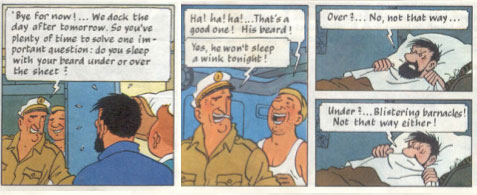
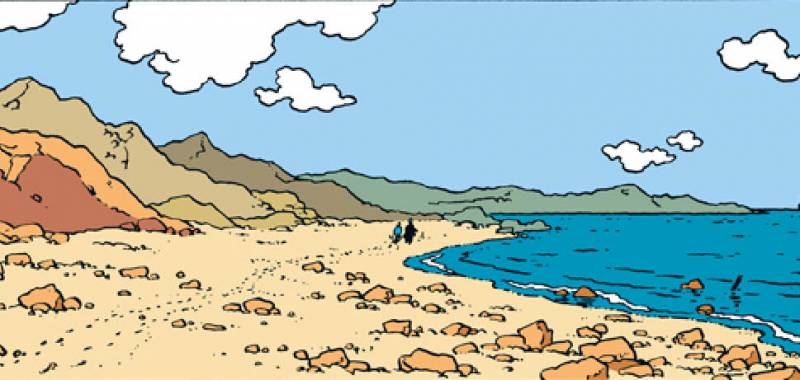
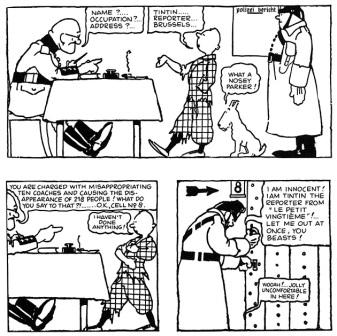
Those who know me will be surprised to find Tintin in joint position at number two instead of in the hotspot at number one. I’m a HUGE fan of Tintin and I’ve got the tattoos to prove it. But number two it is, and as with Asterix, I’ve chosen one book to represent the entire oeuvre. In this case, however, I mean the oeuvre minus Hergé’s more offensive early offerings – we all know which titles they are, and a great deal has already been written on the subject, so enough said. The book I’ve chosen in this instance is The Red Sea Sharks. Why this one in particular? I could have chosen Tintin in Tibet – the only book without a villain – or the wonderfully farcical Tintin-Stays-At-Home story, The Castafiore Emerald. But The Red Sea Sharks it has to be, mainly because the whole gang is here. Every character gets a look-in: even Jolyon Wagg has his moment at the end, and, as always, his chief purpose is to annoy Captain Haddock and deprive the poor man of some much-needed peace and quiet. There are, in fact, some Tintin characters we don’t want to see too much of: Jolyon is one of them and so is the ghastly Abdullah, who, thankfully, is not around for too long, and even he is useful in providing plenty of scope for Captain Haddock to fall downstairs, lose his temper, shout a lot, have things blow up in his face, and so on, and it’s all just so funny.

Image

In fact, Captain Haddock steals the show in this book, full stop. He is ‘onscreen’, as it were, for as much time as Tintin, and he makes us laugh all the way through. He is the subject of a wonderful Medusa joke on page 39 when he falls into the sea – for the second time – and emerges with an octopus on his head. (The characters are on a raft at this point, of course, and whenever you get a raft, you invariably get a reference to Géricault’s marvellous painting, The Raft of the Medusa.) When Captain Haddock spots Bianca Castafiore aboard the yacht that rescues the castaways, his reaction is to ask whether or not they should ‘hop back on the raft’. On the frigate, he yells obscenities at the slave trader through a megaphone until this ‘trafficker in human flesh’ is well out of earshot. And an especial bonus: the frigate is captained by the Best Bad Guy in Tintin, Captain Haddock’s old first mate Allan.

Image

Once Allan and his crew have deserted the frigate, Captain Haddock demonstrates exactly why he bears the title of Captain: he knows what he is doing, and it is he, not Tintin, who runs the show from that point onwards. He gets the Ramona’s engines going again after the fire and manoeuvres the ship safely through a barrage of deadly torpedoes.

Image

This book has everything: plane crashes; bombs that ‘tick tick tick’; punch-ups; daring escapes by our heroes dressed as women; chases on horseback; practically every vehicle you can imagine, including a raft; lots of different kinds of weapons; oodles of suspense and let’s not forget the sumptuous settings.

Image

‘By Toutatis!’ versus ‘Great Snakes!’: Asterix and Tintin Compared

Many have asked me why I bother with Tintin, it being their opinion that Asterix is far superior. I’ve lumped Asterix and Tintin together at number two because the truth is I just can’t separate them. I’ve been reading these books since before my age could be counted in double figures and I get more and more out of them all the time. I find another joke every time I read Asterix, and when I revisit my Tintin books, I always find something else to appreciate in the beauty and accuracy of the drawings. Hergé was a pioneer of the ligne claire style, and the cleanliness of his lines is complimented by his use of flat colours. Scott McCloud refers to Hergé’s achievement on page 190 of Understanding Comics:

‘In Europe Hergé captured the magic of such flat colors with unprecedented subtlety. Hergé created a kind of democracy of form in which no shape was any less important than any other – a completely objective world. Comics printing was superior in Europe and for Hergé, flat colors were a preference, not a necessity.’

Image

So I consider it a mistake to dismiss Tintin out of hand without considering the extent of Hergé’s artistic achievement. Nor do I wish to denigrate Uderzo’s artistry: in fact, I find it very difficult to compare Asterix and Tintin at all. But I’ve had a go here under a few different headings, because if nothing else, the observations below will help demonstrate why these two old favourites are united at number two in my top five.

First appearance: To begin with, these two characters emerged at very different stages of comic book history. Tintin was in there right at the start, appearing first in 1929 when the comic book was very young indeed; Asterix appeared some thirty years later when comics as a creative form had really found their feet. The early Tintin books are rough and ready, yes – but this sort of narrative told in art form (or sequential art) was something brand new.

Image

Audience: Asterix and Tintin books were essentially targeting different corners of the market. Asterix was always aimed predominantly at the adult reader, whereas Tintin began life as part of a children’s supplement in a newspaper. This is not to say that Asterix cannot be read and enjoyed by children or that Tintin is too childish for adults: neither of these statements is true, but if someone is going to set about trying to compare the two, this is something that should be borne in mind.

Image

History and Geography: Asterix and Tintin differ wildly in their treatment of these subjects. In Asterix, everything is scarily accurate; in fact, I learnt most of my history from Asterix, to be honest. I took my copy of Asterix in Corsica with me when my husband and I spent our holiday there two years ago, and Corsica really does look the way it does in Uderzo’s beautiful drawings. Tintin, on the other hand, plays relatively fast and loose with both history and geography. The books feature a couple of made-up countries, Syldavia and Borduria, and Tintin wasn’t the first man on the moon – although obviously, Tintin’s moon-landing pre-dates the real thing. Some of the events in The Blue Lotus have a fragile basis in historical fact, but on the whole, Hergé freely invents whatever he needs to invent to tell a good story.

Style: I’ve already mentioned ligne claire, and Hergé’s mania for pictorial accuracy is well-known: his archives contain hundreds and thousands of pictures which he used as a reference point for his drawings. Asterix is more cartoon-like in its execution and Uderzo captures a great deal of expression in those cartoon human faces. Tintin himself has a limited expressive range – he’s only two dots for eyes, a button nose and a line for a mouth, after all. In fact, it’s amazing what Hergé does with those few dots and lines.

Image

Humour: In Tintin, the humour is derived mostly from slapstick, the winding-up of Captain Haddock, Professor Calculus’s deafness and the verbal antics of the Thom(p)son Twins; in Asterix, we laugh largely at the ingenious word-play.

Image

Development: Asterix doesn’t develop in the way that Tintin does. Tintin doesn’t have any kind of background or a personal history outside of the oeuvre, but he gradually collects a ‘family’ around him and sets up home with Captain Haddock and Professor Calculus at Marlinspike. When we first meet Tintin, he is a reporter, or journalist, living and working alone. By the end of the last Tintin book, he is in a very different position. Asterix, on the other hand, doesn’t develop and doesn’t need to: he just is. Uderzo’s forays into Asterix’s childhood with Obelix produced some rather unsuccessful books aimed at a much younger readership. If it ain’t broke, don’t fix it, and Uderzo would have done better to stick with the winning formula: the village is threatened, Asterix and Obelix beat up lots of Romans, the story ends with an enormous banquet and the bard gagged and bound beneath the tree so he can’t ruin everyone’s evening by singing.

This is why Asterix and Tintin have to be together at number two. They are too different to be really comparable, and I can’t separate them. So what’s going to be number one? There’s a clue for the beady-eyed hidden somewhere in this post…

My Top Five Favourite Comic Books: #2 (joint position) The Asterix Books by Goscinny and Uderzo

Image

I started reading Asterix during my middle school years, and I well remember the scuffling and elbowing which regularly took place in the school library as everyone fought to grab at the titles on the Asterix shelf. My Aunty Clo and Uncle Jim bought me Asterix the Gaul, my first Asterix book, for Christmas in 1980 when I was nine years old, and I have read and re-read these books ever since. I saved my pocket money to buy them from WHSmith when I had to give up on the library because everyone else’s elbows always seemed to be far sharper and harder than mine and I could never get to the Asterix books without suffering various blows to my weedy little person. In those days – and this may still be the case – Asterix books came in two sizes, and you could buy a copy of the book in a size slightly smaller than A5 which cost 75p. These days, I have in my possession every Asterix book in both English and French. The books are scruffy, foxed and yellowed, but all that’s just proof of how long I’ve had them, how often I’ve read them and how much I love them.

I say ‘every Asterix book’, but that’s not entirely true. Goscinny was the partner who wrote the scripts and the quality of the storywriting rapidly faded after his untimely death: Asterix in Belgium was the last book Goscinny and Uderzo produced together. Uderzo still struggles gamely on alone, but the Asterix books have come to be aimed at a much younger market and all the joy of the original has vanished. The drawings are as beautiful as ever, but the sophisticated wordplay is long gone. There’s a new book due out very soon, if it’s not out already, and I’m not going to read it. I just can’t bear to see what has become of Asterix. I stuck with it for as long as I could, and I’ve enjoyed some recent compilations: Asterix and the Class Act, for example, which appeared in 2003, brought together some previously unpublished short stories, and 2007 saw the publication of Astérix et ses Amis, in which a number of artists paid tribute to this character with their own very amusing versions of the plucky little Gaul and his companion envelopé. But to be honest, everything from Asterix and Obelix All At Sea onwards just hasn’t been up to scratch.

I’ll return now, though, to the good stuff, because I have, after all, placed Asterix in joint second place as one of My Top Five Favourite Comic Books. I’ve chosen one Asterix book dating from the years of the Goscinny/Uderzo partnership to represent the entire oeuvre, rather than trying to write about the whole lot in one blog post. The book I’ve chosen is Asterix and the Roman Agent, or La Zizanie in French; semer la zizanie is to sow discord, or to stir up ill-feeling, and a ‘zizanie’ is ‘a type of invasive weed’. The name of the Roman Agent – Convolvulus – is the Latin term for bindweed, and anyone who has bindweed in their garden knows how quickly it spreads and how destructive it is: it takes over and chokes everything else. It’s extremely difficult to get rid of bindweed once you’ve got it, because it’s also incredibly pervasive. On the subject of the Agent himself, Peter Kessler notes in The Complete Guide to Asterix that ‘[t]his is the only adventure that includes a ‘symbolic’ character. Convolvulus, the Roman Agent, is the physical embodiment of social disruption. Injecting him into the Gaulish Village has the effect of a moral tale about the danger of gossip and deceit’ (p. 41).

Image

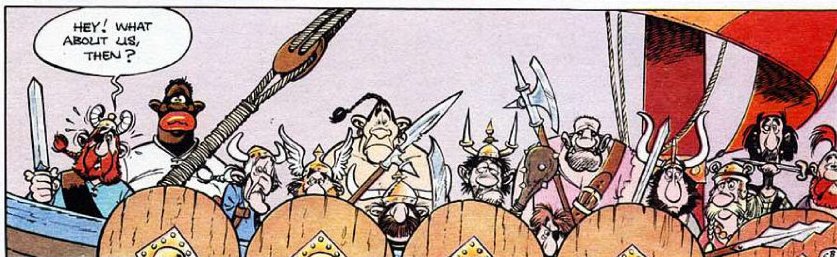
I’ve chosen The Roman Agent for several reasons: the story is excellent, tightly constructed and beautifully executed. The repetition of a scene involving the village women standing in a queue for fish provides a neat frame for the arrival and departure of the titular zizanie, and of course, it’s very funny: the reader knows there’s going to be a fight as soon as Unhygienix’s fish appear in any Asterix book, and frankly, I’d be hard pushed to name anything funnier than Uderzo’s fabulous drawings of the Gauls slapping each other with fish. In fact, The Roman Agent contains some of Uderzo’s most amusing images: the mother hen and her row of six little chicks calmly watching yet another fight on page 20 for example, and the bemused expressions on the faces of the pirates on page 10 when the Romans are too busy bickering with each other to pay the pirates any attention. The book also has some of the funniest lines: when spying on the Roman camp, Fulliautomatix warns Unhygienix ‘Try not to smell!’ (p. 27); the captain of the ship escorting Convolvulus to Gaul says of the look-out in the crow’s-nest that ‘No one’s to listen to him! He’s been sent to Coventrium!’ (p. 9) and on page 30, Obelix complains ‘No one ever explains anything to me! They just keep me around because I’m ornamental!’ Obelix isn’t the only one in the dark and the writers milk the ensuing confusion for every last drop of humour: the Romans are too thick to keep up with Convolvulus’s plans and no one knows whether they’ve got the magic potion or not.

Image

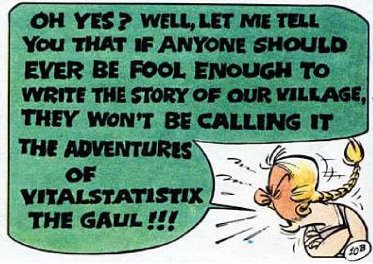
So we have some tight plotting, lots of laughs, and a couple of interesting touches to boot: Uderzo is always very inventive with speech bubbles and in this book we see the colour of the bubbles change from white to pale green to dark green as the zizanie does his work and everyone gets angry. We also see this happen in reverse: on page 18, Obelix storms out of Asterix’s hut after an argument, but he calms down as he marches away and the colour of his speech bubbles fades back to white before Obelix rushes back to make up with Asterix. On page 36, flowers appear in the Roman Centurion’s speech bubble to indicate a false honeyed tone when he asks ‘Did you by any chance fail to understand me?’ ‘Well, to be honest…’ replies the legionary. ‘Get on with it!’ shouts the Centurion (bold lettering always denotes shouting, of course). And no critique of The Roman Agent would be complete without a mention of the lovely self-referential moment on page 14 when Impedimenta bellows ‘Well, let me tell you that if anyone should ever be fool enough to write the story of our village, they won’t be calling it the adventures of Vitalstatistix the Gaul!!!’ This is just wonderful, because now the reader too is involved in the spreading calumny: on the page following, when Geriatrix’s wife claims that Mrs Asterix, if she existed, should be the first lady of the village, we know this to be true, because the books we read are entitled ‘The Adventures of Asterix the Gaul’ (not Vitalstatistix), so we are forced in this way to take sides. And as a result, we would be in line for a smack around the chops with one of those fish.

Image

As well as the moments that make The Roman Agent special, all the usual things we’ve come to expect from an Asterix book are here too: lots of fights, obviously, including fish fights and cat fights; the pirates, who this time scuttle their own ship; the banquet at the end following one final punch-up; Julius Caesar getting grief from the Senate…it’s all here. And what’s nice about this book is that the Romans provide us with at least as much entertainment as the Gauls. There are gags galore involving psychological warfare (hitting someone with a club), and the Romans’ ability to bicker amongst themselves is seemingly endless. The Romans come out of this book very well, because Convolvulus is the main baddie – but there’s even scope for a little sympathy for Convolvulus. It’s a nicely balanced book and a worthy representative of the Asterix canon.

For more about Asterix on Aunty Muriel’s Blog, see Asterix in Translation: The Genius of Anthea Bell and Derek Hockridge.

Bibliography:

Kessler, P., 1995. The Complete Guide to Asterix. London: Hodder.