This post has been removed because the content is now available in book form with many other essays and blog posts previously available on this site. The book is titled Ungrammaticalities: Linguistic Literary Criticism from ‘The Battle of Maldon’ to Muriel Spark, and it is available for purchase HERE from August 2024.
Please see this page for the cover art and table of contents.
This definition of ‘literature’ provided by Dr Johnson was penned in the middle of the eighteenth century. Here he is as played by Robbie Coltrane in the third Blackadder series:
This is such a clever episode, and it’s one of my favourites. The line which makes me laugh every time is Prince George’s response to Dr Johnson’s explanation of the purpose of his famous dictionary:
DR JOHNSON: It is a book, sir, that tells you what English words mean!
PRINCE GEORGE: I know what English words mean! You must be a bit of a thickie.
Dr Johnson was not, of course, thick, and his definition of ‘literature’ was perfectly adequate for the middle of the eighteenth century, when the novel was in its infancy. As Jonathan Culler notes in his Literary Theory: A Very Short Introduction, ‘[p]rior to 1800, literature and analogous terms in other European languages meant “writings” or “book knowledge”‘ (1997:21). But the literary world has grown exponentially since then in terms of production, reception, criticism and theory, and Johnson’s definition now looks to be sadly lacking. So, if we were going to define ‘literature’ for the twenty-first century, where would we start?
What is literature?
Some of my initial thoughts were as follows.
Literature can be anything written down, or any kind of text consisting of words and/or images.
Literature is a crafted piece of work, such as a novel, play or poem etc., consisting of words and/or images in which the form and the content of the work are arguably inseparable, or alternatively, a text in which the aesthetic function is privileged over the communicative.
Literature is both a response to and a product of its socio-historical and cultural context.
These ideas are perhaps drawing a little closer to a more contemporary definition of ‘literature’, but to my mind, they still do not provide a clear picture of what ‘literature’ really is. I had a look at how literature is defined in a couple of modern dictionaries, and this is what I found:
Chambers Dictionary
literature n.
1 The art of composition in prose and verse
2 The whole body of literary composition universally, or in any language, or on a given subject, etc.
3 Literary matter
4 Printed matter
5 Humane learning
6 Literary culture or knowledge
…and here’s the second definition:
Shorter Oxford English Dictionary
literature, n.
[(French littérature from) Latin lit(t)ratura, from lit(t)era LETTER noun: see -URE.]
1 Acquaintance with books; polite or humane learning; literary culture. Now arch. rare. LME
2 Literary work or production; the realm of letters. L18
3a Literary productions as a whole; the body of writings produced in a particular country or period. Now also spec., that kind of written composition valued on account of its qualities of form or emotional effect. E19
-b The body of books and writings that treat of a particular subject. M19
-c Printed matter of any kind. colloq. L19.
The Shorter Oxford English Dictionary (hereafter SOED) is of course a much larger work than the Chambers Dictionary (hereafter CD), and its entries include etymological details and examples of usage, which the CD doesn’t. Hence we have in the SOED a history of the word ‘literature’, including the sense used by Dr Johnson (number 1) marked here as ‘arch. rare. LME’. By the late eighteenth century (number 2), the sense of ‘literature’ has expanded to acknowledge the works themselves, rather than serving as some kind of pseudo-adjective to describe a particular attribute of those who read books and letters. Sense 2 is less centred on the human reader of texts and more focused on literary output, although this output is still very much connected with ‘the realm of letters’. (This makes sense, of course, when put into historical context.) Sense 3 seems to be a more current definition of ‘literature’ accepted by the SOED, and this sense is divided into three parts which reflect the expansion of the term’s usage over the nineteenth century. It’s worth noting, however, that sense 3c, ‘Printed matter of any kind’ is still labelled colloq., as if it is in some way inferior to the other senses.
The CD entry for ‘literature’ is set out differently. There is no etymological or historical information, and no concrete examples are provided. The entry is split into six senses, which seem to be listed in order of decreasing relevance, with 1 being the most commonly used sense and 6 being the least. We can see then, that CD senses 5 and 6 more or less reflect the SOED’s sense 1 in that they are historical meanings no longer or rarely used. ‘Printed matter’ appears at CD sense 4, because it is used more often than 5 or 6, but less often than 1, 2 or 3 (and note there is no ‘colloq.’ value judgement here!). CD sense 3 is too vague for me – I honestly don’t really know what might be meant by ‘literary matter’. Sense 2 describes the existing body of work and the top sense – CD sense 1 – refers to its production.
I’d like to note two things of interest in the comparison of these two definitions. First, the SOED attempts to define why a work might be considered ‘literature’ in sense 3a: literature is ‘that kind of written composition valued on account of its qualities of form or emotional effect’. This, of course, raises heaps of questions: what sort of qualities are valued? Who decides what qualities are valuable? How does a reader recognise these qualities? What sort of emotional effect are we talking about here? – and so on – but it is not a dictionary’s job to answer these questions. The CD, however, perhaps wisely makes no attempt at all to comment on form or effect and sticks to a definition that is unquestionably true, but limited in scope: ‘literature’ is ‘[t]he art of composition in prose and verse’. The other point I wish to mention is the use of the word ‘humane’, which appears in both entries. Dictionary definitions inevitably lead to the search for other definitions, and CD lists the following as one of the senses of ‘humane’: ‘humanising as humane letters, classical, elegant, polite’. I think, then, that this sense is a reflection of the eighteenth century zeitgeist and its obsessive love affair with classical form, rather than any attempt to suggest that reading makes us all better human beings.
Well, dictionary definitions are all well and good, but they are designed for a very specific purpose and are perhaps not the best way to explore this question. Moreover, dictionaries do not define usage, they merely reflect it. A dictionary definition is not timeless or fixed, nor does it represent some kind of untouchable truth. So let’s set about this a different way, and try to provide answers to some fairly open questions.
1. If we want to think about literature as writing, then does the term apply to all written texts, or only to a specific kind?
I’m always very keen to include comics (graphic novels if you must) under the heading of ‘literature’, which I’m aware others are not. For me, they are dense and rewarding texts: the words and images are read in conjunction and work together to create meaning, even when one is apparently undermining the other. But no doubt different people would include all sorts of different works when asked what they would classify as ‘literature’: for example, there have been many voices in favour of the inclusion of Terry Pratchett’s Discworld oeuvre. The fantasy genre, whose readers do tend to put the ‘fan’ in fanatical, throws up an interesting question. If we classify The Lord of the Rings as literature – and we do – why not Game of Thrones (for example)? Is it because the author of the former was a much-lauded Anglo-Saxon scholar and a professor of English? Or does Tolkien’s novel genuinely present properties that are lacking in Martin’s work? (And if so, what are these properties?)
Some texts will not be acceptable as ‘literature’ because the quality of writing is considered too low in standard. But who sets these standards, and what are they? To return to the example of Pratchett’s extremely popular Discworld series, many of these books are formulaic, over-long, and consequently dull – but Monstrous Regiment, Night Watch and Going Postal are really very good. On the other hand again, someone once tried to tell me that Pratchett is on a par with P G Wodehouse, to which my response was a thumping NO HE IS NOT. Pratchett’s comic timing is good, but Wodehouse’s is impeccable: he writes highly sophisticated sentences which turn exquisitely on numerous subordinate clauses to deliver the funny at exactly the right moment. Perhaps in the end it all comes down to a sense of grammar and an excellent ear. I don’t know. But I do know that Wodehouse is better than Pratchett.
I think, in fact, the question is asking for a distinction to be made between texts that are clearly communicative and functional, and texts that are ‘art’. But even here, the line has to be drawn somewhere, and while it is easy to make a distinction between a novel and a shopping list, what do you do if that shopping list has a kind of poetic coherence, or if it makes a poignant comment on the human condition that makes reading it an emotional experience? What then?
2. When does ‘literature’ become ‘Literature’?
I’ve taken the capital L to mean that a work is sanctioned or ratified and can henceforth be considered ‘good’ and ‘worthy of study’.
So, works of literature become ‘Literature’ when:
an over-privileged and overbearing white male such as Harold Bloom decides that a work should be included in the literary canon;
a work is added to the curriculum and taught in schools, colleges and universities;
a work is nominated for a literary prize;
a work chimes with the zeitgeist; when its theme, form or execution fits the prevailing cultural preferences.
All of which means that ‘Literature’ can go back to being ‘literature’ as soon as it falls out of favour. It’s not necessarily a one-way street we’re talking about here. Writers who were once lauded can sink into obscurity, but there is the possibility of rescue when a change in the cultural wind makes them fashionable once again.
I don’t think much of ‘Literature’, really. It’s an interesting phenomenon in its own right, especially in the contribution it can make to the study of culture, but I certainly can’t reconcile myself to the idea of a literary canon.
3. If literature possesses a quality that we recognise as ‘literariness’, then how is this recognised?
To answer this question, one would have to consider the notions of ‘foregrounding’ and ‘deviance’ put forward by the Prague School scholars at the beginning of the twentieth century. It’s about language, and when language draws attention to itself in some way, through use of rhyme, metaphor, and all the many many other literary devices. If we are using metalanguage – language about language – to describe what’s going on in the text, then that text has called attention to its FORM and therefore possesses literary qualities (even if it is not considered literature).
4. Is literature best thought of, beginning perhaps from linguistics, as a form of ‘peculiar language’?
This is Prague School territory again, and I think the New Critics could also be brought into this discussion, but essentially, the answer is no. Some literary works include remarkably non-literary language – Hemingway, for example, and see Terry Eagleton’s comments on ‘This is awfully squiggly handwriting!’ in Knut Hamsun’s novel Hunger (from Eagleton’s Literary Theory, p. 6). The context is literary, but arguably not the style – although I think this statement is problematic. For example, Hemingway’s sentences are simple, but this doesn’t mean they’re not carefully crafted to achieve a certain effect.
Perhaps literature, or literary language, is best thought of as being differentiated from other language use in terms of its function rather than its form. What’s it there for? What is it doing? Why should we read it? …which brings me to the next question.
5. What is literature for?
I came up with seven possible responses to this one.
for entertainment, to tell a story;
for edification and instruction;
for the dissemination of an ideology, whether done knowingly or not;
to provoke discussion, to enlighten, to share, to inform, to make readers think, to shock, to awaken in a mental sense;
to form part of a nation’s cultural life; to create and perpetuate a way of thinking and a body of myths and legends;
to bring people together;
to deceive – remember Plato banned the poets!
And the final question:
6. Does literature make anything happen?
Taking point 3 above, yes. Literature can be enormously powerful, for good or for bad. Stories can become myths, and the myths can become ways of thinking and being. Literature can reveal and shatter normalised thinking patterns, but it can also create them.
In addition, if someone powerful disagrees with what you write, you lay yourself open to hostile criticism or even place yourself in physical danger – look at Salman Rushdie’s experience of the fatwa, and consider Timothy Bell’s recommendation that Hilary Mantel be investigated by the police following the publication of her short story The Assassination of Margaret Thatcher: 6 August 1983. Literature can create culture and cultural revolutions. One has only to look at the historical – and contemporary – persecution of writers to realise that state governments take very seriously the written output of citizens. English PEN certainly has its work cut out.
I’m not sure I’ve got any closer to answering the question ‘What is literature?’, but there’s some food for further thought here at least.
Speech and Thought Representation in Terry Pratchett’s ‘Going Postal’
This post has been removed because the content is now available in book form with many other essays and blog posts previously available on this site. The book is titled Ungrammaticalities: Linguistic Literary Criticism from ‘The Battle of Maldon’ to Muriel Spark, and it is available for purchase HERE from August 2024.
Please see this page for the cover art and table of contents.
We all know we’re not supposed to judge a book by its cover, and we all do it nevertheless. Of course we do. So much so, in fact, that the cover design is now recognised as part of the narratology of a book: the ‘layout and illustration of a book’s cover and the design of its title page strongly influence consumer behaviour when the reader is able to choose from a number of editions from a range of newly published books’ (Monika Fludernik, An Introduction to Narratology, p. 19). The picture on the cover begins to draw us into the text before we’ve glanced at the first page, and in some cases can even contain spoilers, or can provide a reading, or interpretation, of the text that will influence the reader right from the start.
Personally speaking, I avoided Terry Pratchett novels for years because of those awful Josh Kirby covers. Be-thonged maidens with unfeasibly large boobs? No thanks. Kirby’s illustrations gave me the impression that the novels would be representative of the fantasy genre at its most ridiculous, when in fact this is not true at all. A friend urged me to ignore the covers and give Pratchett a try, and when I did, I enjoyed his Discworld books hugely and read them all one after the other. If it hadn’t been for those ghastly covers, I would have read them years ago. My apologies to those who like Kirby’s work – I know there are many who do – but I’m firmly in the Paul Kidby camp.
Anyway, this term I’ve been writing about Muriel Spark’s The Bachelors, The Ballad of Peckham Rye and The Public Image, and I thought I’d put together a little blog about the covers for these books. The Bachelors was first published in 1960, and its central figure is a spiritualist medium by the name of Patrick Seton. Seton is a criminal – of that there is no doubt – but there is textual evidence to suggest that his powers as a medium may be genuine, especially in the episode concerning Dr Lyte. Most of the evidence points to Seton being a fake, but he seems to be genuinely unaware of what it was that he said to Dr Lyte when in his trance. Of course, you never really know where you are with Spark, and her narrators often keep the reader guessing just for the hell of it – you’re never told for sure whether Seton is able to contact the spirit world or not. Let’s have a look at the covers.
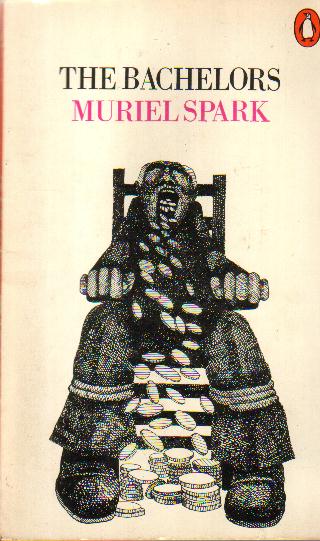
(left) This is Patrick during a séance, mouth open, delivering messages from the other side, with his audience gathered around him. This next one, however (below), goes beyond simple illustration and provides the reader with an interpretation:
Here (right) we have Patrick, tied to his chair as he is during his trances, but this time, coins, not words, are cascading from his open mouth. The impression given is that Patrick makes money from his spiritualist performances, so the further implication is that Patrick is not genuine. This reading will colour the reader’s perception of the text right from the start.
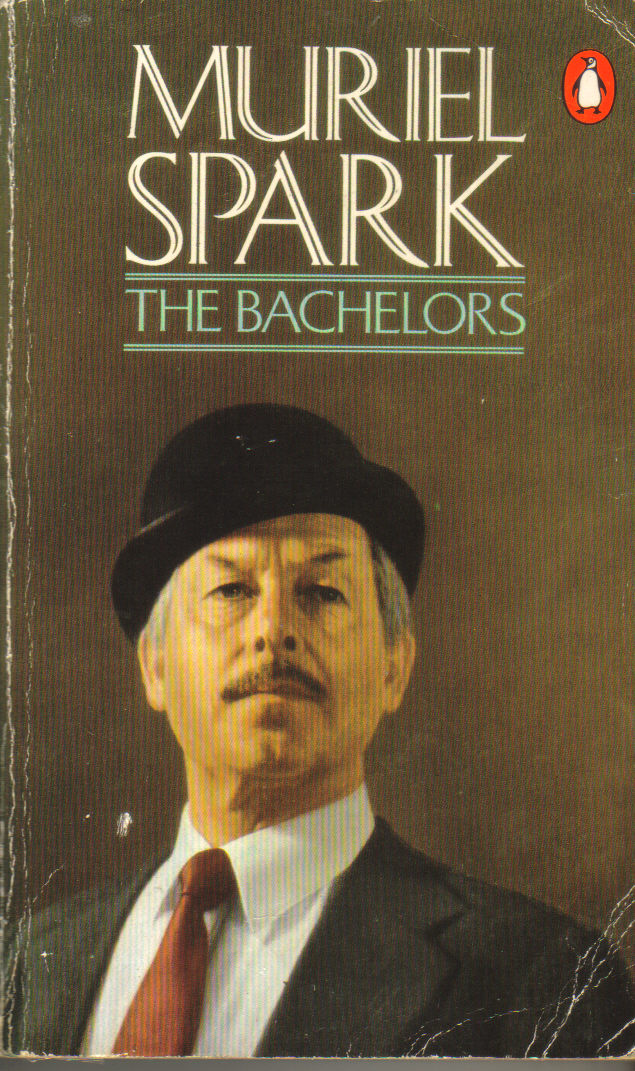
The final cover for this book, however, is more likely to simply confuse the reader:
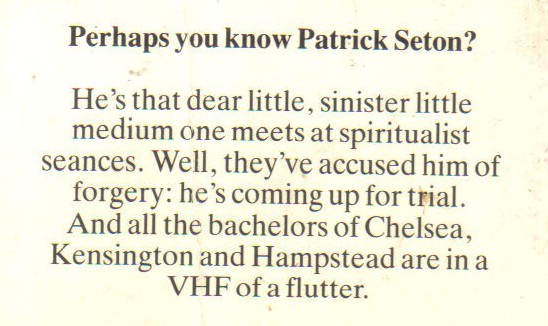
(left) I mean – what’s this about? It’s just a man of a certain age in a suit and a hat. It’s as if someone just searched for ‘bachelor’ in the Clip Art library and came up with this one. Not wrong, because the book is entitled The Bachelors, but not really right either. And the blurb on the back cover is weird too (see below):
Just who is supposed to be talking here? ‘He’s that dear little, sinister little medium’? Is it supposed to be the voice of one of the members of the Wider Infinity, Patrick’s spiritualist group? I suppose it could be, but clearly the last sentence is a narratorial voice rather than the voice of a character, which doesn’t help matters and makes the whole thing look a bit cock-eyed and cobbled together at the last minute. And what’s a ‘VHF of a flutter’ when it’s at home? Really, this is rubbish.
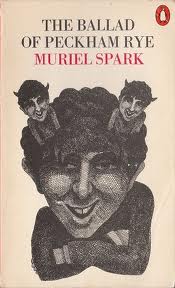
On to the next novel, The Ballad of Peckham Rye, also published in 1960. This story features a character called Dougal Douglas (or Douglas Dougal), who arrives in Peckham Rye and causes mayhem before departing. He has two lumps on his head which he claims to be the remains of horns removed by a plastic surgeon, but we don’t have to believe this. The designer of this cover, however, wants the novel’s readers to believe that Dougal really is an instrument of the Devil (below left):
Here Dougal’s ‘horns’ are two miniature versions of himself, each with their own set of horns – which in turn will have horns, and so on and so on. Dougal is looking at us and grinning, as he is here (below right):
The grin is not so obvious, but can be inferred perhaps from the raised eyebrow and cheek muscle. This cover goes some way towards depicting the canteen scene in the novel, in which Dougal attracts a great deal of female attention by bursting into tears. A third cover does not depict Dougal at all, but focuses on Peckham itself:
Here, Peckham Rye has been made to look a bit like Las Vegas – which it doesn’t – but the artist has picked up on the dancing. There’s an awful lot of dancing in this novel, and of course the Devil loves to dance! But dancing is part of social behaviour and it comes with a whole set of rules and regulations of its own, to which the Peckham inhabitants add their own little rituals. In Peckham Rye, dancing is never very far from fighting (and vice versa, in fact), both of which activities are undertaken by savage and civilised societies. And dancing, of course, is so often a prelude to sex. William Boyd argues that this is a novel about sex in his perceptive introduction, and I’m inclined to agree with him. Sex, fighting and dancing. The inhabitants of Peckham Rye don’t really need a devilish figure running around to cause trouble, because it’s all happening already. Dougal, for all his funny ways, is merely a catalyst.
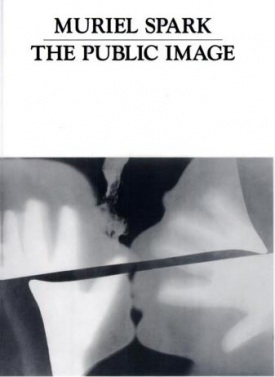
So now we come to my last novel for today, The Public Image, published later than the other two, in 1968. This story is about a second-rate actress, who has somehow become very successful, fighting to save her public image when her husband commits suicide.
The first cover (left) shows a diminutive woman struggling under the weight of a huge star bearing a wide toothy grin. The woman herself is frowning fiercely: she looks off-balance and is obviously unhappy with her position. This picture always reminds me of Atlas trying to bear the weight of the world on his shoulders, but Atlas, of course, had no choice. The idea that the public image is something from which the actress would like to escape is another example of a reading that is given to the reader in the cover image. A second cover looks like this (below right):
It’s very similar in some ways: a large smiling face, eyes hidden by sunglasses as is so often the case, and the shell appears in Frederick’s suicide note to Annabel: ‘You are a beautiful shell, like something washed up on the sea-shore, a collector’s item, perfectly formed, a pearly shell – but empty, devoid of the life it once held.’ (p. 92). The shell image reappears at the end, but I can’t say more without spoiling it. Finally, this third cover is very different:
This image (left) focuses not on the public image, but on the ruptured marriage – an image in negative of two people kissing is torn across the centre. This cover design incorporates Frederick’s role in Annabel’s public image, which the other two do not.
I’ll end with an image of Muriel Spark herself (below). Isn’t it fabulous?




 Aunty Muriel's Blog