
*Please note: spoilers below*
Before I begin, I should point out that I’m not the sort of person who usually succumbs to apoplectic rage over the perceived imperfections of a film adaptation of a book. I was, in fact, immensely irritated by those Harry Potter fans who squawked ‘That’s not in the book!’ and then insisted on listing every single detail that the latest film had left out in order to fit an 800-page book into two-and-a-half onscreen hours. No, I don’t get worked up about this sort of thing because books and films are two different media, and if you really want The Film Of The Book, well, why not just read the book? The idea behind an adaptation is to create something based on the original, but it should be something that explores the text in a different format and perhaps ends up saying something new about it, encouraging the audience to go back to the book and read it again with new eyes. In short, there is NO POINT in simply filming the book. Faithful adaptations are all well and good, but I always think of them as a missed opportunity to say something new.
Having said all that, I HATED Hitchcock’s adaptation of Highsmith’s Strangers on a Train, and I hated it so much that I have to write a post about it in order to get it off my chest. I know Hitchcock was an innovative and inspired director, and that he contributed a great deal to the art of filmmaking, but on the evidence of this film I’d have to say that as a reader of narratives, he was a bit of a duffer.

Highsmith’s novel is a brilliant piece of exceptionally accomplished writing, made all the more astonishing by the fact that this was her first novel, published originally in 1950 when Highsmith was still only 29 years of age. Hitchcock’s film appeared the following year, and the film’s Wikipedia page notes that Hitchcock purchased the rights for only $7,500 after having been careful to keep his name out of the proceedings. Highsmith was understandably annoyed about having been cheated like this. Raymond Chandler produced a screenplay for Hitchcock based on the novel, but almost none of Chandler’s work made it into the final script: you can read his marvellously rude letter to Hitchcock here. (Chandler’s name remains on the credits, though, at the insistence of Warner Bros.)
Highsmith’s novel is based on a very simple premise: two strangers, Charles Anthony Bruno and Guy Haines, meet on a train. Bruno has an idea for the perfect murder: he will murder Guy’s wife Miriam, who is causing trouble over their divorce, and Guy will murder Bruno’s father, who is keeping Bruno on a too-tight rein. If both men are absent with alibis at the time of each murder, there is nothing to link them and their chances of getting away with it are therefore greatly increased. Guy is horrified by the idea, but Bruno goes ahead and murders Miriam while Guy is elsewhere, and Guy is eventually coerced into fulfilling his part of the bargain. Among the many themes of Highsmith’s novel is that of the double, or doppelgänger – the Hyde to one’s Jekyll, a darker side who enacts one’s secret desires, a theme that is brought out through liberal use of free indirect discourse and the ceaseless and seamless interweaving of voices. Hitchcock introduces the double idea at the beginning of his film by showing us Guy’s feet and Bruno’s feet in parallel scenes as they make for the train, but the idea is never pursued as thoroughly as it is in Highsmith’s novel – essentially because Guy has to be a Hollywood hero and isn’t allowed a dark side.

Guy’s status as hero proves detrimental to the entire film, the biggest single problem being that a hero cannot be a murderer, so Guy does not gun down Bruno’s father as he does in the novel – he tries to warn him instead*. But the most terrifying thing about Highsmith’s novel is Bruno’s relentless pursuit of Guy, so in the end Guy is left with no choice but to carry out the deed.
Highsmith’s Guy Haines is an architect at the beginning of what promises to be a brilliant career, but Hitchcock’s Haines is a tennis player, already well-known and riding a tide of success. This switch of profession is an inexplicable decision on Hitchcock’s part, because Guy’s status as an architect is crucial to an understanding of his character as a sensitive and creative soul whose buildings are inspired by his faith. Highsmith underlines this by ‘quoting’ an article about Guy taken from an English architectural magazine, part of which is reproduced below:
Haines [has] set forth principles of grace and function to which he has steadfastly held, and through which his art has grown to its present stature. If we seek to define Haines’ peculiar genius, we must depend chiefly upon that elusive and aery term, ‘grace’, which until Haines has never distinguished modern architecture. It is Haines’ achievement to have made classic in our age his own concept of grace…
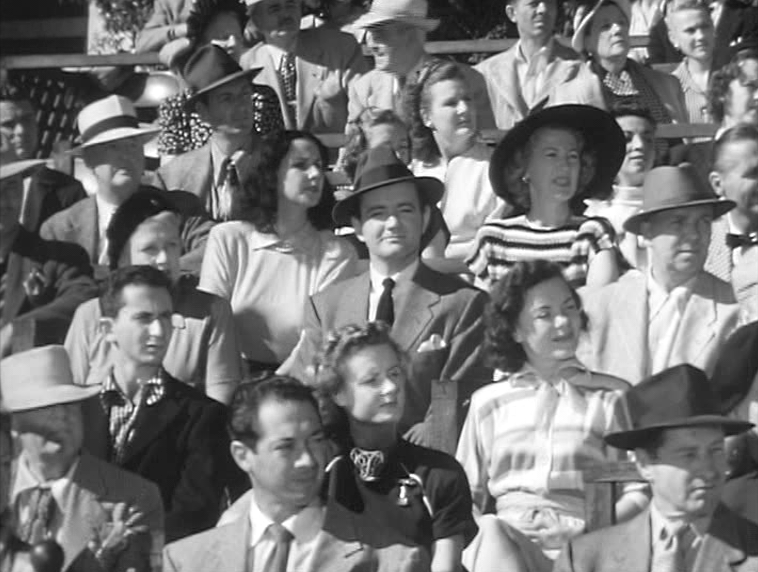
Note that the word ‘grace’ features three times in this very short paragraph, and this is surely important. The novel begins with a temptation scene – Bruno, bearing the mark of the first murderer Cain in the form of a boil in the middle of his forehead, outlines his idea for the double murder – and Highsmith’s story ends with a confession, in which Guy blurts out the truth to Miriam’s ex-lover, Owen Markman. Now, I’m not a religious person and I don’t pretend to understand these things, but my reading is that Guy is tempted and falls, but his confession, and the beautiful buildings he creates, lead him finally to a state of grace. With Guy as tennis player, all this is lost, and we’re left with Farley Granger’s knobbly knees in tennis shorts and some rather dodgy shooting of a match that Guy is trying to win as quickly as possible for reasons that are not in the least bit clear. There is one superb, and very famous, shot which comes out of this tangle, however: all heads are turning to watch the ball except for that of Bruno, whose eyes are fixed on Guy…
And now for Bruno. Robert Walker puts in a marvellous turn as Hitchcock’s bad guy, but he is a cut-price two-dimensional version of Highsmith’s Charles Anthony Bruno. Hitchcock’s Bruno is a murderer who is inept enough to display his name for all to see in the form of a tasteless tie-pin:

Bruno as Highsmith wrote him is young, rich, bored, an avid reader of detective novels (hence his fascination with the perfect murder), and he is terrifying. He is both stupid and an alcoholic and this combination means that he is extremely dangerous because he is unpredictable. His wealthy, cushioned life has made him arrogant. He thinks nothing of murdering Miriam – indeed, it is only a game to him – and he plots the killing of his own father so that he can have full and immediate access to the allowance his father metes out so carefully. The detective Gerard notes that Bruno hates women, and indeed, his latent homosexuality is as clear to the reader as is his Oedipus-like status: the only woman Bruno will tolerate is Elsie, his mother, who in Highsmith’s novel is an attractive, still fairly youthful woman. Hitchcock turns Elsie into a senile old baggage, thus depriving us yet again of an area of potential intellectual interest.

However, I did find something that I liked about Hitchcock’s handling of the Bruno character. Bruno’s ‘bed-trick’, in which he pretends to be his father so he can confront Guy, was a point which sparked my interest, namely because I wondered when I was reading the novel whether it would turn out to be Bruno underneath the bedclothes. Given Bruno’s implied death wish and his adulation of Guy, I entertained the possibility that Bruno would consider it a great adventure to be shot dead by the man he clearly adores. But far more likely that Hitchcock wanted Bruno to call Guy’s bluff at this point so Bruno could direct his attention instead to trying to frame Guy for Miriam’s murder, because from this point onwards, the film departs completely from the narrative as set out in Highsmith’s novel and instead we get a lot of farting about with a lighter which Bruno is desperately trying to deposit as evidence of Guy’s presence at the scene of the crime. As if that would prove anything.
Hitchcock’s plot is ludicrous and scarcely credible. The events of Highsmith’s novel have been twisted beyond recognition simply so that the director of the film can stage set-pieces such as the fast and noisy destruction of the carousel at the end. And I hate the way Hitchcock directs women, how he reduces them. The Anne of Highsmith’s novel is an independent woman with her own successful career: Hitchcock turns Guy’s fiancée into the simpering daughter of a rich Senator, all ready to be passed from one man to another…

…and the film introduces the character of Barbara, Anne’s sister, who plays Scooby Doo’s Thelma to Anne’s Daphne. Of course, the other important thing about Barbara is that she wears spectacles and Bruno’s reaction to the sight of her (because Miriam too, wore spectacles) miraculously informs Anne that he is the murderer:

What utter, utter tosh. But here we come to the only other thing I liked about the film, and that was the way in which Miriam’s murder was filmed, reflected in the lenses of her spectacles which have fallen to the ground:

This shot is really rather good, especially because it leads one to ask exactly who is doing the seeing. We watch the scene through the eyes of the spectacles, as it were: ironically, the spectacles are seeing something that Miriam can no longer see. The spectacles are an inanimate witness to Bruno’s crime.
While I’m on the subject of Hitchcock and women, I feel I have to say something about Miriam as victim. Most notable here is that while Highsmith’s Miriam suffers a miscarriage before she is murdered, Hitchcock’s Miriam is still pregnant when Bruno strangles her. So, for Hitchcock, a pregnant woman and the old man working the carousel are fair game, but Bruno’s rich father is out of bounds in order to protect Guy’s status as hero. That stinks. It just stinks.
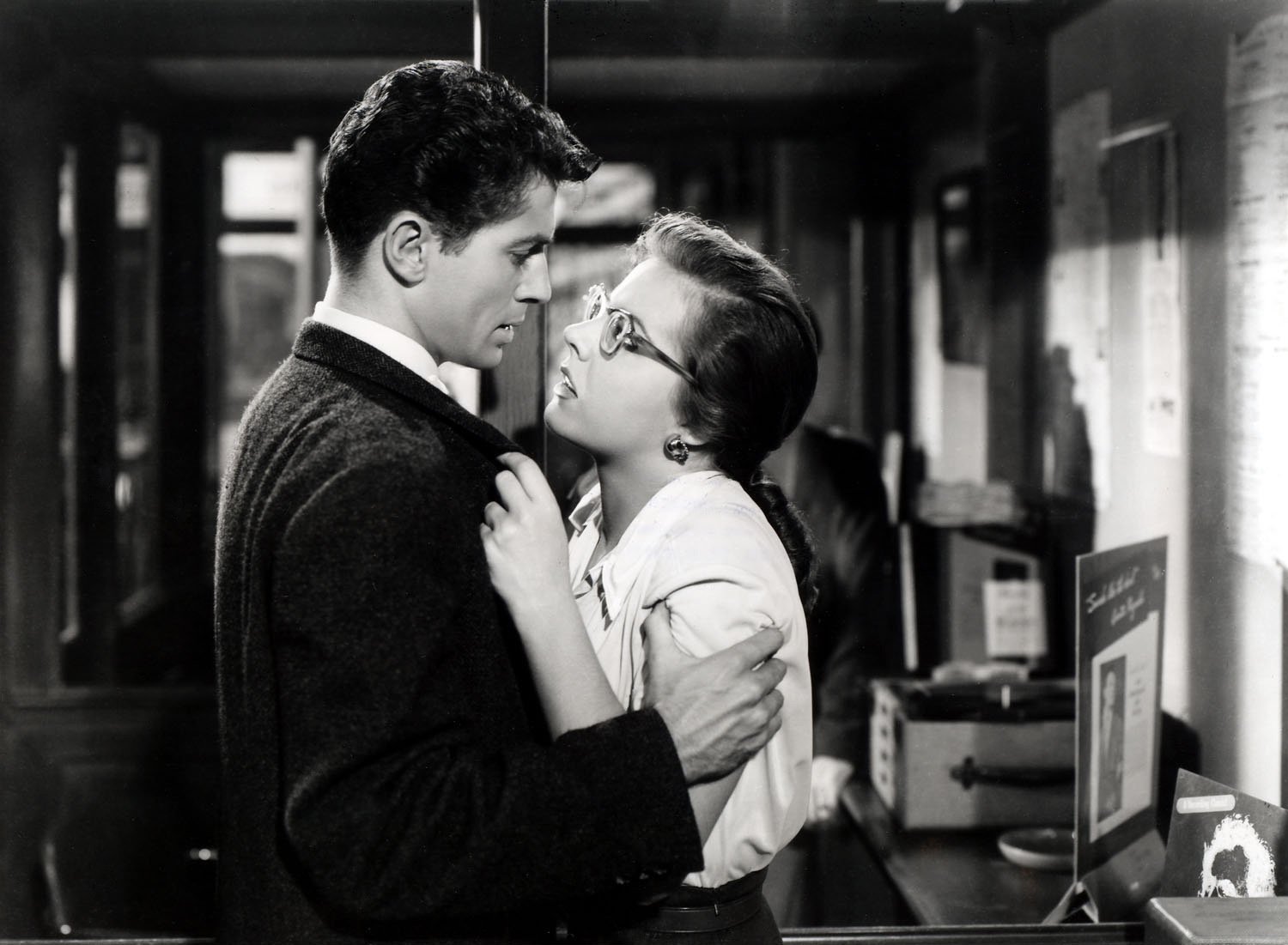
I’m reading Highsmith’s The Talented Mr Ripley now. I hope Clément (1960) and Minghella (1999) did a better job of adapting this one for film, otherwise I really am in danger of turning into someone who says things like ‘That’s not in the book!’

*Compare this with Hitchcock’s Rebecca – Maxim de Winter, played by Laurence Olivier, does not murder Rebecca as he does in du Maurier’s novel. If memory serves, Rebecca falls and fatally hits her head, so our hero can remain blameless.

 Aunty Muriel's Blog