My Top Five Favourite Comic Books: #1 The Work of Will Eisner

Image


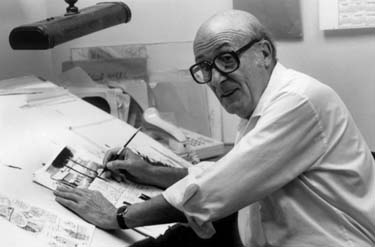
Will Eisner (1917-2005) would have been about twelve years old when Tintin first appeared, and, like Hergé, Eisner’s contribution to the world of comics is immeasurable and invaluable. Eisner’s status as a comic book artist is such that each year the Eisner Award is presented in recognition of significant achievement in this particular medium. Eisner’s stories usually feature city-based people struggling with poverty and hardship: often the ending is an unhappy one, but the tales themselves are rarely sentimental. Eisner’s characters have been brought low and made mean by hunger and hardship and there is a hardened edge to many of them, but one would have to be stony-hearted indeed not to sympathise. Eisner writes about those who lose everything during the Great Depression, those who struggle to raise a family in an impoverished and often violent neighbourhood, those who are the victims of racism, antisemitism, domestic abuse, those who are born poor and die even poorer. And after reading Eisner, one is left with a strong sense of the warmth and sympathy he felt towards his creations, how much he understood human nature and the desperate fight for survival. 

Eisner is, after all, writing from his own life. His parents were poor immigrants to the US and his father, also an artist, had a hard time making ends meet. Eisner was born in Brooklyn and his childhood in New York was a difficult one. He shared those experiences in his heartfelt and beautifully drawn graphic novels; he also wrote books of instruction on sequential art and lectured at the School of Visual Arts in New York City. There’s a bibliography at the end of this post and you can read more about Will Eisner on his Wikipedia page here

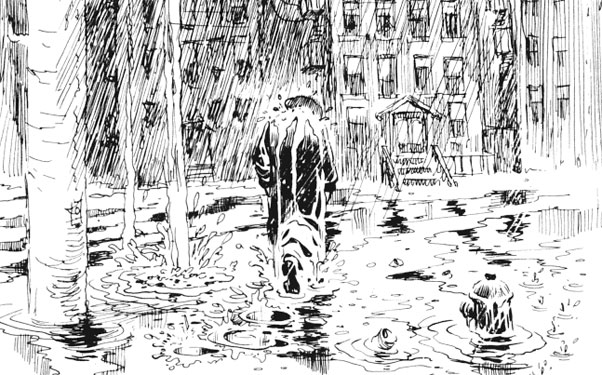
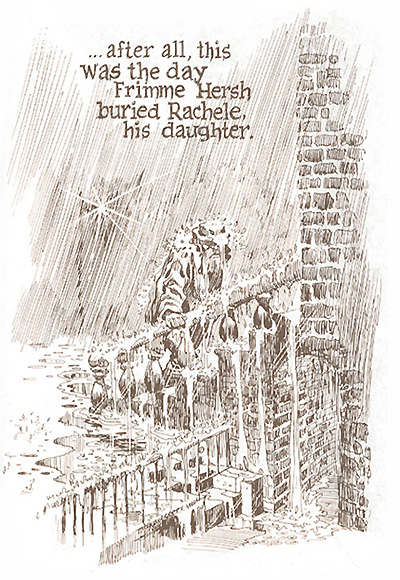
One thing about Eisner is that he does ‘weather’ better than anyone else I’ve come across so far. Look at this from The Contract With God

Image

The torrential downpour mirrors and magnifies the tears of Frimme Hershe, who is returning from burying his daughter, Rachele, the fictional counterpart of Eisner’s own daughter, Alice, who died of leukaemia when she was a teenager. Overwhelmed by grief, Hershe breaks his contract with God and becomes a ruthless landlord, but he never loses our sympathy because we have seen what he once was and we know what shape his demons take. 
Image

Eisner draws beautiful snow as well. In his story Sanctum, poor Pincus Pleatnik believes there to be safety in anonymity and he spends his life trying to keep out of everyone’s way. When his death is reported in error in the obituaries, events catch up with Pincus in quick succession, and, locked out of his home, he is forced to spend the night sleeping in the snow in one of the city’s parks. Unable to contact anyone to verify his continued existence and unrecognised by most owing to his habit of avoiding human contact, Pincus eventually meets his death when he attempts to escape from the union thugs who have kidnapped him, but who didn’t intend to harm him. It’s a very sad story and the salt in the wound comes at the end when the editor whose report led indirectly to Pincus’ death is awarded an ‘errorless editor medal…and a $5000 bond’ on her retirement. I actually jabbed the page and yelled ‘He’s dead because of you!’ Eisner elicits an emotional response from the reader through use of irony as here in the story of Pincus, or through jarring juxtapositions such as those in the scene below: the man trudging through the streets and drinking in the bar is pursued throughout by the notes of a jolly tune, but when we see him here he is returning from the hospital where he has seen his wife’s body. She is beyond the help of the ambulance which rushes past her husband at the top of the picture, the siren temporarily taking the place of the string of musical notes.

Image

I’m sorry this post is such a sad one, but this is why I like Eisner’s work so much. Sometimes there’s nothing like having a good blub, and I have shed many a tear over Eisner’s tales. And in fact, I’ve saved the saddest for last. Ernest Hemingway was once challenged to write a short story in six words that would make everyone cry…and Eisner illustrated it, as seen here below. Those of you who’ve spent a long time on your eye make-up today might want to look away now unless you want to be reapplying your mascara very shortly…

Image

The story Hemingway wrote was ‘For sale, baby shoes, never used’, and Eisner has in fact added one more word to this story by labelling the pawn shop, just in case anyone missed the three-ball symbol in the corner. What is so heartrendingly awful about this brief strip is the woman’s broken and defeated gait as she enters the shop, carrying her box containing the baby shoes. Her beaten-down posture is the same when she exits the shop holding the cash she received in exchange. I’ve turned down the corner of this page in my book so I can skip over it more easily: the sight of that poor woman doubled over with grief is too much for me and mascara is too expensive to have to be applying it more than once a day.

Dry your tears now and remind yourself that this is only a story…

Coming soon! – My Top Five Favourite Comic Books: The Also-Rans and an Outsider

Bibliography:

(All titles by Will Eisner)

  • New York: Life in the Big City
  • The Contract with God Trilogy
  • Graphic Storytelling and Visual Narrative
  • Expressive Anatomy for Comics and Narrative
  • Comics and Sequential Art
My Top Five Favourite Comic Books: #2 (joint position) Tintin by Hergé (Georges Remi)

Image

Those who know me will be surprised to find Tintin in joint position at number two instead of in the hotspot at number one. I’m a HUGE fan of Tintin and I’ve got the tattoos to prove it. But number two it is, and as with Asterix, I’ve chosen one book to represent the entire oeuvre. In this case, however, I mean the oeuvre minus Hergé’s more offensive early offerings – we all know which titles they are, and a great deal has already been written on the subject, so enough said. The book I’ve chosen in this instance is The Red Sea Sharks. Why this one in particular? I could have chosen Tintin in Tibet – the only book without a villain – or the wonderfully farcical Tintin-Stays-At-Home story, The Castafiore Emerald. But The Red Sea Sharks it has to be, mainly because the whole gang is here. Every character gets a look-in: even Jolyon Wagg has his moment at the end, and, as always, his chief purpose is to annoy Captain Haddock and deprive the poor man of some much-needed peace and quiet. There are, in fact, some Tintin characters we don’t want to see too much of: Jolyon is one of them and so is the ghastly Abdullah, who, thankfully, is not around for too long, and even he is useful in providing plenty of scope for Captain Haddock to fall downstairs, lose his temper, shout a lot, have things blow up in his face, and so on, and it’s all just so funny.

Image

In fact, Captain Haddock steals the show in this book, full stop. He is ‘onscreen’, as it were, for as much time as Tintin, and he makes us laugh all the way through. He is the subject of a wonderful Medusa joke on page 39 when he falls into the sea – for the second time – and emerges with an octopus on his head. (The characters are on a raft at this point, of course, and whenever you get a raft, you invariably get a reference to Géricault’s marvellous painting, The Raft of the Medusa.) When Captain Haddock spots Bianca Castafiore aboard the yacht that rescues the castaways, his reaction is to ask whether or not they should ‘hop back on the raft’. On the frigate, he yells obscenities at the slave trader through a megaphone until this ‘trafficker in human flesh’ is well out of earshot. And an especial bonus: the frigate is captained by the Best Bad Guy in Tintin, Captain Haddock’s old first mate Allan.

Image

Once Allan and his crew have deserted the frigate, Captain Haddock demonstrates exactly why he bears the title of Captain: he knows what he is doing, and it is he, not Tintin, who runs the show from that point onwards. He gets the Ramona’s engines going again after the fire and manoeuvres the ship safely through a barrage of deadly torpedoes.

Image

This book has everything: plane crashes; bombs that ‘tick tick tick’; punch-ups; daring escapes by our heroes dressed as women; chases on horseback; practically every vehicle you can imagine, including a raft; lots of different kinds of weapons; oodles of suspense and let’s not forget the sumptuous settings.

Image

‘By Toutatis!’ versus ‘Great Snakes!’: Asterix and Tintin Compared

Many have asked me why I bother with Tintin, it being their opinion that Asterix is far superior. I’ve lumped Asterix and Tintin together at number two because the truth is I just can’t separate them. I’ve been reading these books since before my age could be counted in double figures and I get more and more out of them all the time. I find another joke every time I read Asterix, and when I revisit my Tintin books, I always find something else to appreciate in the beauty and accuracy of the drawings. Hergé was a pioneer of the ligne claire style, and the cleanliness of his lines is complimented by his use of flat colours. Scott McCloud refers to Hergé’s achievement on page 190 of Understanding Comics:

‘In Europe Hergé captured the magic of such flat colors with unprecedented subtlety. Hergé created a kind of democracy of form in which no shape was any less important than any other – a completely objective world. Comics printing was superior in Europe and for Hergé, flat colors were a preference, not a necessity.’

Image

So I consider it a mistake to dismiss Tintin out of hand without considering the extent of Hergé’s artistic achievement. Nor do I wish to denigrate Uderzo’s artistry: in fact, I find it very difficult to compare Asterix and Tintin at all. But I’ve had a go here under a few different headings, because if nothing else, the observations below will help demonstrate why these two old favourites are united at number two in my top five.

First appearance: To begin with, these two characters emerged at very different stages of comic book history. Tintin was in there right at the start, appearing first in 1929 when the comic book was very young indeed; Asterix appeared some thirty years later when comics as a creative form had really found their feet. The early Tintin books are rough and ready, yes – but this sort of narrative told in art form (or sequential art) was something brand new.

Image

Audience: Asterix and Tintin books were essentially targeting different corners of the market. Asterix was always aimed predominantly at the adult reader, whereas Tintin began life as part of a children’s supplement in a newspaper. This is not to say that Asterix cannot be read and enjoyed by children or that Tintin is too childish for adults: neither of these statements is true, but if someone is going to set about trying to compare the two, this is something that should be borne in mind.

Image

History and Geography: Asterix and Tintin differ wildly in their treatment of these subjects. In Asterix, everything is scarily accurate; in fact, I learnt most of my history from Asterix, to be honest. I took my copy of Asterix in Corsica with me when my husband and I spent our holiday there two years ago, and Corsica really does look the way it does in Uderzo’s beautiful drawings. Tintin, on the other hand, plays relatively fast and loose with both history and geography. The books feature a couple of made-up countries, Syldavia and Borduria, and Tintin wasn’t the first man on the moon – although obviously, Tintin’s moon-landing pre-dates the real thing. Some of the events in The Blue Lotus have a fragile basis in historical fact, but on the whole, Hergé freely invents whatever he needs to invent to tell a good story.

Style: I’ve already mentioned ligne claire, and Hergé’s mania for pictorial accuracy is well-known: his archives contain hundreds and thousands of pictures which he used as a reference point for his drawings. Asterix is more cartoon-like in its execution and Uderzo captures a great deal of expression in those cartoon human faces. Tintin himself has a limited expressive range – he’s only two dots for eyes, a button nose and a line for a mouth, after all. In fact, it’s amazing what Hergé does with those few dots and lines.

Image

Humour: In Tintin, the humour is derived mostly from slapstick, the winding-up of Captain Haddock, Professor Calculus’s deafness and the verbal antics of the Thom(p)son Twins; in Asterix, we laugh largely at the ingenious word-play.

Image

Development: Asterix doesn’t develop in the way that Tintin does. Tintin doesn’t have any kind of background or a personal history outside of the oeuvre, but he gradually collects a ‘family’ around him and sets up home with Captain Haddock and Professor Calculus at Marlinspike. When we first meet Tintin, he is a reporter, or journalist, living and working alone. By the end of the last Tintin book, he is in a very different position. Asterix, on the other hand, doesn’t develop and doesn’t need to: he just is. Uderzo’s forays into Asterix’s childhood with Obelix produced some rather unsuccessful books aimed at a much younger readership. If it ain’t broke, don’t fix it, and Uderzo would have done better to stick with the winning formula: the village is threatened, Asterix and Obelix beat up lots of Romans, the story ends with an enormous banquet and the bard gagged and bound beneath the tree so he can’t ruin everyone’s evening by singing.

This is why Asterix and Tintin have to be together at number two. They are too different to be really comparable, and I can’t separate them. So what’s going to be number one? There’s a clue for the beady-eyed hidden somewhere in this post…

My Top Five Favourite Comic Books: #2 (joint position) The Asterix Books by Goscinny and Uderzo

Image

I started reading Asterix during my middle school years, and I well remember the scuffling and elbowing which regularly took place in the school library as everyone fought to grab at the titles on the Asterix shelf. My Aunty Clo and Uncle Jim bought me Asterix the Gaul, my first Asterix book, for Christmas in 1980 when I was nine years old, and I have read and re-read these books ever since. I saved my pocket money to buy them from WHSmith when I had to give up on the library because everyone else’s elbows always seemed to be far sharper and harder than mine and I could never get to the Asterix books without suffering various blows to my weedy little person. In those days – and this may still be the case – Asterix books came in two sizes, and you could buy a copy of the book in a size slightly smaller than A5 which cost 75p. These days, I have in my possession every Asterix book in both English and French. The books are scruffy, foxed and yellowed, but all that’s just proof of how long I’ve had them, how often I’ve read them and how much I love them.

I say ‘every Asterix book’, but that’s not entirely true. Goscinny was the partner who wrote the scripts and the quality of the storywriting rapidly faded after his untimely death: Asterix in Belgium was the last book Goscinny and Uderzo produced together. Uderzo still struggles gamely on alone, but the Asterix books have come to be aimed at a much younger market and all the joy of the original has vanished. The drawings are as beautiful as ever, but the sophisticated wordplay is long gone. There’s a new book due out very soon, if it’s not out already, and I’m not going to read it. I just can’t bear to see what has become of Asterix. I stuck with it for as long as I could, and I’ve enjoyed some recent compilations: Asterix and the Class Act, for example, which appeared in 2003, brought together some previously unpublished short stories, and 2007 saw the publication of Astérix et ses Amis, in which a number of artists paid tribute to this character with their own very amusing versions of the plucky little Gaul and his companion envelopé. But to be honest, everything from Asterix and Obelix All At Sea onwards just hasn’t been up to scratch.

I’ll return now, though, to the good stuff, because I have, after all, placed Asterix in joint second place as one of My Top Five Favourite Comic Books. I’ve chosen one Asterix book dating from the years of the Goscinny/Uderzo partnership to represent the entire oeuvre, rather than trying to write about the whole lot in one blog post. The book I’ve chosen is Asterix and the Roman Agent, or La Zizanie in French; semer la zizanie is to sow discord, or to stir up ill-feeling, and a ‘zizanie’ is ‘a type of invasive weed’. The name of the Roman Agent – Convolvulus – is the Latin term for bindweed, and anyone who has bindweed in their garden knows how quickly it spreads and how destructive it is: it takes over and chokes everything else. It’s extremely difficult to get rid of bindweed once you’ve got it, because it’s also incredibly pervasive. On the subject of the Agent himself, Peter Kessler notes in The Complete Guide to Asterix that ‘[t]his is the only adventure that includes a ‘symbolic’ character. Convolvulus, the Roman Agent, is the physical embodiment of social disruption. Injecting him into the Gaulish Village has the effect of a moral tale about the danger of gossip and deceit’ (p. 41).

Image

I’ve chosen The Roman Agent for several reasons: the story is excellent, tightly constructed and beautifully executed. The repetition of a scene involving the village women standing in a queue for fish provides a neat frame for the arrival and departure of the titular zizanie, and of course, it’s very funny: the reader knows there’s going to be a fight as soon as Unhygienix’s fish appear in any Asterix book, and frankly, I’d be hard pushed to name anything funnier than Uderzo’s fabulous drawings of the Gauls slapping each other with fish. In fact, The Roman Agent contains some of Uderzo’s most amusing images: the mother hen and her row of six little chicks calmly watching yet another fight on page 20 for example, and the bemused expressions on the faces of the pirates on page 10 when the Romans are too busy bickering with each other to pay the pirates any attention. The book also has some of the funniest lines: when spying on the Roman camp, Fulliautomatix warns Unhygienix ‘Try not to smell!’ (p. 27); the captain of the ship escorting Convolvulus to Gaul says of the look-out in the crow’s-nest that ‘No one’s to listen to him! He’s been sent to Coventrium!’ (p. 9) and on page 30, Obelix complains ‘No one ever explains anything to me! They just keep me around because I’m ornamental!’ Obelix isn’t the only one in the dark and the writers milk the ensuing confusion for every last drop of humour: the Romans are too thick to keep up with Convolvulus’s plans and no one knows whether they’ve got the magic potion or not.

Image

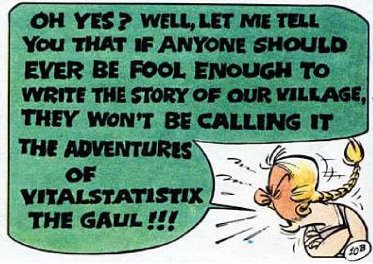
So we have some tight plotting, lots of laughs, and a couple of interesting touches to boot: Uderzo is always very inventive with speech bubbles and in this book we see the colour of the bubbles change from white to pale green to dark green as the zizanie does his work and everyone gets angry. We also see this happen in reverse: on page 18, Obelix storms out of Asterix’s hut after an argument, but he calms down as he marches away and the colour of his speech bubbles fades back to white before Obelix rushes back to make up with Asterix. On page 36, flowers appear in the Roman Centurion’s speech bubble to indicate a false honeyed tone when he asks ‘Did you by any chance fail to understand me?’ ‘Well, to be honest…’ replies the legionary. ‘Get on with it!’ shouts the Centurion (bold lettering always denotes shouting, of course). And no critique of The Roman Agent would be complete without a mention of the lovely self-referential moment on page 14 when Impedimenta bellows ‘Well, let me tell you that if anyone should ever be fool enough to write the story of our village, they won’t be calling it the adventures of Vitalstatistix the Gaul!!!’ This is just wonderful, because now the reader too is involved in the spreading calumny: on the page following, when Geriatrix’s wife claims that Mrs Asterix, if she existed, should be the first lady of the village, we know this to be true, because the books we read are entitled ‘The Adventures of Asterix the Gaul’ (not Vitalstatistix), so we are forced in this way to take sides. And as a result, we would be in line for a smack around the chops with one of those fish.

Image

As well as the moments that make The Roman Agent special, all the usual things we’ve come to expect from an Asterix book are here too: lots of fights, obviously, including fish fights and cat fights; the pirates, who this time scuttle their own ship; the banquet at the end following one final punch-up; Julius Caesar getting grief from the Senate…it’s all here. And what’s nice about this book is that the Romans provide us with at least as much entertainment as the Gauls. There are gags galore involving psychological warfare (hitting someone with a club), and the Romans’ ability to bicker amongst themselves is seemingly endless. The Romans come out of this book very well, because Convolvulus is the main baddie – but there’s even scope for a little sympathy for Convolvulus. It’s a nicely balanced book and a worthy representative of the Asterix canon.

For more about Asterix on Aunty Muriel’s Blog, see Asterix in Translation: The Genius of Anthea Bell and Derek Hockridge.

Bibliography:

Kessler, P., 1995. The Complete Guide to Asterix. London: Hodder.

My Top Five Favourite Comic Books: #4 ‘Eustace’ by S. J. Harris

Image

Eustace is new this year, and it’s astonishingly good. Like Shakespeare’s Measure for Measure, it’s a work of two halves, although with Eustace I’m afraid both halves are tragic: there’s no happy ending here, in spite of the dramatic turn of events when Uncle Lucien (‘Lucy’) shows up almost exactly half-way through.

The first half of the book is really quite remarkable. Our narrator is Eustace, a terminally ill eight-year-old boy who is confined to his bed. On the face of it, there’s not much scope for narrativity given that Eustace is so ill he can barely move and his room is bare and unfurnished; however, Eustace manages to be an entertaining narrator nevertheless. We learn about his parents’ appalling neglect, his mother’s unhealthy fixation on Frank, her eldest son, Eustace’s dread of physical contact with his aunties, the ghastliness of his boisterous cousins, his ineffectual uncles, and the unsavoury doctor, who, despite all evidence to the contrary, believes Eustace to be a time-wasting malingerer. Eustace addresses the reader directly and it becomes clear in the second half of the book that these theatrical ‘asides’ are, in fact, clearly audible to the others present, and Eustace’s guests can’t understand why the boy is chattering away to himself all the time. The reader is cast in the role of ‘invisible stranger’ rather than ‘invisible friend’ (Eustace won’t allow invisible friends in the house anymore), and we are at first rather taken aback to learn that Eustace’s words are overheard by the characters. This is one of the ways in which Harris goes about breaking the fourth wall, as it were. There’s another example of this sort of thing on page 21 when Eustace tells us that Frank is in the army, but the image of Frank changes in the following frame when Eustace realises that the uniform Frank is wearing as he stands next to the bed is probably outdated. The story constantly draws attention to itself, and we are repeatedly reminded that none of this is real. Free and imaginative use is made of space and frames: for example, parts of the picture fade or disappear, often leaving Eustace stranded and floating in white space.

Image

The pictures fade to blankness when Eustace asks the reader to leave so he can use the chamber pot. The effect of all this is twofold: first, the reader is given a role in the story and is actually addressed as a presence in the room, and second, one is led to ask just how much of what we see is actually just a figment of Eustace’s imagination. A small boy confined to bed has to find some way of passing the time, after all. There is a scene in which the aunties actually start devouring Eustace’s cousins, all of which is clearly in the small boy’s mind: he imagines on page 38 that when his aunties tell him he has a label sticking out, they are in reality pulling at his clothes in order to shove a bayleaf down his back before running to the kitchen to switch the oven on.

 Image

And there’s something in the artwork I don’t think I’ve ever seen before – a smaller frame taking up a fraction of the larger frame to suggest not just movement, but a passing moment. On page 143, Eustace begins to address his father, but gives it up as a bad job, and the reader sees in one panel both Eustace’s abortive attempt to get his father’s attention and his angry, despairing expression a second or two later. It’s very effective, and in this instance, very moving.

Eustace’s days are enlivened by the visits of his aunties, one of whom has a splendid left hook and manages to give Eustace a lovely shiner with a blow meant for one of the other aunties. Aunty Nin’s catty remark (‘in that hat, which you wear so relentlessly, my dear, you remind me of one of the four horsemen of the apocalypse – and his horse’) is what sparks the row, and Nin’s retaliatory left hook goes wide of the mark and knocks poor Eustace out. A steak is brought for his eye, and in the pages following, the reader travels with Eustace through his nightmare landscape of the unconscious. Pages 102-105 are the most beautiful and the most disturbing in the whole book. Eustace, still in his pyjamas, wanders through a bleak landscape until he comes across a horribly wounded man tied to a tree with barbed wire. The man has no legs and his blood flows freely. The man is posed as a Christ figure, or perhaps St Sebastian, but he is identified as Frank when men in uniform rumble past in their tanks shouting ‘Three cheers for Frank!’ The family resemblance between Eustace and Frank is so strong that Eustace could almost be looking at himself in the figure tied to the tree. He drives away two crows who are eating what’s left of Frank’s legs and sobs, ‘Oh Frank, what have they done to you?’ and Frank responds with ‘Eustace? That you, old thing?’ Eustace attempts to caress Frank’s poor face, but as he does so, Frank’s mouth melts and in the following frames, his entire body liquefies. Eustace wakes up with a start to find a bloody steak on his face.

Disturbing though this is, the second half of the book demands a stronger stomach still. Uncle Lucy is wanted by the police for crimes of fraud and embezzlement and is ‘lying doggo’ until he can find a way out of London. Uncle Lucy sets up camp in Eustace’s room, and is soon joined by a succession of criminals, whores, pimps and many other characters from London’s underworld. In fact, Eustace’s bedroom becomes The Place To Be, but there is a catch: Uncle Lucy won’t allow anyone to leave in case the police are alerted to his whereabouts. Now everyone is a prisoner in Eustace’s room, and this includes the reader, being, as we are, one of Eustace’s inventions. Eustace was imprisoned before by his illness, but now he is under threat of physical violence if he makes any attempt to leave. All this is very odd and the reader is left wondering whether any of it can be real, but, unreliable narrator though he is, even Eustace couldn’t make this up: an eight-year-old boy as sheltered as Eustace could not possibly be able to imagine the goings-on of the second half of the book. In fact, he quite clearly doesn’t understand what he sees. The reader knows a great deal more than the child-narrator and reads events very differently: we know what Frank and Peter are doing under the bed, and what Uncle Lucy and Oubliette are doing in the wardrobe, but Eustace doesn’t. We read the pictures differently and Eustace is no longer in control, as he was when he re-imagined Frank’s uniform.

Image

The book ends with a newspaper report detailing how the events of the book play themselves out, but this tongue-in-cheek report is obviously not designed to fool the reader into believing that anything narrated here actually took place. Nevertheless, it adds yet another inscrutable layer to this surreal tale. I can’t recommend it highly enough…but be warned: the second half in particular is graphic in every sense.

My Top Five Favourite Comic Books: #5 ‘Gemma Bovery’ by Posy Simmonds

Image

Now, I love lists as much as the next person, so what better way to while away a few of these darker autumn evenings than by writing about one of my favourite things: comic books. Over the next few posts, I’ll be giving you my Top Five plus some extra information about a couple of Also-Rans and an Outsider. I’ll try to avoid spoilers as far as I can, but please be warned that there may be a few here and there. First, straight in at number five is Gemma Bovery by Posy Simmonds.

I’m a big fan of Simmonds’s other work – Tamara Drewe, Mrs Weber, and so on – but Gemma Bovery gets top five placing for the fascinating conflict generated between the various narrators and narrative levels, and the sheer beauty of the delicate pencil and pen-and-ink drawings. It’s a story told in words and pictures rather than in strips made up of panels, but it’s seamlessly put together so there’s no sensation of being jolted about between text and image: the eye of the reader always knows where to go next. I have a penchant for beautifully executed plain pencil drawings, and Simmonds’s artwork here is truly stunning.

Image

Our narrator is the baker, Joubert, who tells us his side of the story and also reveals to us the contents of Gemma’s diaries which he has stolen from her husband Charlie, so we hear Gemma’s voice weaving in and out of Joubert’s narrative. Joubert, who I think is supposed to be a sort of textually reincarnated Gustave-Flaubert-controlling-author figure, becomes convinced that Flaubert’s novel Madame Bovary has some kind of sinister power over the lives of his new neighbours, Gemma and Charlie Bovery, and indeed there are many parallels between the two texts. The more obvious similarities at story level are pointed out for the reader through Joubert, but there are possibly many more parallels at narrative or discourse level that I’ve missed, having not read Madame Bovary for over twenty years. Madame Bovary was considered obscene and Flaubert was taken to court in January 1857, but was acquitted when it was successfully demonstrated that his use of free indirect discourse meant that what appears on the surface to be Flaubert’s words are in fact Emma’s words reported through the narrator. Flaubert could not, therefore, be held responsible for the sentiments expressed.

I’ve mentioned Joubert’s story and Gemma’s diaries, but it seems likely, given the number of scenes that Joubert does not witness directly, that there is a third narrator at work here, linking and fleshing out the two main narratives. There are other texts and voices present too: mainly letters, but bills and faxes also feature alongside examples of Gemma’s artwork, thus the whole story is a complex mesh of competing narratives all held together under the over-arching umbrella of Flaubert’s novel, which repeatedly surfaces in this new and autonomous text. There is a nice distance too between Joubert’s self-deluding narrative and what the reader can pick up either between the lines or from the images: information and impressions which work either to undermine or to flatly contradict Joubert’s narrative. There’s a good example on page 59 when Joubert tells us that he thinks Gemma’s reinvention of herself as The Blonde is a tired cliché; he says he finds her ‘quite without allure’, but the reader can see him in the picture, positively drooling behind his baker’s counter with his eyes popping out of his head. Joubert is an unreliable narrator because he chooses to fool himself and the reader recognises a long time before he does the reality behind Joubert’s rampant voyeurism: he has fallen in love – or, more likely, lust – with Gemma and wishes to replace Hervé (and later Patrick) as Gemma’s lover.

Image

Simmonds has added to the original story of a bored housewife the thrill of a whodunnit, employing the techniques of unreliable narration and repetition used by writers of detective fiction. When the story begins, Gemma is already dead and both Charlie and Joubert are mourning her. Joubert is convinced that Gemma’s death was inevitable because she bore almost the same name as Flaubert’s ill-fated heroine, and Charlie’s subsequent grief-stricken decline seems to indicate that he too will follow in the footsteps of his Flaubertian namesake. There is some mystery surrounding Gemma’s death, however: when Charlie arrives to beg for help on the day Gemma dies, he bears the marks of a struggle – so what really happened? The narrators piece the story together for us bit by bit, but the reader has to balance what s/he is being told against who is doing the telling.

In fact, all three narrators are in some sense unreliable: Joubert because he is self-deluding; Gemma because she is self-absorbed and self-obsessed; the implied narrator behind the ‘camera angles’ of each drawing because the chosen angle excludes all others and thus renders this narrative as selective as the other two. It could be argued that Gemma’s narrative is the most reliable of the three because it is delivered posthumously from her diaries, and diarists are not writing for an audience so tend not to tell fibs. Although diaries are not usually intended for public consumption, writing them is still a selective process because one does self-edit, whether consciously or not. (As a personal aside, I burned seven or eight years’ worth of my own diaries: on re-reading them when I was older and wiser, I didn’t like the self I’d unwittingly revealed in those naïve pages and knew that it would make me feel better if I just chucked them on the bonfire.)

Image

The main character in both books – Gemma in Gemma Bovery and Emma in Madame Bovary – is an impossibly irritating woman, because both women are fantasists and have fed their imaginations on a diet of rubbish literature, poisoning their minds against the reality with which they are faced. Emma reads trashy romantic fiction and she metaphorically regurgitates the literary poison she has swallowed after her death, when black bile pours from her mouth as her body is being prepared for burial. Gemma, on the other hand, reads glossy magazines, and has done ever since she was allowed to peruse such publications in the waiting room of her father’s dental surgery when she was a little girl. Gemma learns of Patrick and Pandora’s marriage from one of these magazines, a bitter moment for her: what she sees is the life she had imagined for herself, after all. But Patrick and Pandora’s marriage doesn’t work either, and the reader realises what Gemma doesn’t – that life as portrayed in the glossies is nothing but an elaborate fake. Gemma, meanwhile, continues to build her castles in the air, as depicted on page 70 in a full-page illustration with explanatory text. (Spoiler: Gemma herself chokes to death on a piece of Joubert’s bread. She too, like her literary predecessor, cannot contain what she has swallowed, either in a realistic or a metaphorical sense. And on another level, G/Emma is once again killed off by Flaubert/Joubert).

It quickly becomes quite clear to the reader of both Flaubert and Simmonds’s text that G/Emma will never be satisfied with what she’s got. And G/Emma is not the only annoying one. Simmonds gives us a whole line-up of fabulously repellent characters: the ghastly Rankins, the awful Judi and her revolting spoilt children, the spineless Hervé and his snobbish, domineering mother, and finally, the borderline sex-pest Joubert.

It’s all great stuff, and it’s my Number Five.