It’s a wet and dreary August bank holiday, and if this weren’t depressing enough, I’m having a fit of the miseries because I’ve been to see Benedict Cumberbatch in Hamlet. I bought tickets about a whole entire year ago and now it’s all over and I have nothing to do but sit here limply on the sofa and think about maybe going out to buy some crisps. There’s a big Hamlet-sized hole in my life and I’m not sure even salt and vinegar Hula Hoops can help me out with this one.
In fact, I’m not sure I have enough money left for Hula Hoops in any case, because when all’s told, this was an extremely expensive evening: Barbican Red Membership plus the cost of the tickets, train and taxi fares, food, interval wine, theatre programme…once all that’s totted up, there wasn’t much change out of three hundred and fifty quid. But I’d do it all again, because mixed reviews and mild rumpus over unauthorised filming notwithstanding, this was an absolutely cracking evening.
Alright, so lots of critics don’t like it. The Guardian’s Michael Billington wrote a very snippy review (although I have to agree with his comments about the clumsily-handled play scene); Wendy Bradley sounds off against The Barbican for its handling of ticket sales (she has a point here) and the schoolmarmish treatment of theatre-goers wielding mobile phones and cameras. Okay, so perhaps the proliferation of signs and warnings was a little over-enthusiastic, but all this policing of electronic gadgetry is being carried out in response to some truly oafish and ill-mannered behaviour from those who thought it was perfectly acceptable to distract both the actors and fellow audience-members so they could film the performance instead of actually just sitting there and enjoying it. The lovely Mr Cumberbatch himself made a plea for this to stop. So I didn’t really mind all the fuss about phones. (I was, however, peeved about how much they charged me for the programme, but never mind. I didn’t have to buy one, after all.)
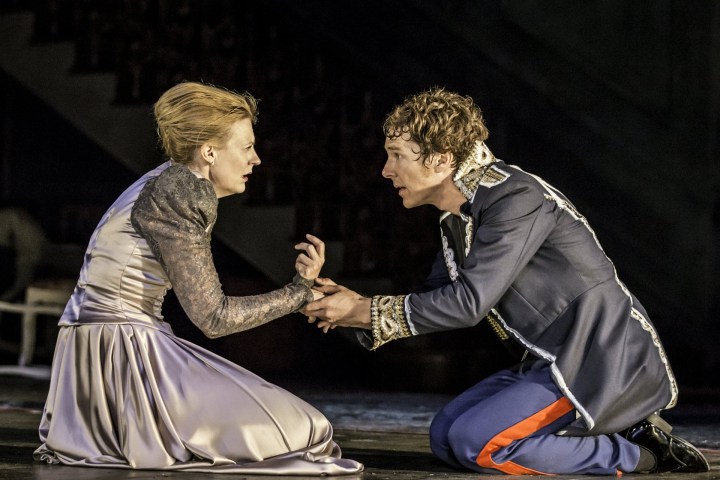
Churlish whinging aside, I’m going to write about what I did like. I’ve included some photos, all of which have been pilfered from The Guardian’s website: follow this link to view the entire gallery. There are pics of the characters here, but you can only glean a rough idea of the fantastic set. The sumptuous palace of the first half is covered in black rubble for the second – a visual metaphor for the disorder that has fallen on Denmark which Billington thought heavy-handed, but it’s undeniably effective because not only does the rubble bring about a dramatic colour change, but the actors have to fight against it. Gertrude enters bare-footed, and I think Ophelia does too, so both women are scrabbling against a thorny surface. The rubble has to be negotiated: it has to be swept aside or clambered over, and this all makes for a telling reminder that the characters have lost control over their environment. The natural order of things has been disrupted and the characters have to struggle to stay upright. Poor mad Ophelia’s exit over this mess was, for me, the most moving part of the performance:
I enjoyed Siân Brooke as Ophelia, and Anastasia Hille’s sympathetic Gertrude, and I thought Ciarán Hinds exuded a wonderful air of menace as Claudius: he really did seem like a very dangerous man indeed. (I couldn’t always catch what Hinds was saying, however: my hearing is poor and I have to wear hearing aids, which may account for the difficulty, but I didn’t have the same problem with anyone else.)
I liked very much Jim Norton’s Polonius, who made us laugh many times. This, I felt, was a shrewd move on the part of the director, because Polonius’ death when it came was felt as the truly sad turn of events that it is, and the chaos which ensues was all the more understandable. Rosencrantz (Matthew Steer) and Guildenstern (Rudi Dharmalingam) were nicely under-played – another shrewd directorial move, because ever since the appearance of Tom Stoppard’s Rosencrantz and Guildenstern Are Dead, this pair can easily upstage everyone else. As my companion pointed out, for an actor to land either one of these roles now must be a woo-hoo! moment, because even though these are only bit-parts, everyone is looking out for you – it’s like instant fame but without the hassle of having to memorise over 4000 lines. Under Lyndsey Turner’s direction, Voltemand (Morag Siller) was (or felt like) the larger role – in fact, I don’t think the deaths of Rosencrantz and Guildenstern were even reported at the end, but I may be wrong there. I was facing a pile of corpses by that stage and felt heartily wrung out.
And what can we say about Benedict Cumberbatch? Well, look, I’m obviously not going to be able to give an impartial account here, but let me just say that he is mesmerising. As my companion said, when the soliloquies don’t feel like soliloquies, you know you’re in good hands. Astonishing stuff. I would go on, but then everyone might think that I massively fancy him or something.
Repetition and narrative time in Muriel Spark’s ‘The Bachelors’, ‘The Ballad of Peckham Rye’ and ‘A Member of the Family’
This post has been removed because the content is now available in book form with many other essays and blog posts previously available on this site. The book is titled Ungrammaticalities: Linguistic Literary Criticism from ‘The Battle of Maldon’ to Muriel Spark, and it is available for purchase HERE from August 2024.
Please see this page for the cover art and table of contents.
In this essay I use the politeness theory framework as formulated by Brown and Levinson (hereafter B&L) in their 1978 study (reissued in 1987) to explore the interaction between two fictional interlocutors in Saki’s satire of the process of ‘talking-out’ a Parliamentary bill. I describe the progress and outcome of the characters’ conversation in terms of the principal face-threatening act (FTA) which takes place. In the second section of the analysis, I consider how the constructed addressee, or implied reader (Iser, 1974), is manipulated by the narrator-intermediary into complicity with one of the two interlocutors. The discussion of the conversational exchange is informed by B&L’s politeness theory with reference to adjacency pairs, speech act theory and Grice’s conversational maxims; the roles of narrator and reader are considered in terms of speech and thought representation, speech-act verbs, and literary point of view. The description of the exchange demonstrates the means by which one character prevents another from achieving a desired goal, and it is concluded that the speaker-hearer relationship between the two characters is mediated through a parallel speaker-hearer relationship comprising narrator and reader.
This is a long post, so I’ve split the content over 6 pages. Please use the page counter below to access the page following. A full text of the short story discussed appears in the Appendix on page 5. The extract under consideration is labelled and the paragraphs numbered for ease of reference. See page 6 for the list of references.
B&L’s framework hinges on their concept of a Model Person (MP), a ‘rational’ being, displaying ‘consistent modes of reasoning from ends to the means that will achieve those ends’ (1987: 61). Kopytko criticises this kind of traditional pragmatics on the grounds that a means-ends rationalistic approach is too simplistic to deal with the multi-faceted and highly complex nature of human interaction, and he argues instead for a more empirical approach (1995). Grainger lists the problematic areas of former practices in pragmatics as ‘speaker intention’, ‘constructed examples of utterances’, ‘inherent meaning and…universality’ (2013: 29), but as the title of her article suggests, Grainger is keen not to jettison those ‘fundamental, universal insights of language-in-interaction’ (36) formulated in early politeness research. I do not intend to deal with these issues here, however, because this essay is concerned with a fictional conversation. B&L intended their framework for use in the analysis of communication between real-life interactants, but the same framework can be employed in fictional analyses because our understanding of literary dialogue is rooted in what we know of the real world: we make sense of such dialogue, with all its implicatures and inferences, by bringing to the text our knowledge of how people converse in real life. However, there is an added complication: in fictional texts, the idealised speaker/hearer of B&L’s framework is joined by constructs such as the narrator and the implied reader, and these must be accounted for. Simpson’s concern that politeness analysis of dramatic texts should ‘encompass the interaction between writer/playwright and reader/audience’ (1989b: 172) finds its counterpart in Chilton’s suggestion that in the analysis of political speeches, politeness theory should be extended beyond the immediate interlocutors to ‘non-present hearers’ (1990: 214).
The starting-point for the present analysis is B&L’s notion of the MP’s ‘public self-image’ as ‘face’: this face is divided into two, the positive and the negative (1987: 61). The positive face is the personality that the MP wishes to project, and that s/he desires others to approve of; the negative face is concerned with ‘freedom of action and freedom from imposition’ (61). In a community of MPs, every member is aware of both their own ‘face’ and that of others. A face-threatening act (FTA) is an attack which can be targeted at the positive or the negative face: for example, an attempt to damage someone’s self-esteem in the case of the former, or in the latter, preventing someone from going about their business freely. B&L use a mathematical formula involving relations of social distance, power and rank of imposition to express how the extent of an FTA might be calculated (1987: 76).
In the text under consideration, there are two FTAs occurring simultaneously: Tarrington acts against Clovis’ negative face while Clovis retaliates by attacking Tarrington’s positive face. The social distance (D) between the two is heavily marked: if, as B&L claim, D is linked with ‘frequency of interaction’ (1987: 77), then Tarrington is in a bad position. He has lunched once with Clovis and his aunt and is an acquaintance his aunt chooses to avoid. Furthermore, in Clovis’ use of pronouns in his speech about pet owls, he firmly places himself and his aunt in one camp and Tarrington in another: ‘if one or two of them…leave us in any of the ways that pet owls are prone to, there will be always one or two left to carry on your name’ (¶8, my emphasis). Clovis groups himself and his aunt together, whereas Tarrington is pushed outside the social group – in fact, in giving his name to the owls, Clovis does not even count Tarrington among the same species. The harshness of this treatment is counterpoised by a narratorial emphasis on the severity of the threat Tarrington poses, in which indicators of the characters’ respective social status are juxtaposed via their attendants: the aunt’s entourage comprises a ‘wake’ of pampered lapdogs whereas Tarrington brings with him a bevy of ‘wives and mothers and sisters’. Tarrington’s FTA towards Clovis is thus magnified into an invasion of the lower classes, in the form of a whole tribe of off-stage women – presumably those who have put Tarrington up to this in the first place.
There are various different versions of Medusa’s origins and history, as is often the case with the dramatis personae of the Greek myths. Her story exists in at least two forms. In the first, Medusa was once a very beautiful young woman whose hair was her crowning glory, but in setting her beauty against that of the gods, she commits the crime of hubris and is subsequently punished by Athena (or Minerva): all Medusa’s luxurious ringlets are turned into snakes. The second version of the story is rather more prevalent: Medusa is raped by Poseidon in Athena’s temple, and the goddess, furious that her temple has been defiled, turns Medusa into a monster. This is how Medusa appears in Ovid’s Metamorphoses:
Her beauty was far-famed, the jealous hope
Of many a suitor, and of all her charms
Her hair was loveliest; …
…She, it’s said,
Was violated in Minerva’s shrine
By Ocean’s lord. Jove’s daughter turned away
And covered with her shield her virgin’s eyes,
And then for fitting punishment transformed
The Gorgon’s lovely hair to loathsome snakes.
Raped by a god and punished for this by a prim virgin of a goddess. Nice. But there is another way to look at this, if you choose to. Athena could not, presumably, take on Poseidon – at least not without massively annoying Zeus – so she turns Medusa into a weapon by granting her the power to destroy. Medusa herself can avenge her violation on every man who crosses her path. This fits nicely with the end of the story: Perseus gives Medusa’s severed head to Athena, who fixes it in the centre of her shield for use as a weapon: ‘Minerva still, to strike her foes with dread, / Upon her breastplate wears the snakes she made’ (Ovid). And this way, it becomes a story about female vengeance directed towards men, rather than each other.
So, what is generally agreed about Medusa? That she has snakes for hair, obviously. Those who look at her are turned to stone, and even after she is decapitated by Perseus, her severed head retains this power. She can only safely be viewed as a reflection, at one remove from reality, and Perseus defeats her by using his shield as a mirror to view her movements without having to look directly at her.
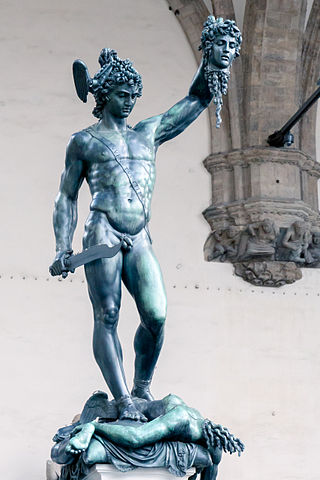
“Perseus (Benvenuto Cellini) 2013 February” by Morio – Own work. Licensed under CC BY-SA 3.0 via Wikimedia Commons
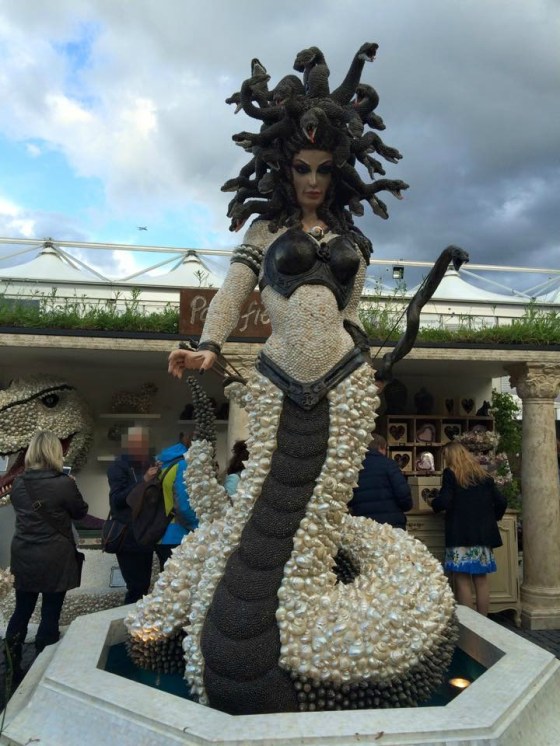
It starts getting fuzzy after this. Medusa is usually an archer, carrying a bow and a quiver of arrows. She is often depicted as half woman-half snake, like a sort of evil version of a mermaid (as in the picture above at the top), but even this is not necessarily a given (the statue in the picture directly above shows a foot). In some versions, Medusa’s blood is also poisonous and various monsters are engendered from the drops that fall on the floor. In Ovid, it is the flying horse Pegasus that springs from the body after her death: ‘and from their mother’s blood / Swift-flying Pegasus and his brother sprang’.
What we can only guess at, and where the myth opens itself up for creative re-workings and re-imaginings, is how much of her former self is left following the transformation. Is she also a monster in her mind, does she kill for pleasure or vengeance? Or – much worse – is her mind left untainted by her physical transformation so that she is horribly aware of her own hideousness and of her isolation from every living thing? She is exiled to a deserted island, but nothing can live in proximity to her in any case – she will forever turn to stone those she gazes upon. She is utterly alone. Those who venture near her island are the would-be-heroes who seek to destroy her for their own glory. Her lair is littered with stone statues, the grisly remains of the men who tried to kill her. Her very name has become synonymous with the monster, as is evident in the frequent use of the definite article when reference is made to her: the Medusa.
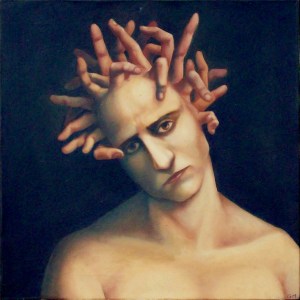
To get some idea of how Medusa features in a twenty-first century consciousness, you could do worse than start with a Google images search. Clearly, the Medusa still appeals to many. There are imaginative attempts to appropriate this figure and situate her within various discourses, but this inevitably entails some changes to the existing myth: the most obvious alteration is that the majority of Medusa-images thrown up by a search retain her trademark snakes but do away with the hideous visage. My guess is that Medusa’s power is attractive but her monster-face is not, so in the spirit having one’s cake and eating it, many of the images feature a beautiful face topped with glossy snakes that have somehow settled into an attractive hair-do. It’s a watered-down Medusa to suit those who want to be powerful and pretty.
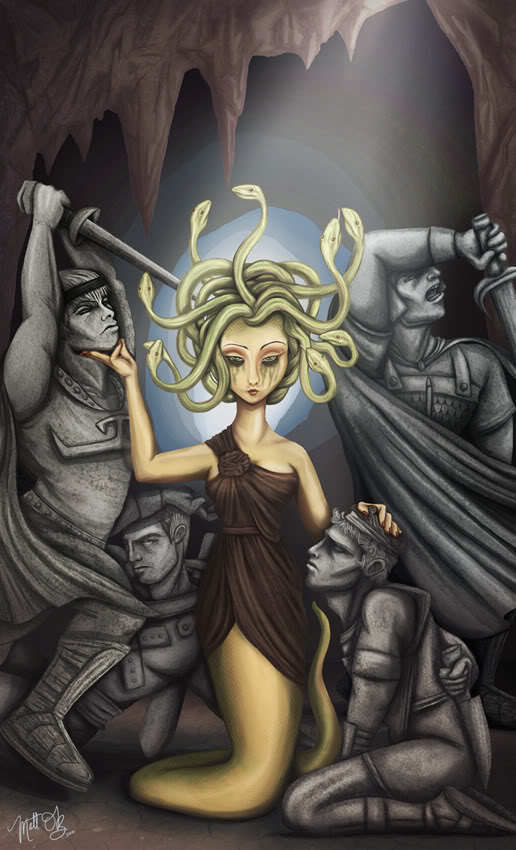
The sadness of a lonely Medusa can also be found in images here and there:
(Artist is ‘Mattchew’. Visit the thread for a detailed blow-by-blow discussion of how the picture was created – it’s really interesting!)
And I’m afraid a very, very large number of Medusa images are quite simply pornographic. I’m guessing these are pictures produced by men, but this isn’t entirely fair because after all, Rhianna must have agreed to those distressingly tasteless photographs for GQ. I’m not posting any of those images here. If you want to see them, look them up yourself, because I’m afraid this sort of thing really gets my back up. Medusa is a killer, a slayer of men, a potent though possibly not entirely uncomplicated symbol of female power: to reimagine her in a pornographic light is quite simply to drag her back into the realms of male fantasy and the discourse of woman-as-sexual-object. Boooooooooring.
Let’s move on to take a look at how Medusa features in films. In the original Clash of the Titans (1981), a stop-motion Medusa is hideous and deadly:
I saw this in the cinema several times when it first appeared and I can still remember how my heart thudded through these scenes. The finale is unbearably tense: the quiet stillness of the hero; his face gradually becoming beaded with sweat; the focus on his hand as he tightens his grip on the sword; the slithering sound and warning rattle that accompany Medusa’s slow progress – all of this made my ten-year-old palms sweat, and it’s a far more effective climactic battle than that of the noisy 2010 remake:
Yawn. Noise, running around, slow-motion leaping, endless CGI, more noise, more impossible movement – it’s all very macho and very silly. It even has a rather pointless noble sacrifice. It’s all straight out of Churn-‘Em-Out Scripts ‘R Us. The Medusa herself is ugly/beautiful by turns (mostly beautiful). Daft. But nowhere near as daft as the Medusa in Percy Jackson and the Lightning Thief (also 2010):
This is just awful. I couldn’t bear to watch any more than this tiny clip, even though Uma Thurman is beautiful enough to take your breath away. This Medusa is beautiful all the time, and what’s more, she has retained her female form – no slithering along the floor for Uma. But no matter how much the hero tries to appear scared, watching him running around a garden centre just isn’t going to make my palms sweat. And in this version, the Medusa’s victims have been reconfigured as naff garden ornaments. No no no. Nope.
But what is different here is that Medusa has a voice. She’s not supposed to, of course – she’s supposed to have a forked tongue following her transformation – but she talks here. In 1981, she couldn’t say a word, she just rattled and hissed. In 2010, she either does a lot of laughing and screaming or she engages in a bit of psychological warfare by taunting her intended victim. This brings me to the title of this post, because both Carol Ann Duffy and Robert Olen Butler have given the Medusa a voice and I’d like to briefly discuss here the differences in those voices.
(Artist: Giovanni Mazzi)
The texts under consideration are taken from Duffy’s The World’s Wife and Butler’s Severance. Duffy’s text is a poem which forms part of a series of poems imagined to have been written by the wives of various biblical, mythical or fictional males (for example, Queen Herod, Mrs Tiresias, Mrs Faust), but there are one or two real wives in there as well: Mrs Darwin, Anne Hathaway (Shakespeare’s wife). You can read the whole text here.
Duffy’s poem is structured thematically into two groups of three six-line stanzas, followed by a final stanza and then one line on its own. The first group of three deals with her transformation, and everything is heavily metaphorical: here she is not the Medusa of myth, but the bride of a philandering husband. The snakes are her jealous suspicions: ‘my thoughts / hissed and spat on my scalp’. The transformation is wrought by herself in something akin to self-harm, a physical manifestation of her mental anguish, and she projects her tortured psyche onto the landscape when she begins to turn things to stone.
The second group of three shows us her growing power through a series of repetitive shifts: ‘I glanced at / I looked at / I stared at’. Glances become looks become stares. The looks which destroy become longer and more deliberate: a glance can be performed almost unintentionally, but not so a stare. Her victims, too, become larger and larger in size as her power grows: bee—bird—cat—pig—dragon. And in the last six-line stanza, we meet her next (final?) victim: ‘And here you come’ (my emphasis). The last line of the poem, the line that stands alone, has both a declarative and an imperative function, with a different meaning for each: ‘Look at me now.’ In a declarative sense, the presupposed meaning in context is that she is asking her husband to compare her present ugliness with her former beauty. As an imperative, she is ordering the man to look at her so she can turn him to stone. As a riff on the theme of female vengeance, it’s pretty good.
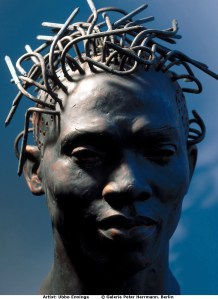
(Artist: Ubbo Enninga)
Butler’s text is a prose poem from his book Severance, the premise of which is as follows. Apparently a head remains conscious for 90 seconds after decapitation, and, given that we can speak at 160 words per minute when sufficiently excited, a severed head should be able to produce 240 words before death is absolute. Butler has written sixty-two prose poems, all imagined to have been the words produced by the decapitated heads of sixty-two persons, the last of which is Butler himself. So far, so good: Butler and Duffy have done the same thing – putting words into the mouths (dead or alive) of various mythical / historical / fictional figures. Butler’s gruesome set-up is intriguing for a while, but I’m afraid it palls very quickly, not least because of the secondary fixation with 240 words delivered in 90 seconds: this means that all the prose poems are rapid stream-of-consciousness affairs with very little punctuation so after a while you feel as if you’re reading the same breathless monologue over and over, especially when most of them seem to run along a theme of How Much I Liked Sex When I Was Alive. Here’s the whole thing:
dreaming, surely I dream now: I can still shake my hair down long and billowing like waves upon the sea, how tender I am how fair I can see in the reflection of water and shield and a man’s eyes, and this softer hair makes no difference I still turn a man to stone who looks at me, the part of him that snakes inside me, a clefting of stone, and my body weeps the sea, pours forth the thickest sea for my god-man Poseidon who smells of brine and the great swimming creatures who attend him scaled and heavy wet limbs about me and that bitch Athena thinks her temple defiled but it was he who came to me and leaned his trident upon her marble face and dripped upon her floor, she tries to hurt me but I love my living hair these serpents whisper when men come close each strand with a split tongue hissing my desire for them I shake my dear children my tresses down and they curl back up their black eyes flashing and the man cries out at my beauty and then his tongue and face and chest and arms and thighs and his toad-headed serpent all turn hard forever the clearing before my cave is thronged with them my admirers, but my children are my true loves rooted in my brain and gathered sleeping against my face muttering sibilant dreams of love
For Butler, Medusa’s snakes are not vindictive thoughts, but penises. Of course. It’s taken me this long to get around to mentioning the phallic qualities of the snake, although I could have mentioned it when I was discussing the pornographic Medusas earlier. Butler’s Medusa is surrounded by stone admirers who are permanently hard for her. Poseidon is now a former lover rather than a rapist, and Medusa’s voice is not an angry one: she believes herself still beautiful and she is full of love for her children, the snakes. I could be generous and say this poem is a celebration of female sexuality, but frankly, it reads more like a love-affair with the penis that a male writer would imagine women to have. Poseidon even has a (phallic) trident that he leans against Athena’s marble face in the temple – but I must admit, I quite liked that bit.
So, Duffy’s Medusa is a woman rendered hideous and vindictive by long-standing neglect and ill-treatment, and Butler’s Medusa is in love with men’s trouser-snakes. Medusa was always a figure that was going to divide the sexes, and we have a perfect example of it here. For me, I will always cherish the terrifying monster of 1981, because let’s not forget, in that film Medusa’s severed head destroys the Kraken – thus saving the lovely Andromeda. Hooray!
This slideshow requires JavaScript.
Bibliography
Butler, Robert Olen (2008). Severance. San Francisco: Chronicle Books.
Duffy, Carol Ann (1999). The World’s Wife. London: Picador.
Ovid. Metamorphoses. Translated by A. D. Melville (1986). World’s Classics. Oxford: Oxford University Press. [Roman names in Ovid, Greek names used in this post.]
This post has been removed because the content is now available in book form with many other essays and blog posts previously available on this site. The book is titled Ungrammaticalities: Linguistic Literary Criticism from ‘The Battle of Maldon’ to Muriel Spark, and it is available for purchase HERE from August 2024.
Please see this page for the cover art and table of contents.
 It’s a wet and dreary August bank holiday, and if this weren’t depressing enough, I’m having a fit of the miseries because I’ve been to see Benedict Cumberbatch in Hamlet. I bought tickets about a whole entire year ago and now it’s all over and I have nothing to do but sit here limply on the sofa and think about maybe going out to buy some crisps. There’s a big Hamlet-sized hole in my life and I’m not sure even salt and vinegar Hula Hoops can help me out with this one.



 Aunty Muriel's Blog