The missing enactor in ‘Our Spoons Came From Woolworths’
This post has been removed because the content is now available in book form with many other essays and blog posts previously available on this site. The book is titled Ungrammaticalities: Linguistic Literary Criticism from ‘The Battle of Maldon’ to Muriel Spark, and it is available for purchase HERE from August 2024.
Please see this page for the cover art and table of contents.
I’m kicking off this year’s Reading Challenge with a couple of books, both of which can be read in a day: Julie Maroh’s Skandalon, and Mario Saraceni’s The Language of Comics, and I’m going to use one to discuss the other. A little bit of background is necessary for the Maroh novel, however: it can be read and understood on its own terms, naturally, but Maroh provides an Afterword which situates the main character in a different, more mythical dimension and provides an explanation for his behaviour which goes beyond the rather trite summary to be found in the book’s blurb: ‘a fiery and intense contemporary myth about the recklessness of fame’. Well, no, not really. The myth in question here is not a new one for our times, it is a much older myth that has been retold in a modern setting with a main character who is the perfect vehicle: an immensely successful rock star who wields enormous power over his fans, men and women who adore him and follow wherever he leads.
Skandalon is a truly astonishing book. Much is explained in Maroh’s Afterword, which, following the writings of René Girard, sets out the philosophy of prohibition and the way in which myths and rites produce stories which become culturally embedded, thereby reinforcing and perpetuating accepted behaviours. The skandalon is a figure that transgresses these imaginary boundaries, attracting scandal as he does so and encouraging others to mimic his behaviour. But inevitably, the skandalon eventually becomes the scapegoat or victim. He who has vicariously fulfilled the desires of others has to face the consequences as the people turn on him – which they must, if societal order is to be restored. And so it is with Maroh’s main character, Tazane, the name being of course a pseudonym. His real name is Cedric. (One of the other characters suggests that the name Tazane is cursed and all would have been well if they’d stuck to Cedric.)
Saraceni’s book is a wonderfully accessible introduction to the study of comics as multi-modal texts: complicated concepts are made simple and exemplified with reproductions of numerous individual frames and complete comic strips. What I propose to do here is to explore a few of Saraceni’s observations with reference to Skandalon, but what follows is certainly not going to be an exhaustive exploration of how comics work – merely a taster.
One of the most interesting points of Saraceni’s discussion lies in his comparison of the layout and format of a comic strip with that of a text composed entirely of verbal features. He notes that the difference between functional and content words is reflected in the make-up of the verbal and visual language of comics, where functional words (words that link other words together to build a sentence, such as conjunctions and prepositions) have their counterpart in functional components, and content words (nouns, verbs, adjectives, etc.) in content components. The functional components of comics are things like captions, sounds effects and emanata (text or icons that represent what’s going on in a character’s head, so for example, sweat drops can indicate anxiety or nervousness). In this image here, for example, the ringing of the telephone rendered by the dring sound effect becomes more insistent over the three panels; Tazane ignores it, but the increased size of the letters and the frequency with which they appear indicate both the character’s consciousness of the sound, the length of time which has passed since the telephone first began to ring, and his growing agitation as the words gradually fill the frame. (Eventually he rips the socket from the wall.)
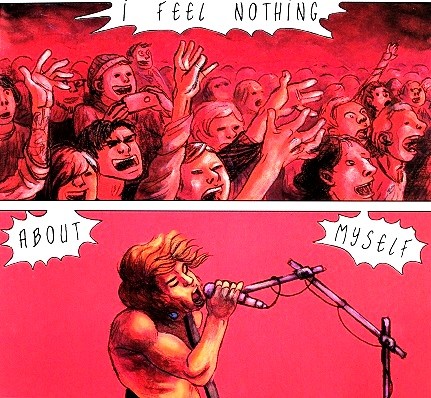
Another functional component is the speech balloon. This is the space that is used to report what a character is saying, and its physical appearance on the page acts as a sort of adverb to tell us how something is said. Here, for example, we know from the visual elements (the crowd, the microphone) that Tazane is onstage singing, but we can guess from the spiky balloons and large spaced-out font of the letters that he is not crooning softly, but belting out the words. The colour scheme reinforces this impression: think how these panels would differ if rendered in pale blue or green, for example.
Saraceni also argues that the gutter – the blank space separating the panels – ‘is similar to the space the divides one sentence from the next’. The gutter is not simply a blank space, in fact: every narrative is necessarily incomplete and this is a space for the reader to fill with real-world knowledge. Take the following example.
This montage is made up of two pages, with the page break occurring down the middle, after the third panel from the left: this is important, because in the Western world we read each panel from left to right, top to bottom, and we do the same thing with the whole page.
So what’s happening here? We see first of all a cloud of smoke. On its own, this means that something is on fire, but what? In the second panel, a lit cigarette lies next to a butt in an ashtray, and we can see that the smoke comes from the cigarette. The ashtray is on a table, and in the third panel, we see what else is on the table: empty or near-empty bottles of alcohol – spirits and beer rather than wine – one bottle could be vodka, another Jack Daniels. The fourth panel shows us another view of the table (and all the time, the repetition of the table image is leading us to assume that it is the same one): a pencil, and some papers with musical notation. Finally, the fifth panel shows us the human agent behind all this – a hand playing a guitar – and we can infer that the musician shown here is the one who has been smoking, drinking and writing music. This is Tazane.
Onto the panels on the right-hand side of the montage, and we see at the top a close-up of Tazane with eyes closed, clearly absorbed in his task. The ‘camera’ pans out for the next panel and we see him playing, the tops of the bottles just visible in the right-hand corner. In the panel which follows, Tazane is writing on the paper, and we can infer again that he is writing down the tune he has just played, or perhaps some lyrics. The foreshortened perspective of the image ensures that the hand holding the pencil is central to the panel, with the trajectory of the pencil leading the eye back to Tazane’s face and from there down to the point of the pencil again, following the circle of thought from the origin to the recording of that thought. He returns to his playing for the final frame, depicted from yet another angle, and here we note an interesting point Saraceni makes about the panel – that it is not the same as a photograph or a film still, because the panel represents a portion of time rather than a snapshot. The final frame of this sequence could take up any amount of time: he could be playing for a few seconds, or a few hours. Panels can fill an entire page, as the one shown below does.
And there are numerous other examples of one-page panels in Skandalon. Page 85 is entirely blank, with not even a page number, but this can also be considered a panel; in fact, the page is blank because the narrative has reached a point where Tazane rapes a young female fan, and the blank page emphasises the horror of the scene by hiding it from the reader.
I mentioned the ‘camera’ earlier, and something that has sparked interest in recent years is the presence of the narrator in comics and graphic novels. In Skandalon, Tazane himself does some of the narrating for us, rendered in square captions in a font different to that of the round speech balloons. So Tazane is narrator as well as character. The other character, Philippe, also does a little narrating for us. On finding the remains of Tazane’s mobile phone, he says ‘Not again!’ – but who is he talking to? Ostensibly, himself, but arguably he is speaking to the reader as well and imparting the information that this is not the first time Tazane has smashed up his phone. But I think there is yet another narrator, the one that decides what to show us in each panel and whose point of view we see: close-ups, for example, are more likely to invite us to feel empathy for the character concerned. Creating a graphic novel involves decisions about the shape and size of each individual panel, its positioning on the page, its relation to other panels and its place in a sequence as well as what is depicted, how characters and events are depicted, what point of view is represented, whether or not captions are used, and many, many other decisions relating to both functional and content components. It is perhaps here, in these decisions, that we should be searching for the narrator. Saraceni recognises that the narrator’s presence cannot be reduced to a consideration of captions alone. The kind of syntagmatic and paradigmatic analyses that are applied to verbal texts can equally be applied to graphic novels, if we consider creative choices made on both horizontal and vertical levels.
To conclude, Skandalon is a disturbing but immensely rewarding read, and Saraceni’s exceptionally useful book helps the reader to understand and articulate Maroh’s work. I’ve had a happy week with this, all in all.
Interesting use of panels to show the division between land and water in Tazane’s heroin-induced narcissistic hallucination.
‘My little stories like birds bred in cages’: The Letters and Journals of Katherine Mansfield
This post has been removed because the content is now available in book form with many other essays and blog posts previously available on this site. The book is titled Ungrammaticalities: Linguistic Literary Criticism from ‘The Battle of Maldon’ to Muriel Spark, and it is available for purchase HERE from August 2024.
Please see this page for the cover art and table of contents.
Good morrow, dearest readers, and I apologise whole-heartedly for the neglect of Aunty Muriel’s Blog last year. For me 2015 was, in the words of the great Philip Larkin, a ‘pig’s arse’ of a year, but life goes on in that one-day-after-another kind of way, and I am determined to put behind me all the stuff that messed up last year and to make 2016 a year I’ll remember as a treasure and a delight.
Now, I haven’t made any New Year’s Resolutions as such, but I have promised myself that I will dust off and revive my moribund blogs – and what better way to do so than with a lovely Reading Challenge? This one has been doing the rounds on Facebook and it’s sparked quite a lot of interest, so I think it’s worth a try.
I think we can all agree that this challenge is far more interesting than just telling yourself that you will read at least twenty books this year, because that never works. It’s the end of July by the time you’ve chosen your twenty books and then it’s the summer holidays and then Christmas before you know it and far from having read War and Peace plus nineteen other worthy novels, you’ve only actually managed to read the first chapter of Les Misérables before giving up and watching the film instead.
The idea is to write a blog entry for the book I read under each one of these categories. I haven’t chosen them all yet, but I have sorted out the following:
A book recommended by your local librarian or bookseller:
Anna Smaill, The Chimes (with thanks to Sarah Elsegood for the recommendation!)
A book you should have read in school:
Henry James, The Turn of the Screw
A book published before you were born:
Barbara Comyns, Our Spoons Came From Woolworths
A book that was banned at some point*:
Lewis Carroll, Alice in Wonderland
A book you previously abandoned:
Vladimir Nabokov, Pnin
*There’s a helpful list of banned books on Wikipedia if you’re struggling with this category.
Righto, so on with the show! I should point out that I have an essay deadline on 1 February, so it’s unlikely I’ll get anything done this month. I’m up to the eyeballs in Katherine Mansfield at the moment, but as soon as I’ve got my essay in, I’m going to dive straight into the Barbara Comyns and I know even at this early stage that I’m going to put off the Henry James until I really really can’t avoid it anymore.
What follows is my answer to an exercise on transitivity patterns for the MA Literary Linguistics programme on which I’m enrolled. This post is probably not going to be particularly readable unless you’re familiar with transitivity patterns – however, I’ve uploaded a pdf of a mindmap I made which may help. You might have to zoom in on the pdf to make parts of it legible. If you’d like to browse some original sources, you’ll need to look up Michael Halliday and read his work.
Transitivity mindmap pdf below. The examples of each process are taken from John Braine’s Room at the Top, but these are examples I’ve picked out myself, so please be wary: I’m not altogether sure I’ve really understood the difference between an attributive and an identifying process, so best treat the examples with caution.
I’ve reproduced below Sonnet 116 in full…and you might remember Marianne (Kate Winslet) reciting part of it after she’s been heartlessly dumped by Willoughby (Greg Wise) in Ang Lee’s Sense and Sensibility:
Let me not to the marriage of true minds
Admit impediments; love is not love
Which alters when it alteration finds,
Or bends with the remover to remove.
O no, it is an ever-fixèd mark,
That looks on tempests and is never shaken;
It is the star to every wand’ring bark,
Whose worth’s unknown, although his height be taken.
Love’s not Time’s fool, though rosy lips and cheeks
Within his bending sickle’s compass come;
Love alters not with his brief hours and weeks,
But bears it out even to the edge of doom.
If this be error and upon me proved,
I never writ, nor no man ever loved.
Which type of process is dominant in the poem, or does the poem mix different types?
The poem consists of a mixture of different transitivity types.
There is a speaking voice in the sonnet, an ‘I’ or a ‘me’, whose presence is most noticeable in lines 1-2, 5 (‘O no’), and 13-14; on a discourse level, therefore, the sonnet in its entirety could be understood as a mental externalised process in which the SAYER is the I/me of the poem, the VERBIAGE is the text of the sonnet, and the TARGET is the reader/audience (Simpson, 1993: 90). Simpson’s PROCESS is absent but understood, owing to considerations of form. There is no novelistic reporting clause such as ‘said the poet’.
The other processes involved are material action processes of both intention and supervention; relational processes and a mental internalised perception process (‘That looks on tempests’).
Labelling the processes is a difficult exercise in this case because much of the poem’s transitivity involves a metaphorical blend in which a personified abstract concept takes on the role of animate ACTOR, and in addition, much of the ‘action’ of the poem is actually inaction. Moreover, the poem contains many expressions of negativity (not, never, no, nor…ever), which complicates matters further.
Who is the main actor or agent in the poem?
The ACTORs are:
•’I/me’ (the speaker of the poem);
•‘love’as abstract concept until the third quatrain when it appears as a personification;
•‘not love’;
•possibly no man in the final line, but there is ambiguity here. The words ‘nor no man ever loved’ could be taken to mean ‘I have never loved a man’ as well as ‘no man has ever been in love’. This depends on whether we understand ‘no man’ to be the ACTOR, or whether we consider the subject to be ‘I’still, carried over from ‘I never writ’: it could be argued that the subject of the following phrase has been removed, but that ‘I’ is understood.
‘Love’ is the CARRIER of the poem’s attributive processes, and the IDENTIFIED of its identifying processes.
Who or what receives all the action?
The action is distributed between the ACTORs, but it should be noted that perhaps as many as two-thirds of the material action intention processes actually refer to an action not being performed. Love as an abstract noun or personification is associated with that which is fixed, permanent and immovable. Any action attributed to Love is that of inaction, and movements such as altering and bending are associated with Love’s antithesis, ‘not love’. This call to inaction reflects the desire expressed in the first line of the sonnet that the poet should not ‘admit impediments’ to ‘the marriage of true minds’: namely, that the poet wishes to do nothing to hinder true love.
Is there a pattern for processes and participants in main clauses, compared with the pattern in subordinate clauses?
Main clauses tend to feature relational processes, and the claim made by way of this process is explored further in the subordinate clauses through material action processes, either intention or supervention.
How can your annotated analysis help to support your sense of the meaning of the poem?
In the opening lines of the sonnet, the speaker exhorts someone to prevent him or herself from embarking on a certain course of action. The remark could, of course, be self-directed – a ‘note to self’ not to act as described. It is the equivalent of a theatrical soliloquy, in which an actor shares his or her thoughts with the audience. The speaker expresses his/her desire not to act, or not to behave in a certain way, and one can see that throughout the rest of the poem the transitivity patterns support this call to inaction. Love is something fixed, immovable and enduring, whilst its antithesis (‘not love’) ‘alters’ and ‘bends’ when provoked to do so.
Having begun the sonnet with this exhortation, the speaker makes an abrupt switch in line 2 to an exploration of what love is not (and, by implication, what it is):
…; love is not love
Which alters when it alteration finds,
Or bends with the remover to remove.
Here a main clause contains two subordinate clauses, both relative, the second a reduced relative clause because ’which’ has been removed, but is understood. The transitivity of the main clause is that of a relational process, incorporating two material action intention processes in the subordinate clauses, where these latter processes are in themselves a metaphorical blend involving an inanimate abstract concept as ACTOR.
The relational process of the main clause is set against the material action intention processes in the subordinate clauses, where the ACTOR ‘not love’ intentionally alters or bends according to circumstances. Put bluntly, action is bad, inaction is good: a ‘still’ process encloses two action processes in which the participants behave in a way that would suggest this is not ‘a marriage of true minds’.
The morphological variations of the action-words enact the changes they describe: ‘alters’ (verb) becomes ‘alteration’ (noun); ‘the remover’ (determiner + noun) becomes ‘to remove’ (verb in infinitive). The change expressed in these two lines (‘alters’, ’bends’) is reflected on a different textual level in the changing word-formations.
In the second quatrain (lines 5-8), the poet moves the discussion on from what love is not, to what love is, and love as an abstract concept is explored through metaphors related to shipping. Once again, the action expressed in the material action intention processes is in fact inaction, and the abstract concept as ACTOR provides a metaphorical blend. Love, expressed as a ‘ever-fixèd mark’, is immobile in the face of a raging sea-storm and immovable regardless of the storm’s violence.
The nautical metaphor continues into the second half of the second quatrain, and love is now a ‘star’, most likely the ‘northern star’ or ‘Pole Star’ (Duncan-Jones, 1997: 342). The star, like the ‘ever-fixèd mark’, serves as a guide to those who are lost (the ‘wandering bark’). The transitivity of line 8 is an attributive process, where the CARRIER is love (personified and metaphorically expressed), and the ATTRIBUTE is ‘of unknown worth’, in other words, invaluable or priceless. This same line balances that which cannot be measured (‘Whose worth’s unknown’) against that which can (‘although his height be taken’). The latter phrase extends the metaphorical references to shipping and navigation: ‘ “take height” was a regular term in navigation and astronomy’ (Duncan-Jones, 1997: 342).
A star is fixed just as the ‘mark’ is fixed, and neither mark nor star can move. In addition, the measurement of the star’s height presumably represents a straight line, which is in contrast to the bending manifested by the ‘not love’ ACTOR and by Time’s sickle in the third quatrain.
The word ‘bends’ from line 4 reappears in one of its lemma forms as ‘bending’, and again, this word is associated with that which is not permanent and which is not love. The transitivity process here is a material action supervention process describing the appearance and action of Time’s scythe scooping up the ‘rosy lips and cheeks’ that are associated with youth and transience, and which serve metonymically here for the whole person. The word ‘compass’ will recall the shipping metaphor of the previous quatrain even though the sense is different here; nevertheless, ‘compass’ shares the same semantic field with the ‘star’ and the ‘wandering bark’.
In lines 11-12, Love as personification is involved in two material action intention processes in a metaphorical blend with a personified ACTOR, as follows:
ACTOR = Love (in personified form)
PROCESSES = 1) alters not, 2) bears it out.
When Love is finally involved in a transitivity process involving action, that action is to stay the same and to do nothing.
The sonnet ends with a rhetorical trick expressed as a hypothetical question which allows no disagreement. The reader has just read the sonnet written by the poet, so ‘I never writ’ is nonsensical in context, and given that this half of the line is untrue, then the second half (‘nor no man ever loved’) is also assumed to be untrue. The transitivity processes may well be those of material action intention process, but as seen several times before, the action referred to represents inaction – in this instance, not writing and not loving. However, because both statements are untrue, the action becomes a positive event: the poet did write the sonnet, people have loved each other, and therefore love must exist as the poet has described it.
List of references
Duncan-Jones, K. (Ed.) (1997) Shakespeare’s Sonnets. London: The Arden Shakespeare.
Simpson, P. (1993) Language, Ideology and Point of View. London: Routledge.

 I’m kicking off this year’s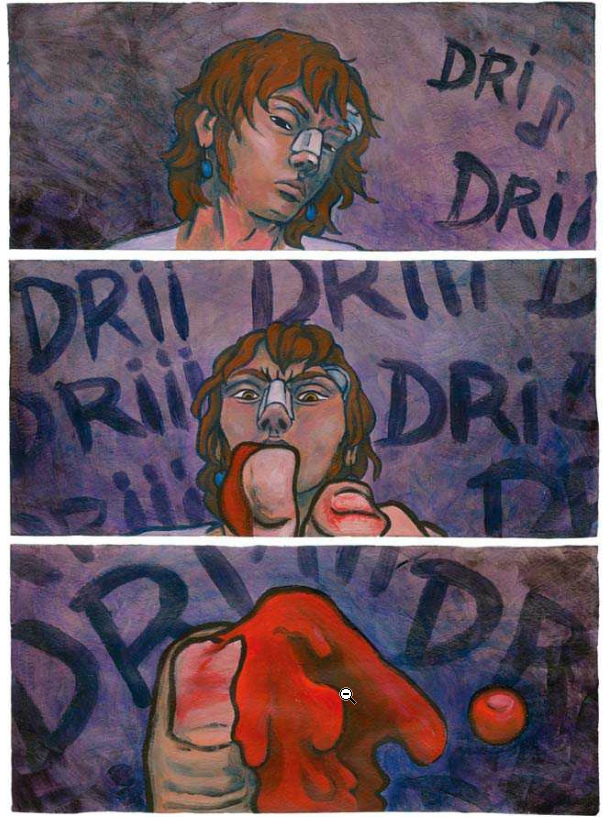
 d, the microphone) that Tazane is onstage singing, but we can guess from the spiky balloons and large spaced-out font of the letters that he is not crooning softly, but belting out the words. The colour scheme reinforces this impression: think how these panels would differ if rendered in pale blue or green, for example.


 Aunty Muriel's Blog