Ghost Stories Part IV (a): Muriel Spark’s ‘The Portobello Road’

Ghost Stories Part IV (a): Muriel Spark’s ‘The Portobello Road’

This post has been removed because the content is now available in book form with many other essays and blog posts previously available on this site. The book is titled Ungrammaticalities: Linguistic Literary Criticism from ‘The Battle of Maldon’ to Muriel Spark, and it is available for purchase HERE from August 2024.

Please see this page for the cover art and table of contents.

Ghost Stories Part III: The Reader’s Imagination

Ghost Stories Part III: The Reader’s Imagination

This post has been removed because the content is now available in book form with many other essays and blog posts previously available on this site. The book is titled Ungrammaticalities: Linguistic Literary Criticism from ‘The Battle of Maldon’ to Muriel Spark, and it is available for purchase HERE from August 2024.

Please see this page for the cover art and table of contents.

Ghost Stories Part II: The Horror Story in Miniature

Spooky graveyard

In Ghost Stories Part I, I wrote about how the structure of a ghost story can mimic that of a joke, with the final awful dénouement as the punchline. In Part II, I’m going to look at something similar: horror stories in miniature, which work in very much the same way as a joke in that they require the reader to fill in the gaps. And if you have a fevered imagination and you’ve read a lot of ghost stories, you’ll have plenty with which to fill those gaps. When I was an undergraduate in London, many years ago, I spent an evening in the kitchen with a housemate and a bottle of wine, and we told each other every ghost story we knew. After a couple of hours of this, we were feeling jumpy to say the least…so when another housemate returned from the pub and banged loudly on the back door, the two of us in the kitchen screamed uncontrollably. I had to sleep with the light on for a week.

Let’s begin with an old chestnut, a very short tale described as the Shortest Horror Story in the World. I’ve lifted the story and the information which follows from here:

“ ‘The last man on Earth sat alone in a room. There was a knock on the door…’ This two-sentence horror tale is presented as a story within a story, right at the start of Fredric Brown’s ‘Knock‘, published in the December 1948 edition of Thrilling Wonder Stories. Brown describes how the horror in this story is all implied…what could be at the door? ‘But,’ he says, ‘it wasn’t horrible, really.’ He then tells the story of Walter Phelan, the last man on Earth after an alien race called the Zan invade and kill everyone apart from Walter Phelan and the last woman alive, Grace Evans.”

Now, any alert reader can work out that if the last ‘man’ on Earth hears a knock at the door, chances are that it’s a woman knocking. But if you change ‘man’ for ‘human being’ and remove the melodramatic ellipsis, it all becomes much scarier:

‘The last human being on Earth sat alone in a room. There was a knock on the door.’

Okay, now this really is scary because you know that whatever it is that’s knocking is not a human being. You also know that it’s intelligent enough, and knows enough about the customs of human beings, to understand the function of knocking at a door. And finally, whatever it is on the other side of the door wants to come in. Who would have the courage to open the door? And yet, what else could you do? A similar predicament faces the person who knows they are alone in the house, and who, groping in the dark for a match, feels the matchbox being placed into their outstretched hand. Who would have the courage to strike a match in this situation? But the alternative is sitting in the dark, wondering what else is in the room with you. The terror would send you mad.

I found the story which follows on the same website, and you can find other short science fiction stories here:

‘Mike ran in, shouting, “Wait!” but once again, Mike had already pushed the button.’

Whoever Mike is, he’s trapped in a time-loop from which he can never escape.

Of the Six Word Stories, still on the same site, I quite enjoyed ‘Rock, paper, scissors. One life jacket’. This next one, however, gave me the screaming heebie-jeebies: ‘Too young to hitchhike. Darkened roadway.’

I like these little tiny horror stories precisely because you can create the rest of the narrative yourself. The same thing is possible with fragments of other stories taken out of context and subsequently reworked. For example, take the following three frames from Robin Barnard’s Whatmen:
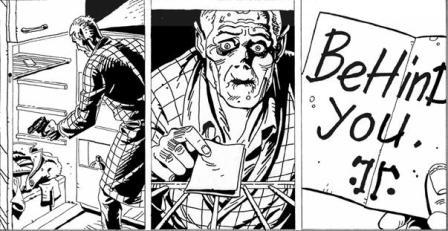
WhatMen 3 frames

Whatmen is a rich, multi-layered text, and it opens itself to many readings, but I like these three frames in particular: together, they could either form a complete narrative on their own, or they could provide the reader with the opening for a whole set of other narratives. There are many questions one could ask, the answers to which would generate a new story; the same is true of the narratives in miniature discussed above. Here, we see an armed man, wearing a garment that could be a dressing-gown, opening his fridge to find nothing but what looks like a jacket of some sort and a note. The man gingerly takes the note and in the final frame he reads the words ‘Behind you’. Fantastic! The narrative potential here is immense. Who or what is behind the man? What happens next? Why is there a jacket in the fridge? Why isn’t there any food in the fridge? Why does the man look so haggard? What has happened to him before now? And what does the strange symmetrical symbol mean at the bottom of the note? So many questions, so many narrative possibilities…

So, the reader has an active part to play in these little stories. There are questions to be asked and gaps to be filled. And the more readers read, the more competent they become: the horror/ghost story genre is extremely well-developed because it has always enjoyed a tremendous popularity, and as a result, regular readers bring a wealth of knowledge and experience to each narrative. In Part III, I’m going to take a closer look at what part the reader plays in a good ghost story.

My thanks to Robin Barnard, who very kindly gave me permission to use his beautifully crafted images here. If you’d like to see more of Robin’s work, you can view his blog at Images Degrading Forever.

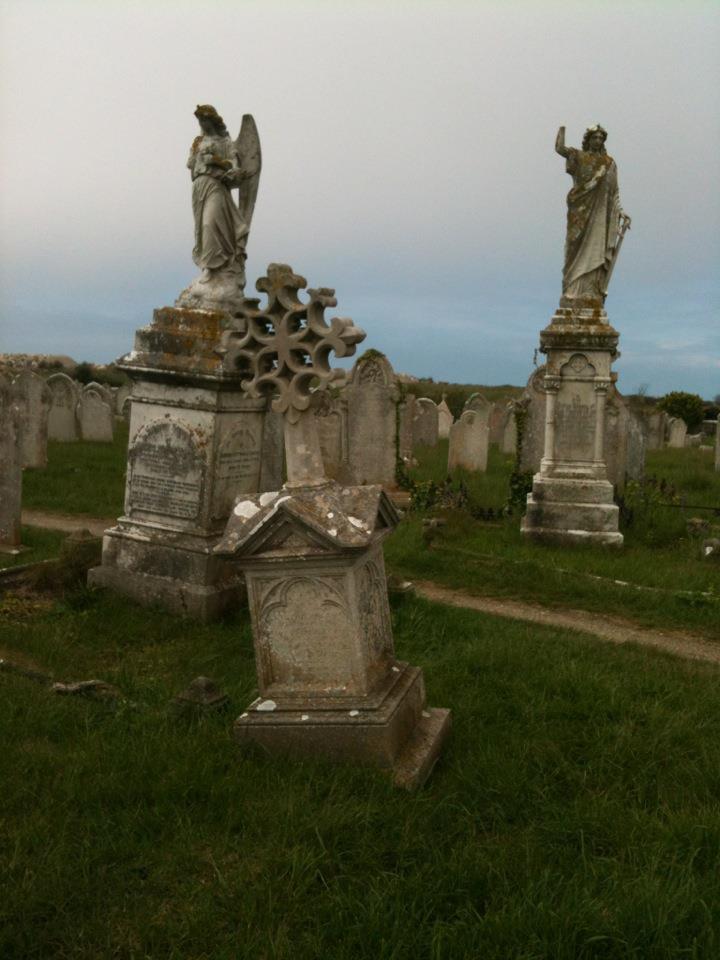
The photograph at the top of this post was taken at Portland Bill by Roy Booth, who always has to take a million billion photographs wherever we go. I like this one though. The menacing sky, the mutilated angel, the gravestone tilting to one side as if the occupant of the grave below had been trying to push its way out…oooOOOOOoooo! …I might have to sleep with the light on tonight.

PS. If you like these very short short stories, Rick Mallery’s Power Shorts Daily are also well worth a look!
Ghost Stories Part I: The Punchline

Ghost Stories Part I: The Punchline

This post has been removed because the content is now available in book form with many other essays and blog posts previously available on this site. The book is titled Ungrammaticalities: Linguistic Literary Criticism from ‘The Battle of Maldon’ to Muriel Spark, and it is available for purchase HERE from August 2024.

Please see this page for the cover art and table of contents.

People are very funny about books


Me reading a book in sepia

Me reading a book while on holiday in the Norfolk Broads a couple of years ago

People are very funny about books – funny peculiar, that is, rather than funny ha-ha.

For example, the last time I bought a bookcase, the retail assistant informed me that the smaller compartments in the particular case I was looking at were handy for storing DVDs or displaying ornaments and other such fripperies. ‘No, I need all the space for books,’ I replied, and even as I said it, I knew what her response would be – and yes, it duly came – ‘Oh, yes, well, I’ve got far too many books myself. I never have enough space for them.’ Right, fair enough, but then why try to encourage me to use up valuable book-storing-space by plonking a vase where the books should be? The thing is, the assistant felt that I’d made some kind of imputation about her intelligence because I’d implied that I owned more books than she did, and she felt the need to correct me on this.

But – the number of books you own is not an indication of how clever you are. What sort of books do you have? Do you have a houseful of Barbara Cartlands and Jilly Coopers? All very well if you like that sort of thing, but I doubt it’ll do much for your IQ. And if you own books of a more intellectual nature, have you actually read them? Again, it’s all very well to own expensive hardback copies of the major works by influential western philosophers, but if you haven’t read them, then you may as well clutter up your bookshelves with china dogs and tea-light holders.

People say they don’t like giving books away: ‘Oh, I couldn’t possibly part with my books. It would be like giving away a little bit of myself.’ Would it? Of course it wouldn’t. There isn’t any part of my physical being that I would give away – at least not while I’m alive and still using it – but I donate books to Oxfam all the time, because I’ve read them. I give books away partly because I know I only have a finite number of years on this planet and it’s very unlikely that I’ll have time to read them again, but mostly because I only have a finite amount of storage space and I part with the books I’ve read in order to make room for the books that I haven’t read. (Of course, this doesn’t always work. I keep the books I know I will need again – textbooks – plus the books I know I will read again – mostly comic books – and just occasionally, I’ll give a book away and then decide that I wished I hadn’t: I did this recently with du Maurier’s Rebecca. Three weeks after having parted with it, I ended up trotting round the charity shops looking for a replacement copy.)

People like books as a physical object. Kindles and similar products have not really taken off as they might have done, despite some clear advantages over bulky hardbacks: Kindles take up less storage space (again!), and are not so heavy to hold. This latter point may seem frivolous, but I struggle to read Simon Schama’s A History of Britain mostly because it’s so bloody heavy and my hands start to ache after twenty minutes or so. The advantages to Kindles are obvious if you are travelling – no excess baggage payments and more room for insect repellent and stomach tablets. But I must confess here that I prefer a good solid paperback myself, although my own reservations about Kindles have more to do with the comparatively small amount of text shown on the screen and the continuous interruption to the reading experience that ensues as a result. We can’t use our peripheral vision when reading from a Kindle in the same way that we do when reading a book, and as far as I know, there hasn’t been any research into this area yet, so it’s possible that when using a Kindle, we might be missing out on a vital part of the reading experience. I do know that I always cover up the last page of ghost stories with my hand because I don’t want to glimpse the ending by accident before I get there.

People won’t write in books or deface them in any way. Why not? It’s your book. You can do what you like with it. I scribble all over mine. I like my books to contain my experience of reading them. For example, there are crinkly pages in my copy of The Three Musketeers because I blubbed all over the chapter in which Constance is murdered, and as for my copy of Watership Down – well, some pages have been welded together forever with snotty salt water. I like it when I buy a second-hand book and someone has drawn little pictures in the margin, or written a mysterious note to the previous recipient of the book. It’s nice if a book retains that small fragment of human experience.

What I’m getting round to, I suppose, is that a book should be a dynamic, not a static, object. It shouldn’t sit on a shelf gathering dust. It shouldn’t be used as a status symbol. It should be read and wept over and annotated, and then it should be passed on for someone else to read and perhaps spill coffee on, and then passed on again and again, until eventually all the pages fall out when the glue in the binding perishes and then it can be recycled and made into another book. Hurrah!