People are very funny about books


Me reading a book in sepia

Me reading a book while on holiday in the Norfolk Broads a couple of years ago

People are very funny about books – funny peculiar, that is, rather than funny ha-ha.

For example, the last time I bought a bookcase, the retail assistant informed me that the smaller compartments in the particular case I was looking at were handy for storing DVDs or displaying ornaments and other such fripperies. ‘No, I need all the space for books,’ I replied, and even as I said it, I knew what her response would be – and yes, it duly came – ‘Oh, yes, well, I’ve got far too many books myself. I never have enough space for them.’ Right, fair enough, but then why try to encourage me to use up valuable book-storing-space by plonking a vase where the books should be? The thing is, the assistant felt that I’d made some kind of imputation about her intelligence because I’d implied that I owned more books than she did, and she felt the need to correct me on this.

But – the number of books you own is not an indication of how clever you are. What sort of books do you have? Do you have a houseful of Barbara Cartlands and Jilly Coopers? All very well if you like that sort of thing, but I doubt it’ll do much for your IQ. And if you own books of a more intellectual nature, have you actually read them? Again, it’s all very well to own expensive hardback copies of the major works by influential western philosophers, but if you haven’t read them, then you may as well clutter up your bookshelves with china dogs and tea-light holders.

People say they don’t like giving books away: ‘Oh, I couldn’t possibly part with my books. It would be like giving away a little bit of myself.’ Would it? Of course it wouldn’t. There isn’t any part of my physical being that I would give away – at least not while I’m alive and still using it – but I donate books to Oxfam all the time, because I’ve read them. I give books away partly because I know I only have a finite number of years on this planet and it’s very unlikely that I’ll have time to read them again, but mostly because I only have a finite amount of storage space and I part with the books I’ve read in order to make room for the books that I haven’t read. (Of course, this doesn’t always work. I keep the books I know I will need again – textbooks – plus the books I know I will read again – mostly comic books – and just occasionally, I’ll give a book away and then decide that I wished I hadn’t: I did this recently with du Maurier’s Rebecca. Three weeks after having parted with it, I ended up trotting round the charity shops looking for a replacement copy.)

People like books as a physical object. Kindles and similar products have not really taken off as they might have done, despite some clear advantages over bulky hardbacks: Kindles take up less storage space (again!), and are not so heavy to hold. This latter point may seem frivolous, but I struggle to read Simon Schama’s A History of Britain mostly because it’s so bloody heavy and my hands start to ache after twenty minutes or so. The advantages to Kindles are obvious if you are travelling – no excess baggage payments and more room for insect repellent and stomach tablets. But I must confess here that I prefer a good solid paperback myself, although my own reservations about Kindles have more to do with the comparatively small amount of text shown on the screen and the continuous interruption to the reading experience that ensues as a result. We can’t use our peripheral vision when reading from a Kindle in the same way that we do when reading a book, and as far as I know, there hasn’t been any research into this area yet, so it’s possible that when using a Kindle, we might be missing out on a vital part of the reading experience. I do know that I always cover up the last page of ghost stories with my hand because I don’t want to glimpse the ending by accident before I get there.

People won’t write in books or deface them in any way. Why not? It’s your book. You can do what you like with it. I scribble all over mine. I like my books to contain my experience of reading them. For example, there are crinkly pages in my copy of The Three Musketeers because I blubbed all over the chapter in which Constance is murdered, and as for my copy of Watership Down – well, some pages have been welded together forever with snotty salt water. I like it when I buy a second-hand book and someone has drawn little pictures in the margin, or written a mysterious note to the previous recipient of the book. It’s nice if a book retains that small fragment of human experience.

What I’m getting round to, I suppose, is that a book should be a dynamic, not a static, object. It shouldn’t sit on a shelf gathering dust. It shouldn’t be used as a status symbol. It should be read and wept over and annotated, and then it should be passed on for someone else to read and perhaps spill coffee on, and then passed on again and again, until eventually all the pages fall out when the glue in the binding perishes and then it can be recycled and made into another book. Hurrah!

Three Spark Novels Covered

We all know we’re not supposed to judge a book by its cover, and we all do it nevertheless. Of course we do. So much so, in fact, that the cover design is now recognised as part of the narratology of a book: the ‘layout and illustration of a book’s cover and the design of its title page strongly influence consumer behaviour when the reader is able to choose from a number of editions from a range of newly published books’ (Monika Fludernik, An Introduction to Narratology, p. 19). The picture on the cover begins to draw us into the text before we’ve glanced at the first page, and in some cases can even contain spoilers, or can provide a reading, or interpretation, of the text that will influence the reader right from the start.

Personally speaking, I avoided Terry Pratchett novels for years because of those awful Josh Kirby covers. Be-thonged maidens with unfeasibly large boobs? No thanks. Kirby’s illustrations gave me the impression that the novels would be representative of the fantasy genre at its most ridiculous, when in fact this is not true at all. A friend urged me to ignore the covers and give Pratchett a try, and when I did, I enjoyed his Discworld books hugely and read them all one after the other. If it hadn’t been for those ghastly covers, I would have read them years ago. My apologies to those who like Kirby’s work – I know there are many who do – but I’m firmly in the Paul Kidby camp.

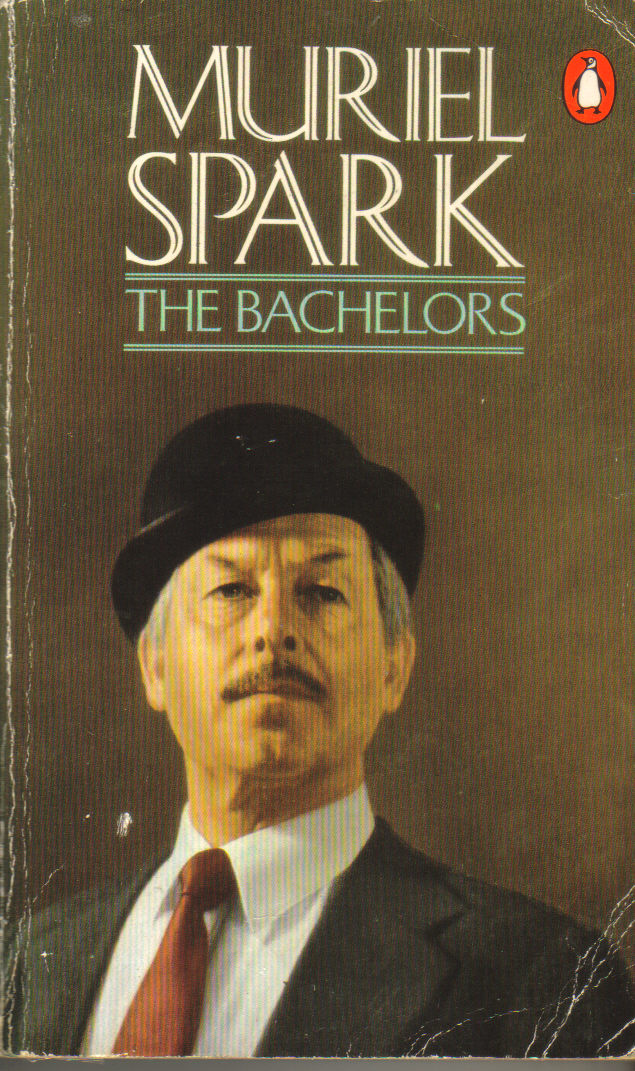
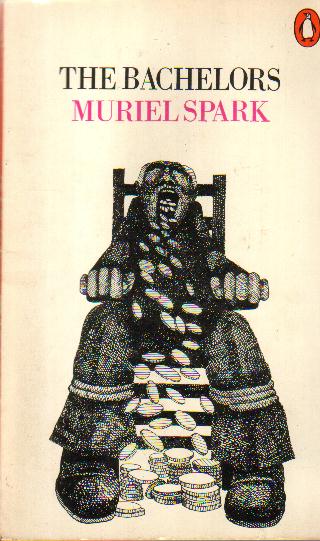
Anyway, this term I’ve been writing about Muriel Spark’s The Bachelors, The Ballad of Peckham Rye and The Public Image, and I thought I’d put together a little blog about the covers for these books. The Bachelors was first published in 1960, and its central figure is a spiritualist medium by the name of Patrick Seton. Seton is a criminal – of that there is no doubt – but there is textual evidence to suggest that his powers as a medium may be genuine, especially in the episode concerning Dr Lyte. Most of the evidence points to Seton being a fake, but he seems to be genuinely unaware of what it was that he said to Dr Lyte when in his trance. Of course, you never really know where you are with Spark, and her narrators often keep the reader guessing just for the hell of it – you’re never told for sure whether Seton is able to contact the spirit world or not. Let’s have a look at the covers.

Image

(left) This is Patrick during a séance, mouth open, delivering messages from the other side, with his audience gathered around him. This next one, however (below), goes beyond simple illustration and provides the reader with an interpretation:

Image


Here (right) we have Patrick, tied to his chair as he is during his trances, but this time, coins, not words, are cascading from his open mouth. The impression given is that Patrick makes money from his spiritualist performances, so the further implication is that Patrick is not genuine. This reading will colour the reader’s perception of the text right from the start.


The final cover for this book, however, is more likely to simply confuse the reader:

Image

(left) I mean – what’s this about? It’s just a man of a certain age in a suit and a hat. It’s as if someone just searched for ‘bachelor’ in the Clip Art library and came up with this one. Not wrong, because the book is entitled The Bachelors, but not really right either. And the blurb on the back cover is weird too (see below):

Bachelors_back cover


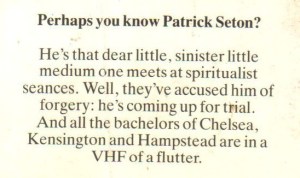
Just who is supposed to be talking here? ‘He’s that dear little, sinister little medium’? Is it supposed to be the voice of one of the members of the Wider Infinity, Patrick’s spiritualist group? I suppose it could be, but clearly the last sentence is a narratorial voice rather than the voice of a character, which doesn’t help matters and makes the whole thing look a bit cock-eyed and cobbled together at the last minute. And what’s a ‘VHF of a flutter’ when it’s at home? Really, this is rubbish.

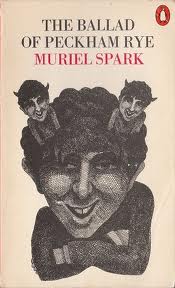
On to the next novel, The Ballad of Peckham Rye, also published in 1960. This story features a character called Dougal Douglas (or Douglas Dougal), who arrives in Peckham Rye and causes mayhem before departing. He has two lumps on his head which he claims to be the remains of horns removed by a plastic surgeon, but we don’t have to believe this. The designer of this cover, however, wants the novel’s readers to believe that Dougal really is an instrument of the Devil (below left):

Image

Here Dougal’s ‘horns’ are two miniature versions of himself, each with their own set of horns – which in turn will have horns, and so on and so on. Dougal is looking at us and grinning, as he is here (below right):

Image

The grin is not so obvious, but can be inferred perhaps from the raised eyebrow and cheek muscle. This cover goes some way towards depicting the canteen scene in the novel, in which Dougal attracts a great deal of female attention by bursting into tears. A third cover does not depict Dougal at all, but focuses on Peckham itself:

Image

Here, Peckham Rye has been made to look a bit like Las Vegas – which it doesn’t – but the artist has picked up on the dancing. There’s an awful lot of dancing in this novel, and of course the Devil loves to dance! But dancing is part of social behaviour and it comes with a whole set of rules and regulations of its own, to which the Peckham inhabitants add their own little rituals. In Peckham Rye, dancing is never very far from fighting (and vice versa, in fact), both of which activities are undertaken by savage and civilised societies. And dancing, of course, is so often a prelude to sex. William Boyd argues that this is a novel about sex in his perceptive introduction, and I’m inclined to agree with him. Sex, fighting and dancing. The inhabitants of Peckham Rye don’t really need a devilish figure running around to cause trouble, because it’s all happening already. Dougal, for all his funny ways, is merely a catalyst.

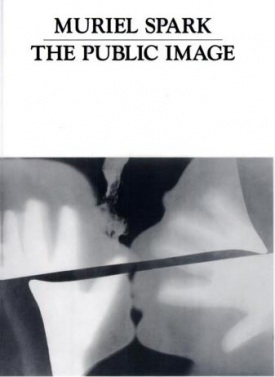
So now we come to my last novel for today, The Public Image, published later than the other two, in 1968. This story is about a second-rate actress, who has somehow become very successful, fighting to save her public image when her husband commits suicide.

Image

The first cover (left) shows a diminutive woman struggling under the weight of a huge star bearing a wide toothy grin. The woman herself is frowning fiercely: she looks off-balance and is obviously unhappy with her position. This picture always reminds me of Atlas trying to bear the weight of the world on his shoulders, but Atlas, of course, had no choice. The idea that the public image is something from which the actress would like to escape is another example of a reading that is given to the reader in the cover image. A second cover looks like this (below right):

Image

It’s very similar in some ways: a large smiling face, eyes hidden by sunglasses as is so often the case, and the shell appears in Frederick’s suicide note to Annabel: ‘You are a beautiful shell, like something washed up on the sea-shore, a collector’s item, perfectly formed, a pearly shell – but empty, devoid of the life it once held.’ (p. 92). The shell image reappears at the end, but I can’t say more without spoiling it. Finally, this third cover is very different:

Image

This image (left) focuses not on the public image, but on the ruptured marriage – an image in negative of two people kissing is torn across the centre. This cover design incorporates Frederick’s role in Annabel’s public image, which the other two do not.

I’ll end with an image of Muriel Spark herself (below). Isn’t it fabulous?

Image