The ideology lurking behind reviews

In this post, I examine three reviews and question the assumptions that are brought to bear in order to ascertain whether or not the performance reviewed is considered ‘good’ or not.

Lady Gaga and Tony Bennett perform live in Atlantic City

Review 1 from Billboard by Joe Lynch

This review is of a concert in Atlantic City featuring Lady Gaga, one of the highest-earning artists of the 21st century, and Tony Bennett, veteran performer and founder of the Frank Sinatra School of the Arts. Perhaps Bennett’s presence on stage rendered inevitable the type of review produced, but this piece is steeped in nostalgia. The review radiates a certainty that popular music and its performance used to be of a higher quality than it is now, claiming that ‘concerts grounded in musical talent’ are ‘rare’ these days. Lynch’s piece focuses on the rapport between the two performers, the enthusiasm of the crowd and Lady Gaga’s solo performance of La Vie en Rose. Lynch’s emphasis on the ‘astonished’ reaction of the audience to the latter has as its subtext the suggestion that today’s singers lack the talent to sing the old songs; Bennett – one of the old-time singers – is described in hyperbolic terms as still having ‘one of the greatest voices on the planet’. The review ends with details of what Lady Gaga did after the show and the attempts of her fans to obtain photographs, which is a testament to the cult surrounding this popular figure and our increasing fixation with celebrities and celebrity status.

lady-gaga-tony-bennett-new-jersey-atlantic-city-july-2015-billboard-650x650The performance, therefore, is a ‘good’ one because it evoked past times. It is compared with present-day concerts in order to voice an unfavourable opinion of the modern-day lack of rapport between artists sharing a stage, and the concert is evaluated through the rapport between the performers involved, the audience reaction and the quality of the vocal performances. The material performed is listed without comment, with the implication that its superior standard is a given. The performance is treated as entertainment, with (for example) its descriptions of the banter between the performers, but the music performed clearly has a status approaching that of high art due in part to its continuing appeal and existing longevity.

Faustus by Christopher Marlowe

Review 2 from The Telegraph by Dominic Cavendish

This reviewer describes Marlowe’s text as an ‘epic 1594 tragedy’ and considers this production a ‘modish’ version. Cavendish writes for The Daily Telegraph, a very conservative publication, so it is perhaps not surprising that this word (‘modish’) should sum up his entire attitude to the performance. Cavendish describes the production as ‘borderline forgettable’ in its original 2013 version and opines that this 2016 revival ‘verges on being totally incomprehensible in this dismally conceived rehash’. The reason for this animosity would appear to be that Acts 3 and 4 are deleted ‘on the grounds that audiences don’t relate to this less accomplished (and likely not sole-authored) central section’. Cavendish describes what is put in place of these acts, but he does not evaluate further; he comments instead on Kit Harrington’s celebrity status and suggests that his fans may feel ‘bamboozled’ (although it is not clear why this should be so). The rewrite is ‘hip but slack’, to which Cavendish adds the apparently unqualified comment that ‘the emphasis is on de-anchoring the original text from its customary moorings’. In the wider context of the review, I assume this latter comment to be a negative evaluation. Cavendish seems determined to rate the production on the level of a B-movie in his use of the simile ‘like staring apparitions from a low-rent zombie flick’. On Harrington’s delivery, Cavendish comments that he is ‘competent and clear but hardly a match for Marlowe’s mighty line, lacking sufficient fervour and meaningful interiority’. I’m not quite sure what this means, or what sort of delivery would satisfy Cavendish’s expectations.
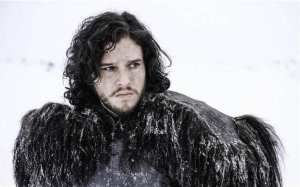
2523194b-jon-snow-arts-large_trans_nvbqzqnjv4bqqvzuuqpflyliwib6ntmjwfsvwez_ven7c6bhu2jjnt8The performance, therefore, is rated ‘bad’ because the original text was altered, ostensibly to meet the requirements of a 21st century audience. It is compared with B-movies and Game of Thrones, both examples of popular entertainment, and the set is likened to Willesden Junction. The performance is rated in comparison with the original text and analysed in terms of its departure from it. Overall, this production is firmly categorised as entertainment in comparison with the original text which is high art. Cavendish clearly considers the show to be the cheapest kind of entertainment – a star vehicle with gratuitous sex scenes – to titillate an audience who would struggle with anything more demanding. The reviewer demonstrates a solidly reactionary response and an unwillingness to examine any potential interest raised by this particular interpretation.

The Taming of the Shrew at The Globe Theatre

Review 3 from Londonist by Savannah Whaley

The Taming of the Shrew is a notoriously difficult play to stage for a modern audience. The BBC series Shakespeare Re-Told addressed the play’s issues by rewriting Katherine (Shirley Henderson) as an MP, and later the PM, so although she eventually bends to the will of Rufus Sewell’s eccentric Petruchio (whom she genuinely comes to love), she does so from a position of the most powerful person in the country. In 1978 Michael Bogdanov produced a feminist Shrew, with a Katherine finally destroyed by a patriarchal society; Bogdanov argued that this reading is inherent in the play, claiming that Shakespeare asks for ‘an egalitarian society of equal rights and opportunity’ (Dollimore & Sinfield, 1994: 197). Whaley is not so generous to Shakespeare, although she does conclude her review with a comment that identifies inequality as one of the themes of the play. The production is set in 1916 Ireland around the time of the Easter Rising and thus takes as its context an occasion when women were once again denied the same rights accorded to men. This decision, states the reviewer, is ‘impossible to ignore’.

taming_of_shrew_second-309-jpg_captioned_3The performance, with its clear message and unmistakably feminist agenda, is considered to be good, in spite of a negative comment relating to the first half of the show. It is compared to other productions less brutal; Whaley describes Katherine as being beaten onstage and suggests that this abuse is ‘generally left off’, but such physical abuse is surely an addition on the part of this particular director and does not feature in the text itself. The performance is evaluated through the way in which it addresses the abuse of women and their unequal status in society in its chosen 1916 context. Finally, this production is treated as high art, and moreover, as art that is important because it seeks to educate and to highlight a societal problem.

Reference: Dollimore, J. and Sinfield, A. (Eds.) (1994) Political Shakespeare: Essays in Cultural Materialism. 2nd ed. Manchester University Press: Manchester.

Criticism and the Literary Canon: Wordsworth vs. Hemans

hemans-felicia-image
Felicia Hemans

In an online discussion of the subject of Felicia Hemans’ place in the literary canon, Jonathan Mulrooney comments that ’Hemans was incredibly popular in her day, and she wrote some fine poetry; students need to know about it. But even if we could imagine a world in which the methods of exegisis [sic] that value Wordsworth over Hemans and those that value Hemans over Wordsworth had equal power, would we really want to live there? I honestly am not sure’ (Romantic Circles, 1997). Mulrooney imagines a world in which all forms of critical discourse are equally valid, thereby rendering useless any attempt to distinguish the ‘good’ writers from the ‘bad’. According to this line of reasoning, the existence of a literary canon can therefore be justified: at best, a canon celebrates that which is worthy of study and closes the floodgates against a deluge of mediocrity. At worst, however, a canon can be used as a tool of oppression, excluding from educational syllabi those whom the canon’s overseers do not wish to be read. Traditionally, this darker side of the canon has eclipsed female writers (such as Hemans), writers from different races, LGBT writers, and so on.

(c) The Wordsworth Trust; Supplied by The Public Catalogue Foundation
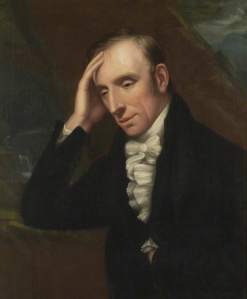
William Wordsworth; supplied by The Public Catalogue Foundation

Nevertheless, it would be disingenuous to claim that canons are static: this is not true. Canons are subject to constant revision, as is evident in the case of both Felicia Hemans and William Wordsworth. Wordsworth is indeed a canonical writer, but opinion has shifted since the Victorian era as to which of his works should be read, and (for example) The Prelude has replaced The Excursion. Hemans, on the other hand, was a prolific and widely-read writer during her lifetime, but her entry in the Dictionary of National Biography describes how she was cast aside by the modernist movement and left unread until a shift in critical attitudes in the second half of the twentieth century led to a resurgence of interest in her work. Feminist and historicist critics argue that Hemans is an important ‘critic of conventions such as patriotism and female self-sacrifice’ (ODNB, 2008) and that her place in the canon should be assured.

There is an argument, however, that the inclusion in the canon of previously excluded writers because their work touches on a contemporary concern amounts to being intellectually dishonest, but Alan Liu counter-argues that the line drawn between ‘good’ poetry and poetry ‘valued for historical, political, [or] gender’ reasons is absolutely artificial. He suggests that ideas about the values of poetical form are inextricably intertwined with whatever happens to be the accepted prevailing notions of ‘universal’ or ‘timeless’, but these same notions are themselves so complicated and culturally imbued that we can only examine them through the discourse of formal criticism (Romantic Circles, 1997). This being the case, we are still in the world feared by Mulrooney, where no existing critical apparatus can reliably differentiate between good and bad poetry.

Chuck Rzepka appears to offer a solution in the form of traditional poetics (although oddly enough, he simultaneously denies that this kind of analysis has any interest for today’s critics). Rzepka claims to value poets who use ‘pitch, accent, rhythmic and metrical variation, figure (of speech or of thought), image, stanza, form, genre, tradition, persona, allusion…besides…invention, characterization, plot, [and] dialogue’. Naturally, as Rzepka makes clear, the presence alone of such devices can hardly constitute an adequate test for ‘good’ poetry: what counts is ‘how well they are used and to what effect’ (Romantic Circles, 1997). How we are to measure the use and effectiveness of poetic devices, however, remains a mystery with which canon revisionists are constantly employed.

Some of the points explored above can be exemplified by a comparison of Hemans’ ‘Indian Woman’s Death-Song’ with Wordsworth’s ‘The Complaint of a Forsaken Indian Woman’. Both poems represent the final lament of a native American Indian woman, but the ‘complaint’ (in the poetic sense) of Wordsworth’s character, abandoned in a cold, silent and comfortless landscape, has otherwise little in common with Hemans’ wild, watery and noisy swansong. Death is imminent for both women, but the nature of these deaths differs according to the landscape in which each woman is placed: Hemans invokes the drama of a broad river in a thick forest as the canoe containing the woman and her (female) child approaches a cataract, whilst Wordsworth’s solitary figure lies prone beside the frozen ashes of a dead fire, her (male) child having been taken along with the woman’s erstwhile travelling companions. The variance in thematic presentation reflects the differing agendas of each poet. Hemans writes a female character who welcomes death in the face of her husband’s desertion and ingratitude, taking her tiny daughter with her so that she might be spared a similar fate. Writing in an age in which a previously unprecedented number of female readers were constantly exposed to an ideal of womanhood which, in Havelock Ellis’ phrase, was ‘a cross between an angel and an idiot’ (Cunningham, 1989: 96), Hemans creates a female character who actively seeks her own demise as a means of rejecting in her turn the masculine world which has rejected her. She issues impatient imperatives to the river, commanding it to ‘roll on!’, and even her hair waves in joyous anthropomorphic triumph. Wordsworth, however, uses the scenario of the dying woman to attempt an artistic portrayal of conflicting internal voices at a moment of crisis. Stephen Bidlake argues convincingly for the merits of Wordsworth’s poem with reference to a framework of Bakhtinian dialogism, in which the woman ‘participate[s] in the dynamism of real speech situations’ (1982: 188). As she considers her predicament and questions events which have led to her impending death, ‘a second voice is heard in the “hidden dialog” that emerges in those words which contain a tacit reference to an alternate viewpoint, such as the anticipation of an unvoiced objection or the implication of an unasked question’ (1982: 189). Bidlake’s ingenious and imaginative reading is in one sense a kind of ‘authoring’ of Wordsworth’s poem: through his critical response, Bidlake uses Bakhtin’s work to express that which Wordsworth arguably does not. Scholarship such as this can breathe life into literary works, but if, for example, such scholarship is vital to the work’s continued presence in anthologies, then the role played by critical writing in canon formation and revision must be carefully examined. Every choice must be questioned if the canon is to be a useful instrument rather than an oppressive one.


List of references 

Bidlake, S. (1982) ‘Hidden Dialog’ in ‘The Mad Mother’ and ‘The Complaint of a Forsaken Indian Woman’. The Wordsworth Circle 13(4): 188-193.

Cunningham, G. (1989) The nineteenth-century novel. In: M. Lynne-Davies, ed., Bloomsbury Guide to English Literature. London: Bloomsbury Publishing Ltd., 93-112.

Oxford Dictionary of National Biography. (2008) Felicia Hemans. [Online] May 2008. Available from: http://www.oxforddnb.com/index/12/101012888/ [Accessed: 23 December 2016]

Romantic Circles. (1997) Reading Hemans, Aesthetics, and the Canon: An Online Discussion. [Online] July 1997. Available from http://www.rc.umd.edu/pedagogies/usingRC/hemans.html [Accessed: 23 December 2016]


The poems discussed in this post can be found via the following links:

William Wordsworth: The Complaint of a Forsaken Indian Woman

Felicia Hemans: Indian Woman’s Death-Song

Reading Challenge 2016: I haven’t forgotten about it

Reading Challenge 2016

I haven’t forgotten about the 2016 Reading Challenge – I just haven’t been very diligent about writing it up. Truth be told, though, I’m behind with the reading, and given that it’s mid-November, I think this is going to turn into a challenge for next year as well as this one, but THAT’S OKAY and I’m not going to beat myself up about it BECAUSE it occurred to me last week when I was attending a conference at Sheffield Hallam that I’ve done very little reading this year outside the confines of my MA course. I read all the time, but I’m reading books about books rather than just books (if you see what I mean). For example, at present I’m reading John Guillory’s Cultural Capital because I have a unit coming up which focuses on the literary canon. It’s an interesting but difficult book: I’m reading at frustration level a lot of the time, but I understand just about enough to persevere with it. It is a shame, though, that studying for a literary-linguistic degree means I’m struggling to make time for a bit of the actual reading-for-pleasure. Trouble is that when I want to relax, reading isn’t my activity of choice right now: I’ve been reading all day, I say to myself, and now all I want to do is listen to that Pink Martini CD and paint pots.

painted-pot
A pot I painted instead of reading

So, this is a sort of cheat of a blog post because actually I’m just going to recap where I’ve got to with the reading challenge and list all the stuff I still have to read.

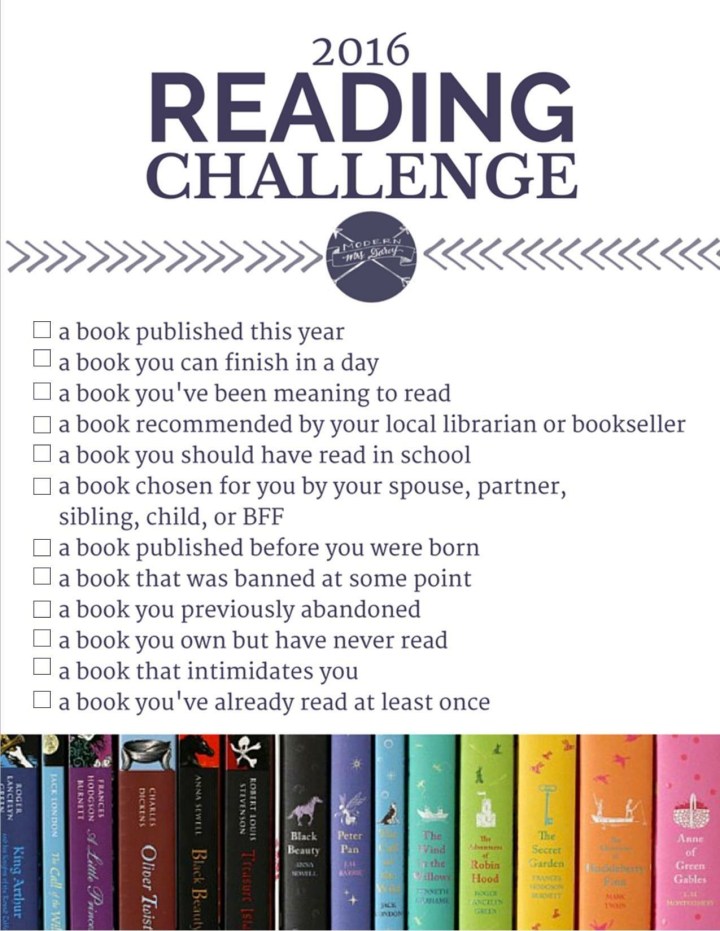
Okay. So. The image above lists the twelve categories for the challenge. I’ve already written about A Book Published Before You Were Born and A Book You Can Read In A Day, but that’s as far as I’ve got. I’m waiting until the end of the year until I make my choice for A Book Published This Year, but I’ve chosen titles for all the other categories and  I’ve listed these with notes below.


A Book You’ve Been Meaning To Read

Well, actually, I haven’t decided this one. But my bookshelves are full of books that I’ve been meaning to read, so I could put LITERALLY ANYTHING here and it wouldn’t make any difference.

A Book Recommended By Your Local Librarian Or Bookseller

The Chimes by Anna Smaill. Yes, I have a copy. No, I haven’t read it yet.

A Book You Should Have Read In School

The Turn of the Screw by Henry James. I also have to read The Ambassadors for my course, so 2016 is clearly my year for reading Henry James. Plus, see below…

A Book Chosen For You By Your (etc.)

The etc. denotes that I roundly rejected the book chosen for me by my sibling, which was A A Gill’s Pour Me: A Life (sorry Tif) and have chosen instead a book recommended by a friend. I just couldn’t get on with Gill. I found his overwritten and self-indulgent prose quite nauseating, and then I read somewhere that he murdered a baboon just to find out what it was like to kill. Gill is in the news this morning because he’s announced that he has cancer, but I don’t care. My sympathy lies with that poor baboon. For this category, I’ve chosen instead The Spoils of Poynton by Henry James, and I have read this and I ENJOYED IT! I’ve been meaning to write a post about Spoils and ekphrasis, but, you know…it’s coming. It’s coming.

A Book That Was Banned At Some Point

Alice in Wonderland by Lewis Carroll. My Significant Other is always nagging me about not having read this. It is (apparently) an unacceptable gap in my knowledge. Okay, fine, I’ll read it. I’ve bought a copy. I haven’t read it yet.

In case you’re wondering why it was banned, the Wikipedia page for banned books tells us that Alice was

Formerly banned in the province of Hunan, China, beginning in 1931, for its portrayal of anthropomorphized animals acting on the same level of complexity as human beings. The censor General Ho Chien believed that attributing human language to animals was an insult to humans. He feared that the book would teach children to regard humans and animals on the same level, which would be “disastrous”.

A A Gill would probably agree with General Ho Chien’s sentiments, but I don’t, and I suspect that baboon didn’t either. Oh, and by the way Ho Chien! Your name is French for dog.

A Book You Previously Abandoned

Oh god. This is Nabokov’s Pnin. I started it – and it is wonderful – but I’m a very anxious person and this book is an absolute nightmare for those of us who worry all the time about journeys going wrong, things getting lost, important stuff getting left behind, etc. This book is like all my anxiety nightmares rolled into one big fat sweaty never-ending anxiety horror film.

A Book You Own But Have Never Read

I’ve done this one! I read The Woman in White by Wilkie Collins and it was bloody awful. It helped me remember why I avoid nineteenth-century fiction. Proper blog post to follow. In due course.

A Book That Intimidates You

Ah, now, I’m going to have a go at House of Leaves by Mark Z. Danielewski. I’ve never read anything like this before, plus it’s HUGE. But given the way my literary interests are leaning these days, I think this is a must-read.

(What’s the Z for? Is it for real or is it a pose?)

A Book You’ve Already Read At Least Once

I could cheat with this one because I had to re-read Titus Andronicus as part of my course, but I’m going to stick with my original choice of Cold Comfort Farm by Stella Gibbons, just because Gibbons’ book is enormous fun. I’m saving this one for the Christmas holiday.

Ta-dah! All my procrastinatory effort laid out before you in block quotes. There’ll be more to follow. I’ll get back to you on this.


What is literature?

Literature, s. learning, skill in letters.

Dr Johnson’s 1755 Dictionary

This definition of ‘literature’ provided by Dr Johnson was penned in the middle of the eighteenth century. Here he is as played by Robbie Coltrane in the third Blackadder series:

This is such a clever episode, and it’s one of my favourites. The line which makes me laugh every time is Prince George’s response to Dr Johnson’s explanation of the purpose of his famous dictionary:

DR JOHNSON: It is a book, sir, that tells you what English words mean!

PRINCE GEORGE: I know what English words mean! You must be a bit of a thickie.

Dr Johnson was not, of course, thick, and his definition of ‘literature’ was perfectly adequate for the middle of the eighteenth century, when the novel was in its infancy. As Jonathan Culler notes in his Literary Theory: A Very Short Introduction, ‘[p]rior to 1800, literature and analogous terms in other European languages meant “writings” or “book knowledge”‘ (1997:21). But the literary world has grown exponentially since then in terms of production, reception, criticism and theory, and Johnson’s definition now looks to be sadly lacking. So, if we were going to define ‘literature’ for the twenty-first century, where would we start?

What is literature?

Some of my initial thoughts were as follows.

  1. Literature can be anything written down, or any kind of text consisting of words and/or images.
  2. Literature is a crafted piece of work, such as a novel, play or poem etc., consisting of words and/or images in which the form and the content of the work are arguably inseparable, or alternatively, a text in which the aesthetic function is privileged over the communicative.
  3. Literature is both a response to and a product of its socio-historical and cultural context.

These ideas are perhaps drawing a little closer to a more contemporary definition of ‘literature’,  but to my mind, they still do not provide a clear picture of what ‘literature’ really is. I had a look at how literature is defined in a couple of modern dictionaries, and this is what I found:

Chambers Dictionary

literature n.

1 The art of composition in prose and verse

2 The whole body of literary composition universally, or in any language, or on a given subject, etc.

3 Literary matter

4 Printed matter

5 Humane learning

6 Literary culture or knowledge

…and here’s the second definition:

Shorter Oxford English Dictionary

literature, n.

[(French littérature from) Latin lit(t)ratura, from lit(t)era LETTER noun: see -URE.]

1 Acquaintance with books; polite or humane learning; literary culture. Now arch. rare. LME

2 Literary work or production; the realm of letters. L18

3a Literary productions as a whole; the body of writings produced in a particular country or period. Now also spec., that kind of written composition valued on account of its qualities of form or emotional effect. E19

-b The body of books and writings that treat of a particular subject. M19

-c Printed matter of any kind. colloq. L19.

The Shorter Oxford English Dictionary (hereafter SOED) is of course a much larger work than the Chambers Dictionary (hereafter CD), and its entries include etymological details and examples of usage, which the CD doesn’t. Hence we have in the SOED a history of the word ‘literature’, including the sense used by Dr Johnson (number 1) marked here as ‘arch. rare. LME’. By the late eighteenth century (number 2), the sense of ‘literature’ has expanded to acknowledge the works themselves, rather than serving as some kind of pseudo-adjective to describe a particular attribute of those who read books and letters. Sense 2 is less centred on the human reader of texts and more focused on literary output, although this output is still very much connected with ‘the realm of letters’. (This makes sense, of course, when put into historical context.) Sense 3 seems to be a more current definition of ‘literature’ accepted by the SOED, and this sense is divided into three parts which reflect the expansion of the term’s usage over the nineteenth century. It’s worth noting, however, that sense 3c, ‘Printed matter of any kind’ is still labelled colloq., as if it is in some way inferior to the other senses.

The CD entry for ‘literature’ is set out differently. There is no etymological or historical information, and no concrete examples are provided. The entry is split into six senses, which seem to be listed in order of decreasing relevance, with 1 being the most commonly used sense and 6 being the least. We can see then, that CD senses 5 and 6 more or less reflect the SOED’s sense 1 in that they are historical meanings no longer or rarely used. ‘Printed matter’ appears at CD sense 4, because it is used more often than 5 or 6, but less often than 1, 2 or 3 (and note there is no ‘colloq.’ value judgement here!). CD sense 3 is too vague for me – I honestly don’t really know what might be meant by ‘literary matter’. Sense 2 describes the existing body of work and the top sense – CD sense 1 – refers to its production.

I’d like to note two things of interest in the comparison of these two definitions. First, the SOED attempts to define why a work might be considered ‘literature’ in sense 3a: literature is ‘that kind of written composition valued on account of its qualities of form or emotional effect’. This, of course, raises heaps of questions: what sort of qualities are valued? Who decides what qualities are valuable? How does a reader recognise these qualities? What sort of emotional effect are we talking about here? – and so on – but it is not a dictionary’s job to answer these questions. The CD, however, perhaps wisely makes no attempt at all to comment on form or effect and sticks to a definition that is unquestionably true, but limited in scope: ‘literature’ is ‘[t]he art of composition in prose and verse’. The other point I wish to mention is the use of the word ‘humane’, which appears in both entries. Dictionary definitions inevitably lead to the search for other definitions, and CD lists the following as one of the senses of ‘humane’: ‘humanising as humane letters, classical, elegant, polite’. I think, then, that this sense is a reflection of the eighteenth century zeitgeist and its obsessive love affair with classical form, rather than any attempt to suggest that reading makes us all better human beings.

Well, dictionary definitions are all well and good, but they are designed for a very specific purpose and are perhaps not the best way to explore this question. Moreover, dictionaries do not define usage, they merely reflect it. A dictionary definition is not timeless or fixed, nor does it represent some kind of untouchable truth. So let’s set about this a different way, and try to provide answers to some fairly open questions.

1. If we want to think about literature as writing, then does the term apply to all written texts, or only to a specific kind?

I’m always very keen to include comics (graphic novels if you must) under the heading of ‘literature’, which I’m aware others are not. For me, they are dense and rewarding texts: the words and images are read in conjunction and work together to create meaning, even when one is apparently undermining the other. But no doubt different people would include all sorts of different works when asked what they would classify as ‘literature’: for example, there have been many voices in favour of the inclusion of Terry Pratchett’s Discworld oeuvre. The fantasy genre, whose readers do tend to put the ‘fan’ in fanatical, throws up an interesting question. If we classify The Lord of the Rings as literature – and we do – why not Game of Thrones (for example)? Is it because the author of the former was a much-lauded Anglo-Saxon scholar and a professor of English? Or does Tolkien’s novel genuinely present properties that are lacking in Martin’s work? (And if so, what are these properties?)

Some texts will not be acceptable as ‘literature’ because the quality of writing is considered too low in standard. But who sets these standards, and what are they? To return to the example of Pratchett’s extremely popular Discworld series, many of these books are formulaic, over-long, and consequently dull – but Monstrous Regiment, Night Watch and Going Postal are really very good. On the other hand again, someone once tried to tell me that Pratchett is on a par with P G Wodehouse, to which my response was a thumping NO HE IS NOT. Pratchett’s comic timing is good, but Wodehouse’s is impeccable: he writes highly sophisticated sentences which turn exquisitely on numerous subordinate clauses to deliver the funny at exactly the right moment. Perhaps in the end it all comes down to a sense of grammar and an excellent ear. I don’t know. But I do know that Wodehouse is better than Pratchett.

I think, in fact, the question is asking for a distinction to be made between texts that are clearly communicative and functional, and texts that are ‘art’. But even here, the line has to be drawn somewhere, and while it is easy to make a distinction between a novel and a shopping list, what do you do if that shopping list has a kind of poetic coherence, or if it makes a poignant comment on the human condition that makes reading it an emotional experience? What then?

2. When does ‘literature’ become ‘Literature’?

I’ve taken the capital L to mean that a work is sanctioned or ratified and can henceforth be considered ‘good’ and ‘worthy of study’.

So, works of literature become ‘Literature’ when:

  • an over-privileged and overbearing white male such as Harold Bloom decides that a work should be included in the literary canon;
  • a work is added to the curriculum and taught in schools, colleges and universities;
  • a work is nominated for a literary prize;
  • a work chimes with the zeitgeist; when its theme, form or execution fits the prevailing cultural preferences.

All of which means that ‘Literature’ can go back to being ‘literature’ as soon as it falls out of favour. It’s not necessarily a one-way street we’re talking about here. Writers who were once lauded can sink into obscurity, but there is the possibility of rescue when a change in the cultural wind makes them fashionable once again.

I don’t think much of ‘Literature’, really. It’s an interesting phenomenon in its own right, especially in the contribution it can make to the study of culture, but I certainly can’t reconcile myself to the idea of a literary canon.

3. If literature possesses a quality that we recognise as ‘literariness’, then how is this recognised?

To answer this question, one would have to consider the notions of ‘foregrounding’ and ‘deviance’ put forward by the Prague School scholars at the beginning of the twentieth century. It’s about language, and when language draws attention to itself in some way, through use of rhyme, metaphor, and all the many many other literary devices. If we are using metalanguage – language about language – to describe what’s going on in the text, then that text has called attention to its FORM and therefore possesses literary qualities (even if it is not considered literature).

4. Is literature best thought of, beginning perhaps from linguistics, as a form of ‘peculiar language’?

This is Prague School territory again, and I think the New Critics could also be brought into this discussion, but essentially, the answer is no. Some literary works include remarkably non-literary language – Hemingway, for example, and see Terry Eagleton’s comments on ‘This is awfully squiggly handwriting!’ in Knut Hamsun’s novel Hunger (from Eagleton’s Literary Theory, p. 6). The context is literary, but arguably not the style – although I think this statement is problematic. For example, Hemingway’s sentences are simple, but this doesn’t mean they’re not carefully crafted to achieve a certain effect.

Perhaps literature, or literary language, is best thought of as being differentiated from other language use in terms of its function rather than its form. What’s it there for? What is it doing? Why should we read it? …which brings me to the next question.

5. What is literature for?

I came up with seven possible responses to this one.

  1. for entertainment, to tell a story;
  2. for edification and instruction;
  3. for the dissemination of an ideology, whether done knowingly or not;
  4. to provoke discussion, to enlighten, to share, to inform, to make readers think, to shock, to awaken in a mental sense;
  5. to form part of a nation’s cultural life; to create and perpetuate a way of thinking and a body of myths and legends;
  6. to bring people together;
  7. to deceive – remember Plato banned the poets!

And the final question:

6. Does literature make anything happen?

Taking point 3 above, yes. Literature can be enormously powerful, for good or for bad. Stories can become myths, and the myths can become ways of thinking and being. Literature can reveal and shatter normalised thinking patterns, but it can also create them.

In addition, if someone powerful disagrees with what you write, you lay yourself open to hostile criticism or even place yourself in physical danger – look at Salman Rushdie’s experience of the fatwa, and consider Timothy Bell’s recommendation that Hilary Mantel be investigated by the police following the publication of her short story The Assassination of Margaret Thatcher: 6 August 1983. Literature can create culture and cultural revolutions. One has only to look at the historical – and contemporary – persecution of writers to realise that state governments take very seriously the written output of citizens. English PEN certainly has its work cut out.

I’m not sure I’ve got any closer to answering the question ‘What is literature?’, but there’s some food for further thought here at least.

Elizabeth Bennet reads Mr Darcy’s letter

Elizabeth Bennet reads Mr Darcy’s letter

This post has been removed because the content is now available in book form with many other essays and blog posts previously available on this site. The book is titled Ungrammaticalities: Linguistic Literary Criticism from ‘The Battle of Maldon’ to Muriel Spark, and it is available for purchase HERE from August 2024.

Please see this page for the cover art and table of contents.