Figure and ground in Michael Symmons Roberts’ ‘What’s Yours is Mine’

IMG_1129


What’s Yours is Mine

By Michael Symmons Roberts

‘Doors which yield to a touch of the hand…

permit anyone to enter.’

Thomas More, Utopia

It was our game, to drive at night into their city,

scan the streets, choose a house at random

and stroll in mid-evening as the householders

were finishing, say, a birthday dinner.

We watched them look up, terrified but mute.


We picked lambs off their plates, emptied their glasses

then ran upstairs, threw open drawers

tried on jackets, fingered through their journals,

pocketed the odd keepsake – scarf, set of car keys,

half-read book, a piece of underwear for shame.


We tried to get a rise from them by breakage:

a cabinet of crystal cups, statuettes of local gods,

but they are patient in their sad-masks.

Such acquiescence, you knew they saw you straight,

and even so would give you everything.


Our only rule: we never touched them.

Save one time I saw a blue heart-shaped soap

clutched in a woman’s hand and something in her

would not give it up to me for all the world.

I have it somewhere. Let me find it.


Published in the London Review of Books, 18 May 2017, p. 23

Figure and ground in Michael Symmons Roberts’ ‘What’s Yours is Mine’

The cognitive categories of figure and ground facilitate discussion of how the reader’s attention is directed and assist in the positive identification of foregrounded items. Figures attract the reader’s attention whereas the ground consists of items that are neglected and/or deselected. In the case of the poem under consideration in this essay, the speaker of the poem and his/her companions collectively comprise the figure for the first three verses of the poem in that they move and act against the householders, who constitute the background all the while they remain static and undeveloped.

‘What’s Yours is Mine’ by Michael Symmons Roberts was published in the London Review of Books on 18 May 2017, appearing alongside another poem by the same writer entitled ‘Soliloquy of the Inner Emigré’ and an article on ‘Brexitism’ by Alan Finlayson. Given this context, it is fair to assume that the subject of Roberts’ poem is that of immigration, a highly contentious and emotionally-charged topic in the current political climate. In this reading, the householders represent an immigrant or ethnic community terrorised by those who cannot accept their presence. Nevertheless, this is not the only possible reading. When removed from the circumstances of its publication, the poem could equally be read as a metaphor for an oppressive political regime or an abusive personal relationship. Alternative readings such as these resonate behind any chosen interpretation and I see no reason to pin down one reading as definitive.

The poem describes a scenario in which the speaker and his/her companions enter the homes of the city-dwellers and cause havoc. The intruders’ motivation is not that of pecuniary gain (although some small items are looted as ‘keepsake[s]’), but merely to ‘get a rise from’ the ‘householders’, or in other words, to provoke some reaction from them. Their efforts are unsuccessful until the last verse, and the narrative change in the final lines is marked textually by a fluctuation in the figure/ground relationship coupled with a foregrounded presence of negation and a deictic pronoun shift.

The ‘dominant’ of the poem, or its larger organising principle, is the us/them dichotomy established in the poem’s title (yours/mine) and the first line: ‘It was our game, to drive at night into their city’ (my emphasis). This polarity is sustained throughout in the pronouns ‘we’ and ‘they/them/their’ until the final verse, when one of ‘them’ emerges from the background to become a figure through her unwillingness to relinquish the ‘blue heart-shaped soap’. Her defiance is marked against a background of acquiescence which had formerly characterised ‘them’, and this figure, previously one of the ‘sad-masks’, is now recognised as a woman. Equally, the speaker is no longer part of a larger ‘we’, but in the final verse becomes ‘I’ and ‘me’. The woman’s stand against the intruders has led to a recognition of the presence of the individual within a larger group in both parties: the woman as part of ‘them’ and the speaker as part of ‘we’. The poem’s ending is unrelentingly bleak, nonetheless. The last line comprises two complete sentences and the caesura created by the first full stop allows the reader a moment for the full impact of the preceding statement to sink in: ‘I have it somewhere. Let me find it.’ What happened to the woman is unknown, but the intruder is now in possession of the soap and broke the game’s only rule (‘we never touched them’) to get it.

The next section of this essay takes a closer look at figure and ground in the poem to further elaborate on the points already made. The poem comprises four verses each of five unrhymed lines, and a mixture of long and short sentences. I have already mentioned the devastating effect of the caesura in the final line, and in fact, this structure is mirrored in the first line of the final verse: ‘Our only rule: we never touched them.’ This rule has clearly been broken in the poem’s final line and the enormity of this event is foregrounded in the parallel construction of these lines, both of which are uncharacteristic of the rest of the poem, where the lines run into one another in imitation of one half of a spoken dialogue. The speaker is relating to the listener (who may or may not be identified with the reader) details of a ‘game’. Given that the past tense is consistently used, one may assume that the game is no longer played, presumably because its object has been achieved. The first verse describes how the victims of the game were chosen: entirely ‘at random’. The second verse shows the game in progress, with lists of actions performed and objects stolen; each of the latter takes temporary prominence before being deselected as the next item – with all its attendant implications – moves into focus. The intruders are a collective ‘figure’ here because almost every action in the first two verses belongs to them. Even the one exception performed by the householders (line 5) is an action embedded in another: the intruders, in subject position, watch the householders ‘look up’ and the following description (‘terrified but mute’) is rendered through the intruders’ eyes. As the intruders ransack the house, the full meaning of the poem’s title is made clear. The intruders violate the householders’ food, drink, clothes including underwear, means of transport, literature, even their private thoughts (‘fingered through their journals’). The third verse furnishes the reader with the object of the game, expressed in colloquial form: ‘We tried to get a rise from them’. The ‘but’ which follows in line 13 renders this construction implicitly negative: a ‘rise’ has not been obtained. The revelation of the game’s object occurs at the exact mid-point of the poem and this is the crux: what the intruders want is a reaction. When a reaction is obtained, albeit it one of static defiance (‘something in her / would not give it up to me for all the world’), the only rule is broken and the game is over.

The figure/ground relation is rather more complex in the third verse. The intruders remain the key attractor even in the active verbs attached to the householders in lines 14 and 15, because the viewpoint belongs to the intruders. Nevertheless, this position is clouded by foregrounded language attached to the householders. Alliteration draws attention to the ‘cabinet of crystal cups’, for example, and the precise meaning of ‘statuettes of local gods’ is unclear. (These statuettes may be family photographs, or shelf ornaments, but the phrase could also be taken entirely literally: this is one point in particular where the reader’s interpretation of the poem as a whole will dictate what form the statuettes take.) The pattern of past-tense verbs is broken in line 13 (‘they are patient’) and the householders are dehumanised and rendered faceless in the phrase ‘sad-masks’. The emergence of one of the householders as a figure in the final verse is anticipated in the preceding verse as the foregrounded items mentioned gradually draw the reader’s attention towards those persecuted rather than the persecutors. Finally, it is the woman’s reluctance to part with the ‘blue heart-shaped soap’ that changes the game.

I have not yet mentioned other texts brought into play by this poem, namely those referred to in the title and accompanying quotation. The title would seem to be a paraphrase of a marriage vow from the Book of Common Prayer (‘with all my worldly goods I thee endow’), and refers to a state in which goods become common property by mutual consent. The quotation from More’s Utopia similarly refers to a set-up in which theft is unimaginable. More’s utopian blueprint describes a society in which everyone’s possessions are identical, so there is no motive for robbery. By contrast, the intruders in Roberts’ poem steal only ‘keepsake[s]’ from the households they invade at random through doors which are left open. The motivation for their actions is not the acquisition of goods, but the exercise of power. Their intention is not robbery or assault, but humiliation and provocation. The intruders wish to assert their dominance over the householders and to strip them of all human dignity by treating them with heartless contempt.

This analysis has employed the cognitive categories of figure and ground to articulate that which is readily understood, but perhaps not otherwise so clearly demonstrated. The analysis has benefitted from the application of this framework in that the woman’s emergence as a figure and the speaker’s recognition of her as such has been effectively traced. The poem’s bleak ending is rendered all the more powerful once it is realised that the speaker has recognised an individual human being amongst the faceless ‘them’ that s/he is engaged in persecuting, but has carried out an act of violence towards the woman regardless of this insight. The speaker is not simply lacking in empathy, but is finally characterised as a being who is actively cruel and merciless.
‘Dick Turpin’ Episode 3: The Champion (in which our hero lands another lucky punch)


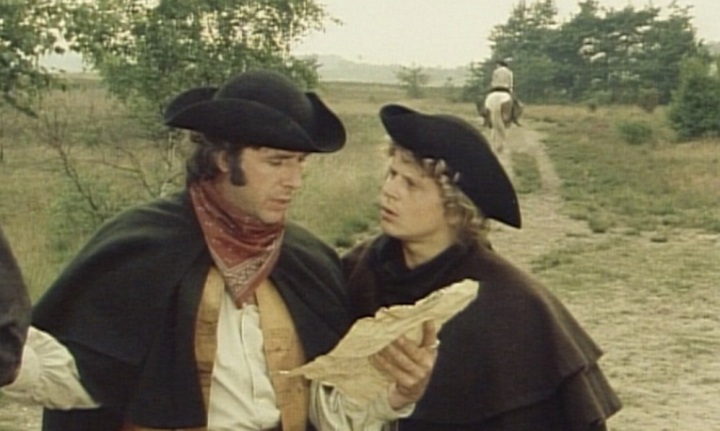
Ep 3 reading the flyer
Clunky plot device: Tom ‘The Bristol Butcher’ Bracewell, drops a flyer that conveniently tells us the who, the what and the why, and which also serves to set events in motion

Synopsis: Turpin and Swiftnick are riding towards Mudbury, to lie low for a while. On the way, they save a man’s life when he is attacked by deserters. The man turns out to be Tom Bracewell, a prize-fighter on his way to a fight. Turpin brags to Swiftnick of the time he knocked out the English prize-fighting champion, but admits it was probably down to a lucky punch. Once at Mudbury, Turpin takes a bath while Swiftnick learns that a man named Nightingale is running a protection racket and terrorising the village.

Ep 3 Nightingale bullying the village
Nightingale extracting money from the people of Mudbury

Nightingale employs a thug by name of Hogg (played by Robert Russell) to beat up anyone who refuses to pay. Swiftnick brags of Turpin’s former victory and the villagers temporarily regard Turpin as their potential saviour until, following an altercation with Nightingale, Turpin is beaten by Hogg.

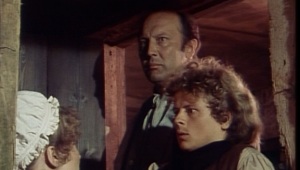
Ep 3 Hogg
Our first glimpse of Hogg

Turpin refuses to leave and is determined to rescue Mudbury from the clutches of Hogg and Nightingale. He engages Bracewell to challenge Hogg to a fight. On the day, however, Bracewell is nowhere to be found, and in order to avoid forfeiting the money put down for the challenge, Turpin steps into the ring in Bracewell’s place. Swiftnick breaks into Nightingale’s house to find out if Bracewell is being held there, but in fact Bracewell has been gagged and bound and is trapped in a box near where the fight is being held. A small boy in the crowd discovers Bracewell, and just in time – Turpin has been well and truly beaten up, but refuses to give in. Bracewell steps into the ring just as Turpin delivers one final punch which defeats Hogg. The village is freed and Nightingale is placed in the stocks.

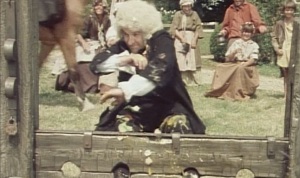
Ep 3 Nightingale in the stocks
Nightingale in the stocks

Commentary: The deserters we see at the beginning of this episode are presumably from the Jacobite Rising of 1715. James II fled to France following the Glorious Revolution of 1688-89 and was active afterwards as The Pretender. Those still loyal to James II feature in episodes which follow this one, as we shall see. The reigning monarch at this time was George I, who succeeded to the throne after Queen Anne’s death in 1714.

That which is most interesting about this episode is the way in which Turpin’s vanity manifests itself. He can’t reveal his name willy-nilly as he travels about the country because there is a very large price on his head and if captured, he will hang. The pair travel under assumed names: Mr Turner (close to Turpin) and Mr Nicholas Smith (which is Swiftnick’s real name, but it is a common enough name and he is unlikely to forget it). However, as we see in this and other episodes, there is a conflict between the necessity of keeping Turpin’s name a secret and his desire to create his own legend.

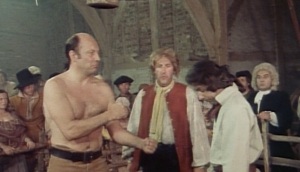
Ep 3 Turpin faces Hogg in the ring
A reluctant Turpin faces Hogg in the ring

In spite of Turpin’s vanity, he is hero-material nevertheless. He refuses to chuck in the fight, even though he is half-dead, and he is fighting under an assumed name – it is only at the end of the episode that he reveals his true identity. Fortunately for him, his ‘lucky punch’ replays itself and he lays out Hogg without having to concede the fight.

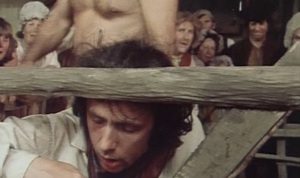
Ep 3 not going well
The fight is not going well for Turpin

This episode features a lovely over-the-top performance from John Grillo as the zealous tax-collector Father Nightingale. Turpin shows himself to be more than capable of preaching the Bible right back at the village’s oppressor, reminding us, perhaps, that he wasn’t always a highwayman and was once a gentleman-farmer. There are many funny moments in this episode and some excellent comic timing from O’Sullivan, who, of course, was something of a sit-com star (Man About the House in the seventies, Robin’s Nest and Me and My Girl in the eighties). The final fight itself, with Turpin dodging punch after punch, reminds me of the fight between Vitalstatistix and Cassius Ceramix (whose name is a pun on Cassius Clay, Muhammad Ali’s real name) in Asterix and the Big Fight – and of course, Vitalstatistix emerges the victor in exactly the same way that Turpin does here.

Ep 3 the victor
Turpin, sore and swollen, but victorious


‘Dick Turpin’ Episode 2: The Capture (in which our hero is duped by Cleopatra and labelled a symbol of anarchy)

Ep 2 Turpin captured
Turpin is captured!

Synopsis: Swiftnick’s apprenticeship is not going well because he’s foolhardy and talks too much. Turpin is not pleased with him, but agrees to give him one last chance as long as he can do as he’s told and keep his mouth shut. Within minutes of their arrival at the White Lion, however, Swiftnick is telling tales of their adventures to one of the staff, a young girl called Kate. Spiker has been tipped off and arrives on the scene, only to receive a splendid black eye during the fight which ensues. Turpin assumes it was Kate who informed Spiker, so he arranges for Swiftnick to serve an apprenticeship with a gunsmith and leaves him behind.

Ep 2 Swiftnick gabbing
Swiftnick telling Kate tales of derring-do

Meanwhile, Sir John Glutton and Spiker are laying a trap for Turpin. An actress sentenced to three years for scrumping apples is disguised as a rich widow travelling alone. Turpin holds up her coach and is captured. He is thrown into jail and sentenced to hang.

Ep 2 Spiker hanged her father
Kate tells Turpin he used to ride with her father

Kate visits Turpin in jail and tells him that he used to ride with her father, who was hanged by Spiker. Turpin informs Kate where to find Swiftnick, and the two lay an explosive ambush to rescue Turpin as he is transported from jail to the place where he is to be executed. Swiftnick is forgiven and reconciled with Turpin.

Ep 2 Swiftnick arranges a surprise
Swiftnick and Kate rescue Turpin

Commentary: the themes of betrayal and loyalty characterise this episode. The ‘squealer’ at the White Lion witnesses Turpin’s arrival and rides off to betray his whereabouts, motivated no doubt by the thought of the £200 reward offered for Turpin’s capture. The actress, who tells us she has played Cleopatra, is induced to play her part in Sir John’s plot in exchange for her freedom, but she cooks her own goose when she demands the reward and is instantly slung back in jail.

Ep 2 Cleopatra
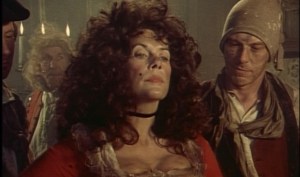
‘Cleopatra’ sentenced for scrumping

In spite of the generous reward on offer, there are those who are loyal to Turpin. Kate stands out as one who risks a great deal to help the man who once rode with her father, and when Swiftnick hears that Turpin has been taken, he charges to the rescue regardless, not worrying that Turpin had dismissed him from his service.

Ep 2 The gunsmith
The gunsmith

Something else to note in this episode is the way in which Spiker’s vanity and ambition is exploited by Sir John Glutton. Spiker spends quite a lot of time looking in mirrors (for which he is often berated) and Sir John knows that what the man wants is property, position and respect. ‘Rid the nation of this symbol of anarchy’, says Sir John, and promises to reward Spiker accordingly once Turpin has been safely hanged.

Ep 2 Cleopatra disguised
‘Cleopatra’ in disguise with Sir John

In spite of the seriousness of the heavy-weight themes and all the talk of hanging, it’s important to note that the series has a light-hearted touch throughout, with plenty of humour. The gunsmith comments that Swiftnick looks as if he’ll eat too much, for example. Our ‘Cleopatra’ gives a wonderfully hammy performance and Sir John can’t make up his mind whether or not he wants Spiker to knock before he comes in.

Ep 2 reconciled
Turpin and Swiftnick reconciled


Intertextuality and the poetry of John Heath-Stubbs

Intertextuality and the poetry of John Heath-Stubbs

This post has been removed because the content is now available in book form with many other essays and blog posts previously available on this site. The book is titled Ungrammaticalities: Linguistic Literary Criticism from ‘The Battle of Maldon’ to Muriel Spark, and it is available for purchase HERE from August 2024.

Please see this page for the cover art and table of contents.

‘Dick Turpin’ Episode 1: Swiftnick (in which our hero acquires a sidekick and reports of Turpin’s death are greatly exaggerated)

Generic strip image for each post

Dick Turpin was a television series produced by London Weekend Television and screened in half-hourly episodes from 1979 to 1982. Richard O’Sullivan starred as the eponymous hero, with Michael Deeks as Swiftnick, Christopher Benjamin as Sir John Glutton and David Daker as Captain Nathan Spiker. I loved this series when I was a kiddy, and I’ve just acquired the DVD box set so I’m planning on writing a short post dedicated to each episode with a plot synopsis and commentary. I’ve even worked out how to make screenshots from the DVDs so there’ll be pics too, and I’m not going to pretend that most of them won’t be of Richard O’Sullivan looking gorgeous because that most certainly will be the case. He was my first celebrity crush and I adoooooooored him.

Ep 1 Dick Turpin revealed
Dick Turpin revealed to the viewer for the first time

Richard Turpin was indeed a real person and you can read about his exploits here. The Turpin of the television series is a ‘Robin Hood’ type of character, who only steals from the rich and often shares what he has stolen with those less fortunate. As Swiftnick says in ‘The Imposter’, Turpin offers an opportunity for the poor ‘to drag [themselves] from the mire’. In addition, Turpin is a character who has turned to crime because his farm was stolen from him by Sir John Glutton while Turpin was away fighting for his country. But the real Turpin certainly wasn’t the noble hero depicted in the television series: he was a notorious highwayman and a murderer who was eventually hanged for his crimes. Fortunately though, most of us can tell the difference between real life and telly (some YouTube commenters excepted) and we know that this is just a bit of entertainment.

Dick Turpin Episode 1: Swiftnick in which our hero acquires a sidekick and reports of Turpin’s death are greatly exaggerated

Synopsis: Sir John Glutton plans to evict Mary Smith and her son Nick from The Black Swan inn where they hold tenure if they cannot pay twenty guineas in rent. Mary borrows the money from Dick Turpin, who holds up Sir John’s coach and takes the money back. Nick helps Turpin evade capture, but Nick himself is taken by Captain Spiker. Mary begs Turpin to rescue Nick and to let Nick ride with him as a highwayman. Turpin grudgingly agrees. Disguised as a doctor, Turpin tells Sir John that Nick has the plague. Turpin’s ruse is discovered by Spiker who arrives just as Turpin and Nick are about to make their escape, and a fight ensues. Turpin and Nick escape and the episode concludes with Turpin bestowing on his new sidekick the name of ‘Swiftnick’.

Ep 1 Swiftnick_s arrest
Nick Smith, later ‘Swiftnick’, is arrested

Commentary: In this, the first episode, everyone’s sort of finding their feet a bit – by which I mean ‘it’s not great’. The fights are very stagey and the scene in which Turpin and Mary are discussing Turpin’s past and Nick’s future in The Black Swan is uncomfortably like watching a filmed play, but this is in part owing to a pretty bloody awful performance on the part of Jo Rowbottom as Mary. She’s just terrible. The series improves rapidly, however, and this first episode is really just about providing expository information: who the characters are, Turpin’s tragic backstory as justification for his criminal activity, how Swiftnick becomes the sidekick, and so on.

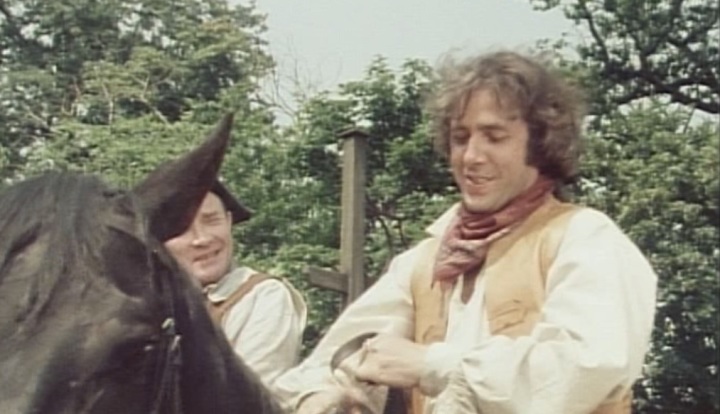
Ep 1 genuine riding of horses
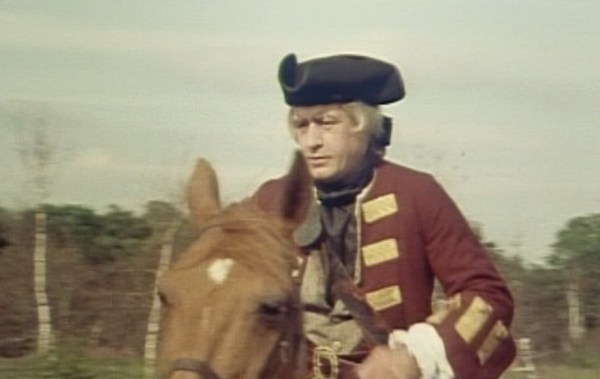
David Daker on horseback as Captain Nathan Spiker 

The other point to mention is that there is genuine riding of horses: O’Sullivan, Deeks and Daker are all seen mounting and dismounting, with a bit of trotting too perhaps, although obviously the more dangerous riding scenes (and there are lots of them) are clearly performed by stand-ins. Nevertheless, the actors were clearly required to do some actual horse-riding themselves.

Ep 1 The Farm
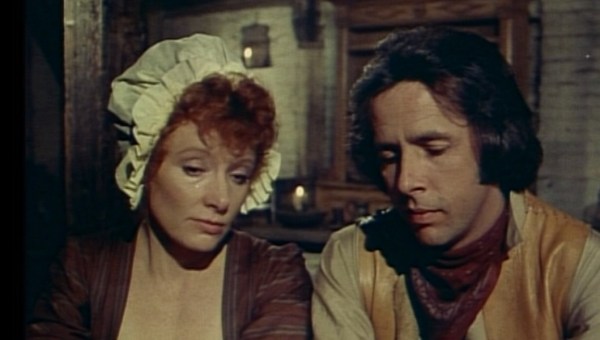
Jo Rowbottom as Mary Smith with Richard O’Sullivan as Dick Turpin

The key themes that emerge from this episode and that feature throughout the series are those of disguises, imposters, impersonators, and the use of Turpin’s name. Turpin is presumed dead at the beginning of the story, hanged for his crimes, but this turns out to be another man who used Turpin’s name to carry out his own acts of robbery and who eventually went to the gallows still professing to be Turpin. The most interesting moment of the episode comes when Nathan Spiker, who believes Turpin to be still alive, is explaining to Sir John Glutton why anyone would want to die in another’s stead. Spiker claims that the carnival atmosphere attending the execution of a celebrated criminal is such that the condemned man had to be Turpin to the end, to go out in a blaze of (someone else’s) glory. Even Nick Smith takes on Turpin’s name to steal the twenty guineas needed to pay the rent; unfortunately for him, the traveller he tries to rob is none other than Turpin himself. There is a kind of hero-worship that surrounds Turpin in as much as other would-be thieves are anxious to emulate him. And it is easy enough to pretend to be Turpin, when all the imposters have to do is pull a neck-tie up over their noses so the lower half of the face is obscured.

Ep 1 Dick Turpin in disguise
Turpin’s first disguise

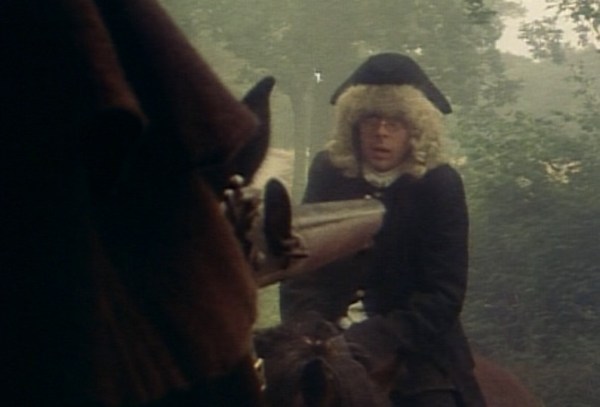
In this episode, Turpin ‘dies’ twice: first when another goes to the gallows for him, and second when Turpin disguised as the doctor announces that Turpin has perished of the plague. Turpin also appears in disguise twice: first as the traveller who unwisely flashes his money in The Black Swan (thus provoking Nick’s attempted robbery), and second as the doctor. It takes no more than a wig, a pair of spectacles and an unconvincing accent.

Ep 1 another disguise
Turpin disguised as the doctor, with Christopher Benjamin as Sir John Glutton (far left)